
Buckle Inc.: Sales Growth, Earnings Volatility, and the Realities of Mid-Tier Apparel Retail
The company’s ability to convert traffic and navigate a shifting retail landscape will shape its next chapter.
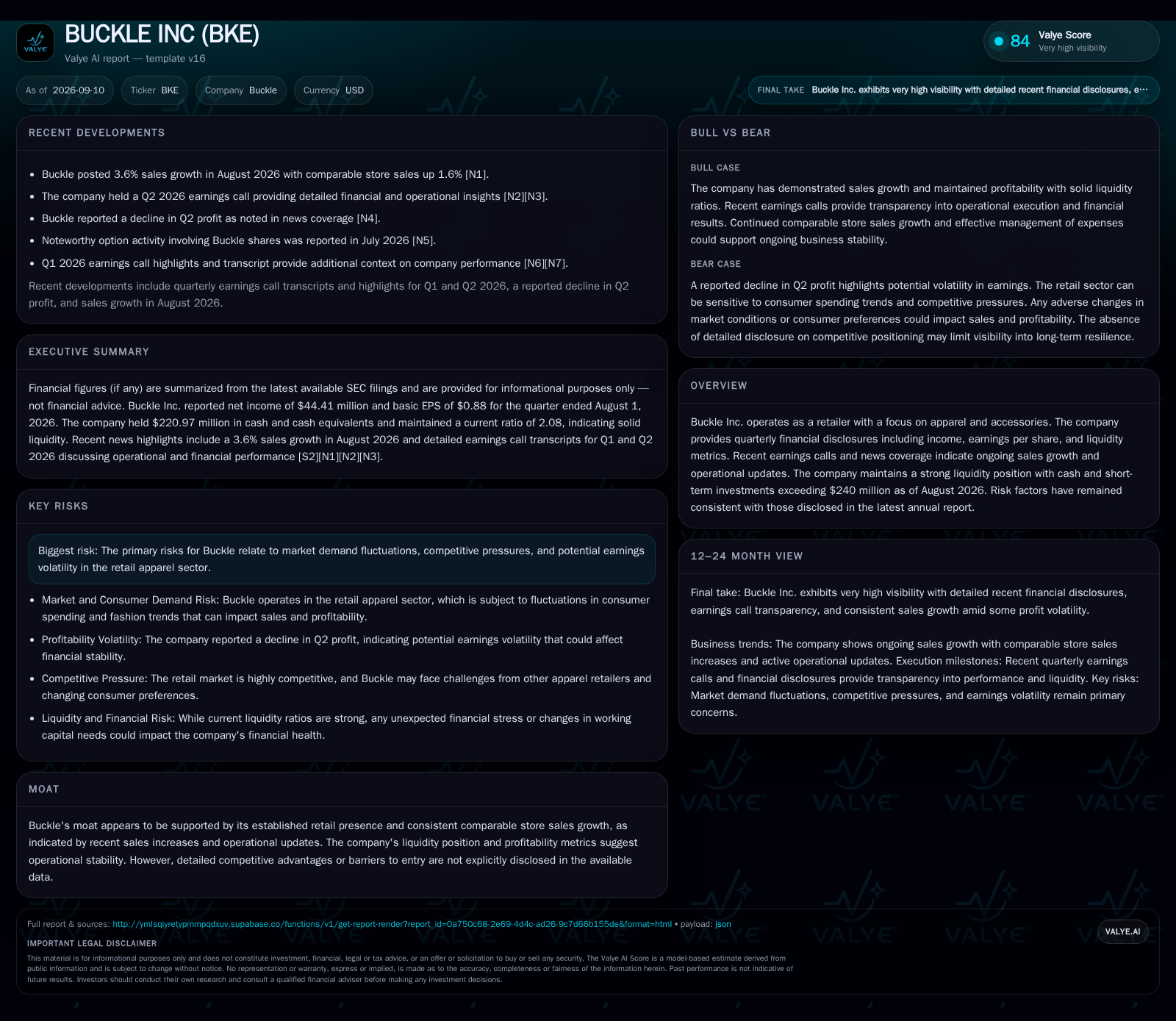
Buckle Inc. reported net income of $44.41 million for the quarter ended August 1, 2026, with basic EPS of $0.88 and cash plus short-term investments exceeding $240 million. August 2026 sales grew 3.6% year over year, although Q2 profit declined. Buckle’s future will hinge on its capacity to sustain sales growth, defend margins, and differentiate in a competitive environment. [S2] [N1] [N4]
Buckle Inc. stands at a familiar crossroads for mid-sized apparel retailers: modest top-line growth and a robust balance sheet on one side, but declining quarterly profits and persistent sector risks on the other. As of August 2026, Buckle reported liquidity position and posted year-over-year sales growth, yet saw profits shrink in Q2. This mix of resilience and pressure reflects not only Buckle’s own execution but also the broader retail landscape, where shifts in consumer spending, fashion cycles, and competitive intensity can quickly swing fortunes. The company’s next phase will depend on its ability to turn sales momentum into sustainable earnings and defend its market position as retail dynamics evolve.
Recent Results: Sales Growth Meets Profit Pressure
Buckle reported net income of $44.41 million for the quarter ended August 1, 2026, with basic earnings per share of $0.88 and diluted EPS of $0.87 [S2]. As of the same date, the company held $220.97 million in cash and cash equivalents, plus $22.4 million in short-term investments, supporting a current ratio of 2.08 and a cash ratio of 1.05 [S2]. In August 2026, the company posted 3.6% year-over-year sales growth, with comparable store sales up 1.6% [N1]. However, Buckle experienced a decline in Q2 profit, as highlighted by recent news coverage [N4]. These facts signal a business that remains fundamentally profitable and liquid, but is not immune to swings in margin and underlying consumer demand.
How Buckle Converts Sales into Earnings—and Where Leverage Can Cut Both Ways
Buckle’s core business model is classic specialty retail: drive in-store and online traffic, convert visits into apparel and accessory sales, and manage costs to protect margins. Revenue growth is currently coming from both total and comparable store sales, but profit declines suggest either margin compression, increased promotional activity, or higher operating costs. In retail, gross margins can be sensitive to inventory management, markdowns, and product mix, while SG&A leverage is achieved primarily through scale.
With over $240 million in cash and short-term investments as of August 2026, Buckle is not capital-constrained [S2]. The company reported cash and liquidity metrics for the period; these figures do not by themselves establish operating runway, investment capacity, financial flexibility, or financing capacity. Operating leverage in retail can be a double-edged sword: when sales rise, fixed costs are absorbed more efficiently, boosting earnings; when sales stall or margins compress, profits can fall sharply, as seen in the latest quarter.
The question is whether Buckle can continue to grow same-store sales without sacrificing margin, and whether its expense structure allows for rapid adjustment if demand weakens further.
The interplay between Buckle’s inventory management and gross margin is particularly critical. Retailers often face the challenge of balancing inventory levels to meet anticipated demand without overstocking, which can lead to markdowns and margin erosion. If Buckle’s inventory turnover slows, it may signal either overestimation of demand or shifts in consumer preferences, necessitating discounting that compresses margins. Conversely, lean inventory aligned with strong demand supports pricing power and profitability. Additionally, the company’s ability to leverage data analytics for demand forecasting and assortment planning could materially influence its margin resilience and inventory efficiency.
Competitive Realities: Differentiation in a Crowded Apparel Market
Buckle operates in the intensely competitive U.S. apparel sector, where mid-tier specialty retailers face pressure from fast fashion, e-commerce pure-plays, and value-oriented department stores. The company’s established retail footprint and history of comparable store sales growth offer some insulation, but do not guarantee market share retention.
In this environment, product curation, in-store experience, and brand identity are critical. Buckle’s ability to differentiate on merchandise selection, customer service, or loyalty programs could support repeat traffic and higher conversion rates. However, these advantages are vulnerable to shifting consumer preferences and the ongoing migration of apparel spending online.
Without explicit disclosure of proprietary brands, unique sourcing, or technological differentiation, Buckle’s competitive moat appears to rest on execution and operational steadiness rather than structural barriers. The risk is that, in a commoditized retail landscape, even short bursts of sales growth may not translate into durable earnings power if rivals are able to match product, price, or convenience.
Buckle’s competitive positioning also depends on its response to evolving omnichannel retail trends. As consumer shopping behavior increasingly blends online and offline experiences, the integration of digital platforms with physical stores becomes essential. Efficient inventory visibility across channels, seamless fulfillment options, and personalized marketing can enhance customer engagement and conversion rates. If Buckle invests strategically in technology and supply chain capabilities to support an omnichannel model, it may strengthen its differentiation. Failure to adapt could result in lost market share to more digitally savvy competitors who better meet consumer expectations for convenience and experience.
Sustained Traffic and Margin Discipline Could Drive a Reacceleration
If Buckle can extend its recent sales momentum while maintaining or recovering gross margins, the company could see earnings stabilize or even grow despite sector volatility. This would likely require a combination of effective merchandise assortment, disciplined inventory management, and selective promotional activity—enough to drive traffic and conversion without undermining profitability.
Additional upside could come from further leveraging its liquidity for targeted store investments, digital enhancements, or share repurchases (if authorized), all of which could boost per-share earnings and shareholder returns. Confirmation would come from several quarters of rising or stable EPS alongside continued positive comparable store sales and resilient gross margins. Falsification would be signaled by ongoing margin compression, negative comparable sales, or significant inventory build-up.
Incremental Progress but Persistent Margin Tension
The most plausible path is for Buckle to maintain modest top-line growth—driven by a mix of store traffic and online sales—while continuing to face pressure on margins from competitive discounting and input costs. Profitability would remain positive but could fluctuate quarter to quarter depending on inventory cycles, promotional intensity, and the broader retail environment.
Confirmation would be a pattern of single-digit comparable store sales gains, stable but unspectacular EPS, and continued absence of material risk-factor changes. Falsification would involve either a sharp reversal in sales trends or an unanticipated spike in operating expenses.
Margin Erosion and Demand Weakness Threaten Profitability
Should consumer demand soften or competitive pressures intensify, Buckle could face further margin erosion—either through increased promotional activity, higher markdowns, or inability to pass on cost increases. In this scenario, fixed operating costs would become harder to absorb, and profit declines could accelerate even if top-line sales remain flat or modestly positive.
A material inventory build, rising SG&A as a percentage of sales, or negative comparable store sales would all point to mounting trouble. In this case, liquidity could be drawn down to fund operations or defend market share, and the risk of store closures or restructuring would rise. This downside would be confirmed by consecutive quarters of falling EPS, deteriorating liquidity ratios, and negative trends in comparable sales.
Factors That Will Shape Buckle’s Next Chapter
Comparable store sales trends: sustained positive comps would support the thesis of ongoing customer engagement and brand relevance.
Gross margin evolution: any movement in gross margin, if disclosed, would clarify whether sales growth is translating into profitable growth or being driven by discounting.
Inventory levels and turnover: rising inventory relative to sales could signal demand weakness or misaligned merchandising.
SG&A as a percentage of sales: increases here would indicate deleveraging or rising cost pressure.
Quarterly EPS volatility: persistent swings would underscore the fragility of earnings and the company’s exposure to sector dynamics.
Store count changes: net store openings or closures would reveal management’s confidence in underlying demand and market opportunity.
Traffic and conversion rates (if disclosed): these would help assess whether sales growth is coming from increased footfall, better conversion, or higher average transaction size.
Disclaimer: This is research-only, informational analysis and not investment advice. It may include AI-generated interpretation and general industry context. Always verify important details using primary sources.

Comments