
Vera Bradley’s Turnaround: Operational Gains, Competitive Hurdles, and the Economics of Branded Consumer Retail
Vera Bradley’s recent profit rebound, improved expense discipline, and positive investor reaction mark a tangible turnaround, but sustaining momentum in a fiercely competitive retail landscape will require more than short-term cost controls. The company’s reported liquidity position, but ongoing margin management and brand relevance are essential levers for long-term value creation.
Vera Bradley delivered improved Q2 2026 results, with net profit up and expenses down, sparking a double-digit stock rally. While operational execution is trending positive, long-term success depends on maintaining margin discipline and brand appeal in a saturated market. The key question is whether recent gains are durable or merely cyclical.
Vera Bradley’s latest quarterly results mark a clear inflection point: higher net income, lower expenses, and a sharply positive stock reaction all suggest that turnaround efforts are gaining traction. However, retail’s structural headwinds—ranging from fast-changing consumer tastes to relentless price competition—mean that improved short-term metrics are only part of the equation. Vera Bradley’s reported balance sheet position, but the long-term thesis hinges on whether the company can convert operational momentum into durable brand and margin strength.
Recent Results Signal Operational Progress, But Sustainability Remains the Core Question
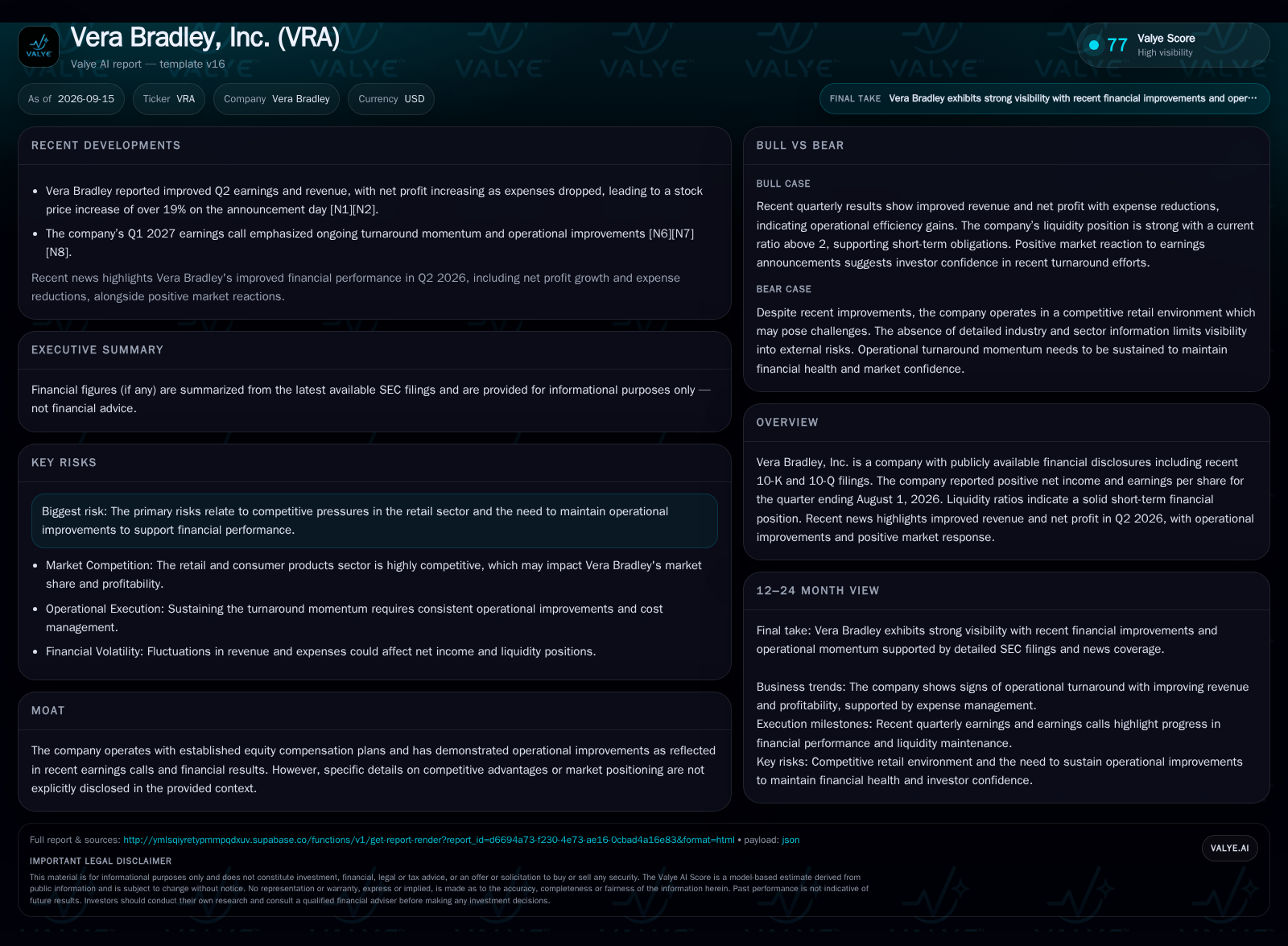
Vera Bradley reported net income of $4.5 million for the quarter ending August 1, 2026, translating to basic EPS of $0.16 and diluted EPS of $0.15 [S2]. Cash and cash equivalents stood at $34.25 million, with a current ratio of 2.44 and a cash ratio of 0.66 as of the same date [S2]. The company’s expenses declined, helping drive the profit rebound, while revenue improved in the quarter [N1] [N2]. The market responded strongly: shares rose over 19% on the day of the earnings announcement, reflecting renewed investor confidence [N1] [N2]. Management’s Q1 2027 commentary continued to emphasize operational turnaround momentum [N6] [N7] [N8]. These facts frame a business in transition, with positive near-term financial and sentiment signals, but lacking detail on the underlying drivers of growth or margin improvement.
A deeper understanding of the sustainability of recent operational gains requires analyzing the quality of revenue growth and expense reductions. For instance, if revenue improvements are driven primarily by promotional activities or temporary channel incentives, the durability of profit expansion may be limited. Conversely, growth stemming from a broadened customer base or increased wallet share would suggest a more stable foundation. Similarly, expense reductions that rely heavily on one-time cost cuts or deferred investments could impair future competitiveness. Continuous monitoring of underlying cost drivers and revenue sources is essential to differentiate between transient improvements and structural enhancements in the business model.
How Vera Bradley’s Business Model Converts Brand and Volume into Profit
Vera Bradley’s core economics depend on branded consumer goods—primarily bags, accessories, and related products—where gross margins are typically driven by brand equity, channel mix (direct-to-consumer vs. wholesale), and product innovation. Recent expense reductions suggest management has focused on variable and possibly some fixed cost containment, which in a retail context may involve renegotiating supplier contracts, optimizing store footprints, or improving inventory management. The reported improvement in net income on higher revenue implies some degree of operating leverage: as sales rise, fixed costs become a smaller proportion of the total cost base, boosting margins. However, the business remains exposed to input cost volatility (materials, labor), promotional pressures, and the need for ongoing investment in design and marketing to maintain relevance. Capital needs are moderate compared to asset-heavy sectors, but working capital management—especially inventory and payables—is critical to free cash flow generation. The company reported cash and liquidity metrics for the period; these figures do not by themselves establish operating runway, investment capacity, financial flexibility, or financing capacity.
The interplay between channel mix and margin performance is particularly critical in Vera Bradley's model. Direct-to-consumer channels typically offer higher gross margins due to the elimination of wholesale discounts but require greater investment in marketing, fulfillment, and customer acquisition. If the company can shift sales toward these channels without disproportionately increasing variable expenses, operating leverage will improve. However, a failure to optimize channel economics or an overreliance on wholesale partners with demanding terms could compress margins. Additionally, the timing and scale of product innovation investments must be balanced against short-term profitability to avoid undermining brand relevance or missing growth opportunities.
Brand Differentiation and Retail Channel Dynamics Shape Competitive Standing
Vera Bradley operates in a highly competitive segment of the consumer discretionary sector, facing national and regional peers in handbags, accessories, and lifestyle products. Key sources of potential advantage include brand loyalty, distinctive design, and the ability to control distribution channels. However, the company must contend with intense price-based competition from both established brands and new entrants, as well as the ongoing shift to digital and omnichannel retail models. Consumer switching costs are generally low—shoppers can easily move to alternative brands if product relevance or perceived value declines. While operational improvements may temporarily boost profitability, the durability of these gains will depend on Vera Bradley’s ability to sustain brand desirability, manage promotional intensity, and execute across channels. The absence of explicit information on customer retention, digital penetration, or channel economics in the current disclosures means the true depth of competitive moat remains unproven.
The evolving retail landscape imposes structural challenges on Vera Bradley’s competitive positioning. The rise of digital-native brands and fast-fashion retailers intensifies price and innovation pressures, requiring agile product development cycles and responsive marketing strategies. Moreover, consumer expectations for seamless omnichannel experiences necessitate investments in technology and supply chain integration. Failure to keep pace with these shifts could erode customer loyalty and market share. Conversely, leveraging proprietary data analytics to personalize offerings or optimize inventory could create differentiated value. The company's ability to navigate these dynamics while preserving brand identity will be a critical determinant of competitive resilience.
Sustained Margin Expansion and Brand Relevance Drive a Virtuous Cycle
The upside scenario envisions Vera Bradley translating its recent operational improvements into a persistent margin expansion, supported by continued cost discipline and a successful refresh of product lines that resonate with target consumers. If the company can leverage its brand to command premium pricing and increase direct-to-consumer sales—thereby capturing higher gross margins—operating leverage could amplify profit growth even in a modestly growing revenue environment. Evidence that would confirm this trajectory includes several consecutive quarters of rising gross and operating margins, stable or growing same-store and e-commerce sales, and improved inventory turns. Sustained positive investor sentiment, reflected in continued share price appreciation and favorable analyst coverage, would further validate the durability of the turnaround.
Incremental Improvement, but Competitive Forces Limit Margin Upside
The most plausible outcome is that Vera Bradley maintains its current trajectory of operational discipline, yielding incremental improvements in profitability while managing cost structure tightly. Confirmation of this scenario would come from stable, positive net income and cash flow, coupled with modest but not accelerating revenue growth. Falsification would occur if expense reductions prove unsustainable, if revenues stagnate, or if margin improvement stalls amid renewed competitive discounting.
Turnaround Falters Amid Renewed Promotional Intensity and Brand Fatigue
In the downside case, Vera Bradley’s recent gains prove transitory. Competitive intensity increases—either due to aggressive discounting by peers or the emergence of new digital-native brands—forcing Vera Bradley to sacrifice margin to defend market share. If consumer tastes shift away from the company’s core design aesthetic and marketing fails to reinvigorate the brand, revenue could stagnate or decline. Fixed cost reductions may hit a limit, exposing the business to negative operating leverage if sales fall. Confirmation of this scenario would be seen in declining same-store sales, compressing gross and operating margins, and potential inventory build-ups. A reversal in stock price momentum and negative revisions from analysts would reinforce the thesis that the turnaround has lost steam.
What Will Reveal Whether Vera Bradley’s Turnaround Is Durable or Short-Lived?
Gross and operating margin trends over the next two to four quarters—sustained improvement would support the turnaround thesis, while stagnation or compression would challenge it.
Same-store sales growth and digital channel performance, if disclosed—key for gauging both brand relevance and channel strategy effectiveness.
Inventory turnover rates—slower turns may indicate demand weakness or inventory mismanagement.
Expense ratio as a percentage of revenue—continued cost discipline is crucial for margin maintenance.
Quarterly revenue growth and composition (retail vs. wholesale, if disclosed)—to assess whether gains are broad-based or concentrated.
Cash flow from operations—critical for confirming that reported profits are translating into liquidity.
Promotional activity and discounting levels—rising reliance on promotions could signal underlying demand softness.
Management commentary and guidance on brand initiatives, product launches, or channel investments—would help test the sustainability of recent momentum.
Disclaimer: This is research-only, informational analysis and not investment advice. It may include AI-generated interpretation and general industry context. Always verify important details using primary sources.

Comments