
Balance Labs Shows Early Advisory Revenue Growth While Facing Critical Liquidity Constraints
Q1 2026 advisory gains highlight initial client traction as Balance Labs confronts severe funding shortages crucial to advancing its digital asset treasury plans.
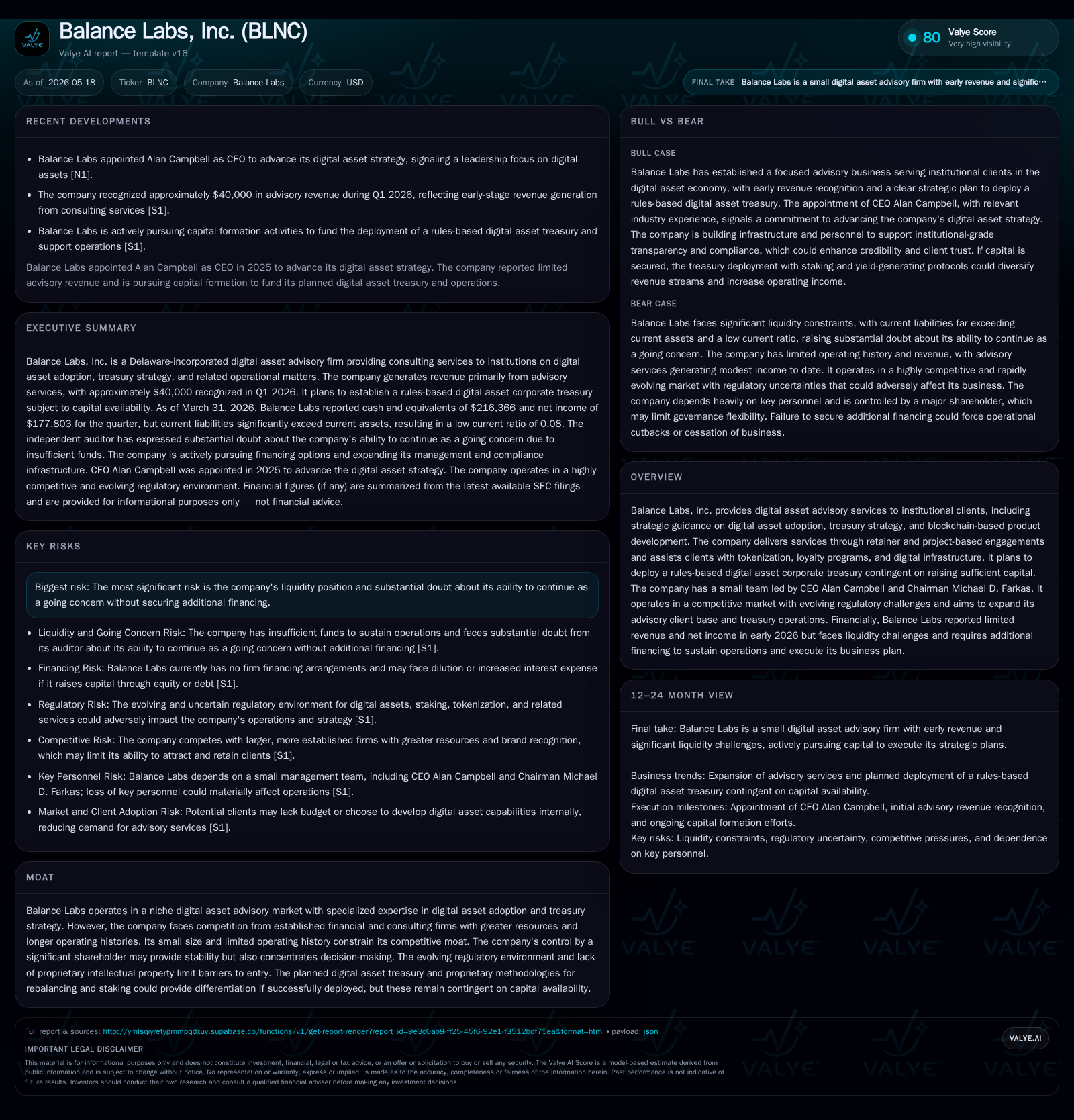
Balance Labs reported modest advisory revenue growth to approximately $40,000 in Q1 2026, up from minimal revenue in late 2025, signaling initial client engagement progress within its digital asset advisory business. However, the company faces acute liquidity constraints highlighted by a critically low current ratio of 0.08 and cash reserves insufficient to cover liabilities, raising substantial doubt about its ability to continue as a going concern absent new financing. The firm’s business model centers on institutional advisory services combined with a planned, capital-dependent rules-based digital asset treasury aimed at generating staking income. Its competitive environment is marked by larger, more established incumbents and regulatory uncertainty that could shape demand for advisory and treasury services. Key growth drivers hinge on expanding the advisory client base and successfully raising capital to deploy the treasury operation. Near-term risks are heavily concentrated on funding availability and evolving regulation affecting digital assets. Milestones include capital raise execution and onboarding treasury management infrastructure critical for scaling.
Q1 2026 Operating Update: Limited Revenue Gains Amid Tight Liquidity
Balance Labs’ latest quarterly filing dated May 15, 2026 [S2] reveals incremental revenue growth in its nascent institutional digital asset advisory practice. For Q1 2026, the company recognized approximately $40,000 in advisory-related revenue, a notable increase from roughly $6,000 reported in Q4 2025 [S1], demonstrating some early market traction albeit at a small scale. While this progression evidences growing client engagement within Balance Labs’ targeted niche of digital asset product strategy and market structure consulting for institutional asset managers and enterprises [S4], it remains dwarfed by the firm's operational burn.
On the balance sheet front, Balance Labs confronts acute liquidity challenges with cash & equivalents standing at roughly $216,366 as of March 31, 2026 [F1], starkly contrasted against current liabilities exceeding $3.1 million for the same period [F1]. This translates into a critically weak current ratio near 0.08 [F1], signaling an imminent funding crunch. The low liquidity runway underlines severe operational risk absent fresh capital infusions or rapid revenue gains.
Balance Labs’ Business Model: Digital Asset Advisory and Planned Treasury Strategy
Balance Labs operates as a specialized consulting firm serving institutional clients venturing into digital assets. Its business model currently generates revenue exclusively through advisory engagements—both retainer-based and project-oriented—that encompass strategic guidance on digital asset adoption, corporate treasury frameworks, blockchain product development, tokenization strategies, loyalty program design, and supporting compliant blockchain infrastructure [S1,S4]. Clients pay for expertise critical to navigating the complexities of integrating digital assets into their operations.
Strategically distinctive is the company's ambition to launch a proprietary rules-based digital asset corporate treasury designed to achieve diversified exposure through predefined inclusion criteria for cryptocurrencies and other tokens [S5]. This treasury would employ proprietary rebalancing algorithms alongside staking/yield-generating activities on select proof-of-stake networks intended to deliver protocol rewards as supplementary operating income [S5]. However, this initiative remains conditional upon securing adequate capital resources; deployment has not yet commenced [S1].
Revenue mechanics rest on broadening institutional advisory contracts combined prospectively with recurring income streams from staking yields post-treasury launch—a complex hybrid model blending service fees with portfolio-generated returns.
Competitive Dynamics and Regulatory Environment in Digital Asset Advisory
The market niche Balance Labs targets is intensely competitive and rapidly evolving. It faces competition from larger consulting firms and financial institutions that have expanded into digital assets with far greater resources, longer-established reputations, more extensive client relationships, deeper compliance infrastructures, and superior brand recognition [S18]. These incumbent competitors enjoy scale benefits that constrain Balance Labs’ moat.
Compounding these challenges is significant regulatory uncertainty spanning multiple agencies—SEC, CFTC, FinCEN, IRS—and encompassing securities laws, commodities regulation, anti-money laundering directives, tax treatment of digital assets and staking income, custody obligations and reporting requirements [S1,S6,S21]. Regulatory developments or interpretive shifts could impact client appetite for outsourcing digital asset strategy or affect feasibility of staking protocols in the planned treasury.
Balance Labs currently lacks proprietary intellectual property or patents tied to its services [S6], limiting structural barriers to entry; differentiation will depend on successful deployment of its treasury methodologies and deep subject matter expertise.
Growth Drivers: Expanding Institutional Advisory Footprint and Treasury Deployment Potential
Key growth levers reside in enlarging Balance Labs’ institutional client base for its advisory services—a trend evidenced modestly by rising quarter-over-quarter revenues from $6K in Q4 2025 to $40K in Q1 2026—and eventually deploying the digital asset treasury at scale [S5]. Institutional clients’ increasing engagement reflects growing recognition of external specialist expertise required to architect complex tokenization programs and compliant blockchain initiatives.
The operationalization of the staked corporate treasury offers a differentiated pathway to recurring income streams beyond linear consulting fees by capturing protocol rewards through yield-generating activities [S5]. This provides upside optionality should Balance Labs secure sufficient capital to realize this plan. Effective capital raise execution measures will be pivotal KPIs alongside steady expansion in advisory retainer wins.
Additionally, enhancements such as employing dedicated personnel for treasury management functions including portfolio operations oversight and institutional-grade reporting infrastructure are planned investments supporting scalable growth [S5]. Evaluations of third-party partners for custody services, execution venues, staking platforms and tax/reporting solutions further indicate preparation for complex operational capabilities necessary for success.
Risks and Constraints: Liquidity Shortfalls and Market Regulation Uncertainty
The predominant risk factor afflicting Balance Labs is acute liquidity insufficiency. As detailed repeatedly across filings ([S1],[S2],[S7],[F1]), the company requires additional financing imminently or it faces inability to meet obligations jeopardizing continued operations. The independent auditor has expressly raised substantial doubt regarding it being a going concern absent new funds [S1,S7]. Current operating funds are inadequate to sustain business plans or fund treasury deployment absent external capital injections or rapid revenue acceleration.
This funding risk compounds regulatory uncertainties that cloud market demand for both advisory engagements and any future corporate treasury deployment due to potential shifts in legal treatment of staking activities or token holdings by regulators domestically or internationally (SEC/CFTC/FinCEN/IRS) [S21,S23]. Unfavorable regulatory changes could depress client budgets or stall planned yield-generating programs altogether.
The small team size constrains capacity to meet rising compliance burdens associated with being a public company under Sarbanes-Oxley Act requirements alongside internal control weaknesses flagged by management due to limited segregation of duties [S25]. These operational limitations may delay scaling or add cost burdens detrimental to profitability.
Key Milestones to Watch: Capital Raise Progress and Treasury Deployment Timing
Near-term execution markers will center on successful completion of capital formation initiatives aimed at bridging funding gaps vital for both sustaining operations long term and enabling launch of the rules-based digital asset treasury [S5]. Milestones include recruiting specialized staff tasked with overseeing the treasury portfolio’s operations as well as selecting appropriate third-party vendors spanning custody solutions, execution platforms, staking infrastructure providers plus accounting/tax reporting services critical for public company disclosure compliance [S5].
Other notable benchmarks comprise enhancements in corporate governance such as appointing independent directors per listing standards possibly aligned with efforts toward an exchange uplisting from OTC Pink markets into national securities exchanges which would improve market access/liquidity profile [S5]. Meanwhile broadening the portfolio of institutional advisory contracts will serve as leading indicators of organic business momentum extension beyond pilot clients.
Financial Summary: Cash Position, Liabilities, and Revenue Trajectory
As of March 31, 2026 (Q1), Balance Labs held approximately $216K in cash & equivalents contrasted against over $3.1 million in current liabilities producing an extremely weak current ratio near 0.08; effectively indicating critical near-term liquidity stress requiring immediate financing actions or operational restructuring [F1],[S2]. The total debt level is relatively nominal at approximately $25K as of end-2025 indicating leverage is not currently driving financial risk but rather an acute working capital shortfall dominates concerns [F1].
Revenue generation remains nascent with $40K recognized during Q1 2026 marking progress over prior quarters but still insignificant relative to general admin overheads expected around professional service costs including compliance burdens as public filer plus costs anticipated preparing for scaled treasury deployment activities [S1,S5]. The net outcome places Balance Labs firmly in an early-stage loss-making position necessitating quick tangible improvements either via successful financing rounds or accelerated commercial traction.
This analysis was prepared based solely on publicly available SEC filings dated up through May 15th, 2026 without consideration of any non-public information. It aims to provide comprehensive industry-contextualized insights without specific investment research views or price guidance.
Disclaimer: This is research-only, informational analysis and not investment advice. It may include AI-generated interpretation and general industry context. Always verify important details using primary sources.

Comments