
BioMarin’s 2025 Growth Strains Earnings as Strategic Shifts and Acquisitions Recast Pipeline
A rare disease biopharma leader, BioMarin’s recent operational decisions and acquisition activity underscore a pivotal inflection in growth and cash flow dynamics.
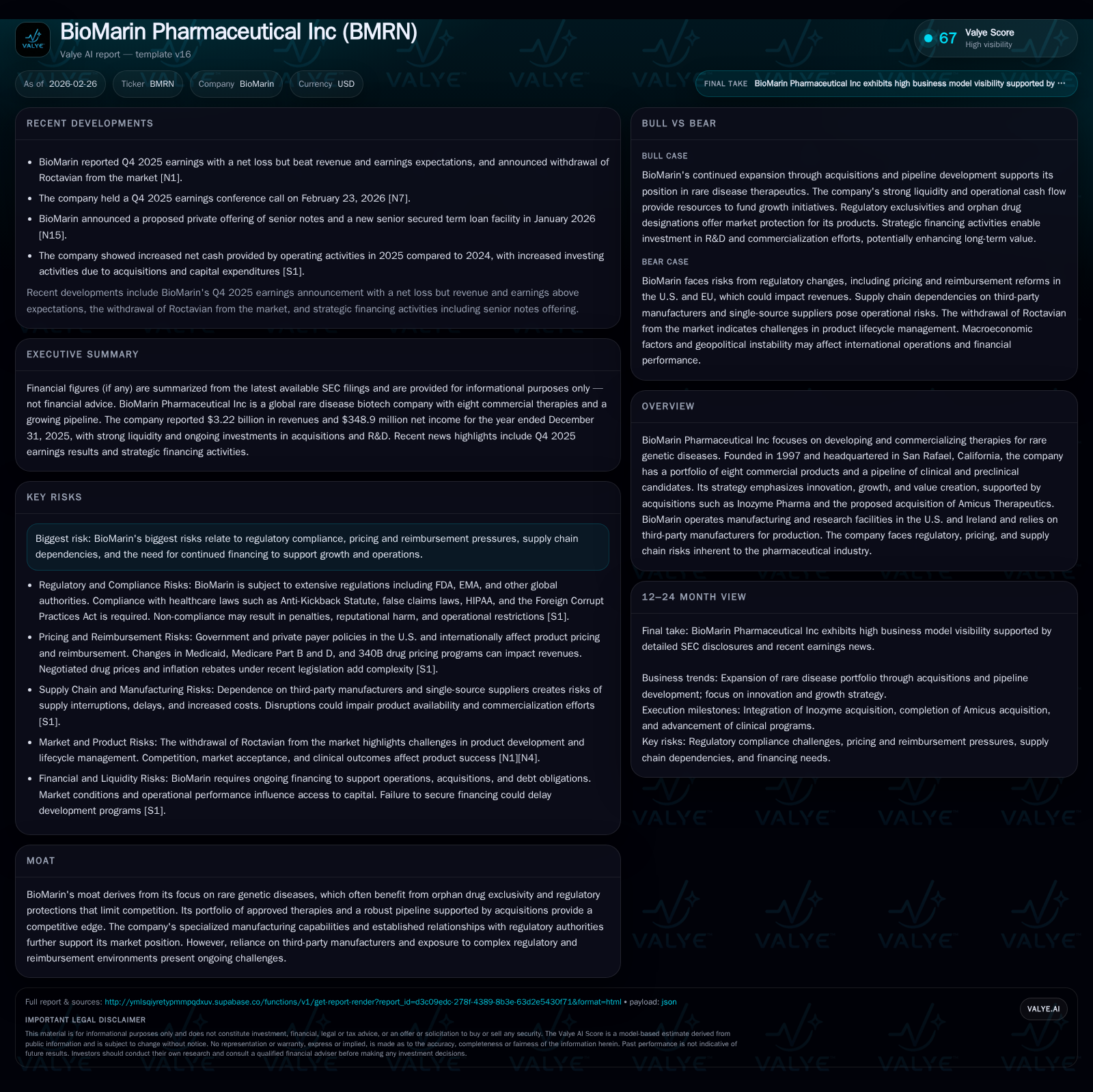
BioMarin Pharmaceutical achieved robust revenue growth in 2025 driven by expanded product sales and strategic acquisition of Inozyme Pharma, yet its operating income and net income declined due to a costly strategic withdrawal of ROCTAVIAN. The company strengthens its pipeline breadth with the pending Amicus Therapeutics acquisition but faces regulatory, pricing, and manufacturing challenges inherent to orphan drug markets. Ongoing financing activities underpin capital deployment for acquisition-driven growth, while operational cash flow generation remains healthy. Investors should monitor execution on pipeline expansion beyond VOXZOGO, regulatory developments in drug exclusivity periods, and integration risks tied to recent M&A.
Company Overview and Strategic Positioning
Founded in 1997 and headquartered in San Rafael, California, BioMarin Pharmaceutical Inc specializes in treatments for rare genetic disorders—a niche characterized by high barriers to entry due to orphan drug exclusivities and complex regulatory regimes. The company's commercial portfolio encompasses eight approved therapies with an expanding clinical pipeline enhanced through notable acquisitions such as Inozyme Pharma and the proposed Amicus Therapeutics merger slated for completion later in 2026. BioMarin operates primary manufacturing sites domestically and abroad (including Ireland), while outsourcing select production processes.
Historical Financial Performance
Between fiscal years (FY) 2017 and 2025, BioMarin demonstrated robust revenue growth driven by elevation in sales volumes across enzyme therapies and newly approved indications—particularly VOXZOGO targeting achondroplasia and related conditions.[F1]
Historical performance (annual)
| FY | Net ($mm) | CFO ($mm) | OpInc ($mm) | Capex ($mm) | Net YoY |
|---|---|---|---|---|---|
| 2025 | 349 | 828 | 409 | 103 | -18.3% |
| 2024 | 427 | 573 | 484 | 85 | +154.6% |
| 2023 | 168 | 159 | 158 | 97 | +18.4% |
| 2022 | 142 | 176 | 150 | 121 |
Source: SEC companyfacts cache [F1].
Capital returns and efficiency (annual)
| FY | FCF ($mm) | ROE% |
|---|---|---|
| 2025 | 725 | 5.7 |
| 2024 | 487 | 7.5 |
| 2023 | 63 | 3.4 |
| 2022 | 55 | 3.1 |
Source: SEC companyfacts cache [F1].
Note: Revenue figures for post-2017 years are provided within SEC excerpts but exact numeric values listed only through FY2017 snapshot; revenue growth rate computed per official disclosures.
Operating profits contracted significantly in the latest fiscal year largely due to strategic inventory impairments stemming from the voluntary withdrawal of ROCTAVIAN gene therapy amid lower-than-expected commercial uptake.[S8] Despite this accounting hit depressing operating income by approximately $119 million, operational cash flows surged given timing variances and ongoing core business strength.[F1][S5]
Recent Operational Developments
In July 2025, BioMarin finalized its purchase of Inozyme Pharma, bolstering its enzyme replacement therapies with late-stage candidate BMN 401—targeting ENPP1 deficiency—a condition previously unaddressed therapeutically.[S16] This reinforces BioMarin's focus on deepening niche treatment areas where data exclusivity fosters durable competitive moats.
However, the decision to pull ROCTAVIAN from market channels late last year marked a strategic pivot that underscores challenges associated with gene therapies' commercial viability outside strict ultra-rare segments.[N1] The company prioritized resource reallocation towards higher-return assets including broader indications for VOXZOGO that target larger patient populations such as idiopathic short stature and Noonan syndrome.[S18]
Pipeline & Growth Prospects
BioMarin's future growth hinges on executing expansion beyond its flagship VOXZOGO franchise—including leveraging enzymatic approaches acquired via Inozyme—and integrating Amicus Therapeutics' assets pending regulatory approval.[N1][N6]
The pipeline diversification manifests as both opportunity and risk given inherent clinical development uncertainties in rare diseases: lengthy trials, considerable expense, high regulatory scrutiny with conditional approvals prevalent.[S20] Regulatory reforms currently underway within the European Union propose adjusted market exclusivity lengths (up to eleven years for breakthrough orphan drugs), potentially extending protection windows but also tightening post-approval criteria for price negotiations.[S1]
Additionally, pricing environment dynamics loom large—governmental initiatives aimed at cost containment impose pressure on allowable reimbursement levels across key markets including the US Medicare/Medicaid landscape.[S20][S25] Consequently, broad access policies coupled with rising third-party payer scrutiny may cap price premiums offsetting unit volume gains.
Capital Allocation & Financial Health
BioMarin ended FY2025 with approximately $1.31 billion of cash and equivalents atop a solid liquidity runway facilitated by credit facilities fully undrawn at year end.[F1][S21] Capital expenditure outlay rose moderately reflecting investments into manufacturing capabilities likely tailored to expand biologics production amid pipeline maturation.[F1][S12]
In February 2026, BioMarin issued $850 million senior unsecured notes at a fixed coupon rate intended primarily for financing the Amicus Therapeutics acquisition—a move dovetailing with earlier arranged bridge financing commitments scaled back upon note issuance.[S10]
Leverage metrics remain conservative given ample equity capital base exceeding $6 billion alongside manageable convertible debt maturities in coming years warranting monitoring for refinancing or conversion risk ahead of May 2027.[F1][S21]
Notably, the firm has not distributed dividends historically nor engaged materially in share repurchases recently—indicative of reinvestment toward R&D and acquisitions aligned with long-term growth imperatives rather than short-term capital return strategies.[F1]
Risks & Regulatory Environment
BioMarin navigates complex risk landscapes typical of orphan drug specialists including:
- Regulatory compliance costs heightened by evolving international legislation impacting exclusivity terms, pediatric investigation plans (PIPs), and clinical trial transparency requirements.
- Potential liability stemming from product withdrawals or adverse event litigations increased under stringent safety regulations newly enforced or contemplated both domestically and abroad.[S4][S18]
- Supply chain dependencies compounded by third-party manufacturing arrangements necessitate robust quality controls notwithstanding internal capabilities.
- Pricing headwinds amplified by U.S. federal efforts toward drug price transparency coupled with Medicaid/Medicare rebate alterations as well as global health system negotiations constraining premium pricing power.
- Cybersecurity vulnerabilities inherent in IT system complexity introduce operational disruption risks requiring heightened governance oversight established recently under senior management mandates.[S13][S18]
What To Watch / Analysis
Important near-term milestones include successful closure of the Amicus deal alongside regulatory filings advancing next-generation indications for VOXZOGO targeting larger patient populations beyond achondroplasia.[N6][N14] Monitoring pipeline readouts on late-stage assets like BMN 401 will provide signals on potential new commercial engines that could diversify revenue sources sustainably.
Given reported revenue strength but profitability pressure from ROCTAVIAN impairment charges in Q4/2025,[N13] margin recovery paired with integration efficiencies post-Inozyme/Amicus transactions remain critical metrics for scrutinizing BioMarin's capacity to translate innovation into stable earnings streams.
Furthermore, evolving pharmaceutical pricing reforms warrant close attention as they materially impact unit economics especially within rare disease categories where annual treatment costs are noteworthy yet reimbursement frameworks increasingly restrictive.[S25]
Overall, BioMarin's strategic repositioning towards broader rare disease segments combined with sustained R&D investment anchors a differentiated moat but requires adept capital management amidst industry headwinds involving regulatory complexity and payer demands.
This analysis is based on publicly available information including SEC filings dated February 26, 2026 ([F1],[S1]-[S29]) and recent news reports ([N1]-[N14]). It is intended solely for informational purposes without providing investment advice or recommendations.
Disclaimer: This is research-only, informational analysis and not investment advice. It may include AI-generated interpretation and general industry context. Always verify important details using primary sources.

Comments