
BONK, INC.: From Functional Beverages to Decentralized Finance—Strategic Repositioning and Execution Risk
BONK, INC. has rapidly shifted from health and wellness beverages to digital assets and decentralized finance, leveraging acquisitions, strategic financing, and a new partnership model. The company’s transformation offers both diversification and complexity, with future value hinging on execution in unproven markets and the ability to monetize new digital platforms.
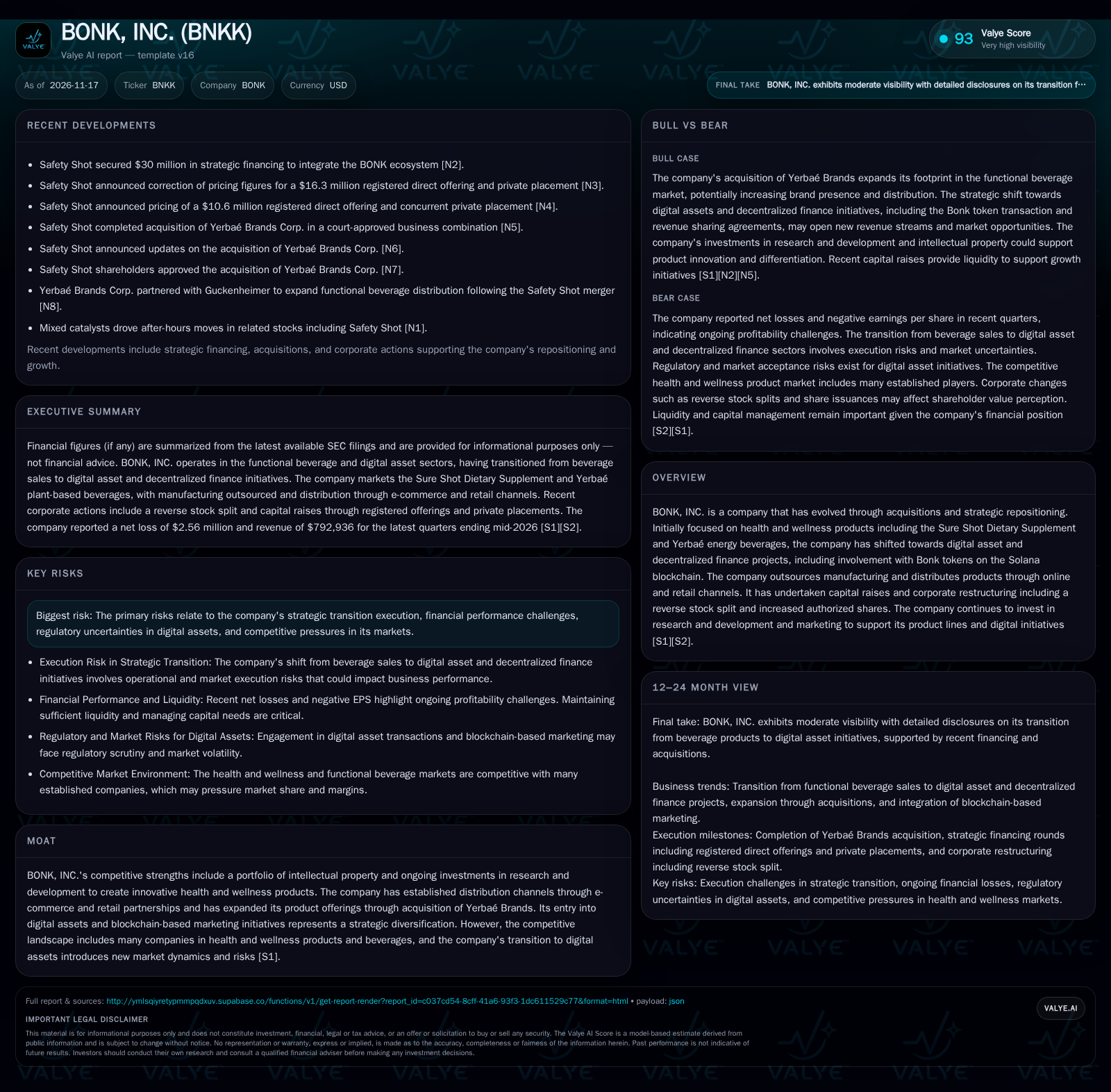
BONK, INC. has exited its legacy beverage business to focus on digital assets and decentralized finance, highlighted by the acquisition of Yerbaé Brands and a revenue sharing deal for the Bonk digital platform. With recent capital raises and a rebranding, the company’s prospects now depend on successfully bridging consumer products and blockchain-enabled business models—an ambitious but high-risk transformation. [S1] [S2] [N2]
BONK, INC. has undergone a dramatic transformation over the past two years—from a functional beverage company with products like Sure Shot and Yerbaé, to a digital asset and decentralized finance (DeFi) venture anchored by the Bonk token and an associated digital platform. This pivot was financed by new capital infusions and accompanied by a full corporate rebranding, a reverse stock split, and the exit from its legacy wellness product lines. The question now is whether BONK, INC. can generate sustainable value in its new digital domain, having left the relative familiarity of consumer packaged goods for the volatility and regulatory complexity of DeFi.
Strategic Realignment and Capital Raise Define BONK’s New Identity
In 2025, BONK, INC. completed a decisive transition from health and wellness beverages to digital asset and decentralized finance projects. This included the acquisition of Yerbaé Brands Corp., the discontinuation and spin-off of its historical product lines, and a rebranding to BONK, INC. (ticker: BNKK) to reflect its new strategic direction. [S1]
The company raised approximately $29.25 million in August 2025 through a registered direct offering and private placement, and later secured $30 million in strategic financing for integrating the BONK ecosystem. [S1] [N2]
A revenue sharing agreement was established with Bonk Digital, Inc., tying the company’s future revenue streams to the performance of a new digital platform centered around Bonk tokens. [S1]
Recent financials highlight the risk: for the quarter ended June 30, 2026, revenue was $792,936, while the quarter ended September 30, 2026 saw a net loss of $2.56 million and a basic and diluted EPS of -$0.46. [S2]
Evaluating the Economics of BONK’s Digital Pivot
Historically, BONK, INC.’s economics were driven by volume and mix in the beverage sector, with outsourced manufacturing and distribution through retail and e-commerce. The gross margin profile in this category is typically modest, with meaningful variable costs and significant marketing spend to drive velocity and secure shelf space.
With the shift to digital assets and DeFi, BONK’s revenue model becomes less predictable and more dependent on the adoption and transaction volume of its digital platform and Bonk token ecosystem. If structured as a platform or protocol, revenue could derive from transaction fees, token appreciation, or revenue sharing with third-party projects. However, these models are highly sensitive to user growth, tokenomics design, and regulatory treatment.
Operating leverage could increase if the digital platform achieves scale, as marginal costs to serve additional users are typically low. Conversely, fixed costs for technology development, compliance, and ongoing marketing remain material, especially during the ramp phase. The company’s recent capital raises provide a liquidity buffer for this transition but do not guarantee positive unit economics or sustainable cash flow. [S1] [S2] [N2]
The transition from a tangible product business to a digital asset platform fundamentally alters the risk profile and capital intensity of BONK’s operations. In the beverage sector, inventory management, supply chain disruptions, and shelf life concerns impose operational constraints and working capital demands. By contrast, a digital platform’s primary costs relate to software development, cybersecurity, and regulatory compliance, which although less variable, require sustained investment to maintain competitive positioning. This shift implies a reallocation of capital from physical assets to intangible assets, increasing the importance of intellectual property protection and continuous innovation to defend market share and justify valuation multiples.
Competition Intensifies Across Beverage and Digital Asset Arenas
BONK, INC. faces a two-front competitive dynamic: legacy beverage market competition is characterized by entrenched brands with scale advantages, while the digital asset and DeFi space is crowded with both incumbent platforms and new entrants.
In functional beverages, switching costs are low, and established brands dominate shelf space and consumer mindshare. While the Yerbaé acquisition expanded BONK’s reach, the company’s exit from this space means it forfeits any compounding distribution or brand equity effects.
In DeFi and blockchain-enabled platforms, BONK enters a fragmented landscape where customer acquisition costs can be high and regulatory risk is non-trivial. The company’s IP portfolio and revenue-sharing model may provide some differentiation, but network effects, liquidity, and trust are difficult to establish without a large, engaged user base. The competitive moat in digital assets is typically built through technical innovation, ecosystem partnerships, and brand credibility—areas where BONK is still in early stages.
If BONK’s Platform Achieves Network Effects, Revenue and Margin Could Inflect
A favorable outcome for BONK, INC. hinges on the successful launch and scaling of its digital asset platform. If the Bonk token ecosystem attracts meaningful user adoption—potentially by leveraging its beverage brand legacy for initial user acquisition or loyalty rewards—the company could benefit from platform economics: recurring transaction fees, network growth, and token appreciation.
Confirmation of this scenario would come from rapid growth in platform users, transaction volumes, and third-party integrations, as well as evidence that revenue from digital initiatives is outpacing legacy beverage sales. Key falsifiers would be stagnant user metrics, low engagement, or regulatory interventions that limit platform operations.
Digital Initiatives Ramp Slowly While Legacy Revenue Declines
The most plausible scenario is that BONK, INC. experiences a protracted transition period: digital asset revenues ramp gradually, offset by declining or negligible beverage sales following the spin-off of legacy products. The company’s capital buffer supports ongoing development and marketing, but net losses persist as the platform seeks traction.
Evidence supporting this base case would include continued quarterly losses, modest revenue growth attributable to digital projects, and incremental updates on platform features or ecosystem partnerships. A shift toward profitability would likely require either a step-change in user adoption or significant cost discipline.
Failure to Monetize Digital Assets Exposes BONK to Prolonged Losses
In the adverse scenario, BONK, INC. fails to achieve meaningful adoption or monetization of its digital asset platform. Regulatory headwinds, lack of user trust, or technical challenges could constrain growth, while the absence of legacy beverage revenue leaves the company exposed to ongoing operational losses.
This scenario would be confirmed by persistently weak platform engagement, lack of ecosystem partnerships, and continued cash burn without a clear path to positive operating cash flow. Additional dilution or asset sales could become necessary if capital needs outstrip available liquidity.
Milestones and Metrics to Test BONK’s Digital Transformation Thesis
Growth in active users and transaction volumes on the Bonk digital asset platform—if disclosed—would be a primary signal of adoption.
Revenue mix evolution between digital asset initiatives and any residual beverage or legacy product streams would help clarify the transition’s pace.
Updates on regulatory developments affecting DeFi and digital asset operations, as adverse rulings could materially impact business prospects.
Evidence of third-party integrations or ecosystem partnerships, which would support the case for network effects.
Research and development pipeline disclosures, indicating ongoing innovation capacity and platform differentiation.
Cash burn rate and runway updates, particularly as the company invests in technology and marketing to build the digital business.
Management commentary or guidance on the strategic roadmap, including milestones for platform launches or new revenue streams.
If available, data on customer acquisition costs and retention in the digital asset platform would help assess scalability and sustainability.
Disclaimer: This is research-only, informational analysis and not investment advice. It may include AI-generated interpretation and general industry context. Always verify important details using primary sources.

Comments