
Brady Corporation Poised for Growth with PSS Acquisition Amid Balance Sheet Strength
Brady Corporation advances its strategic transformation with the pending Honeywell PSS acquisition supported by solid liquidity and manageable leverage.
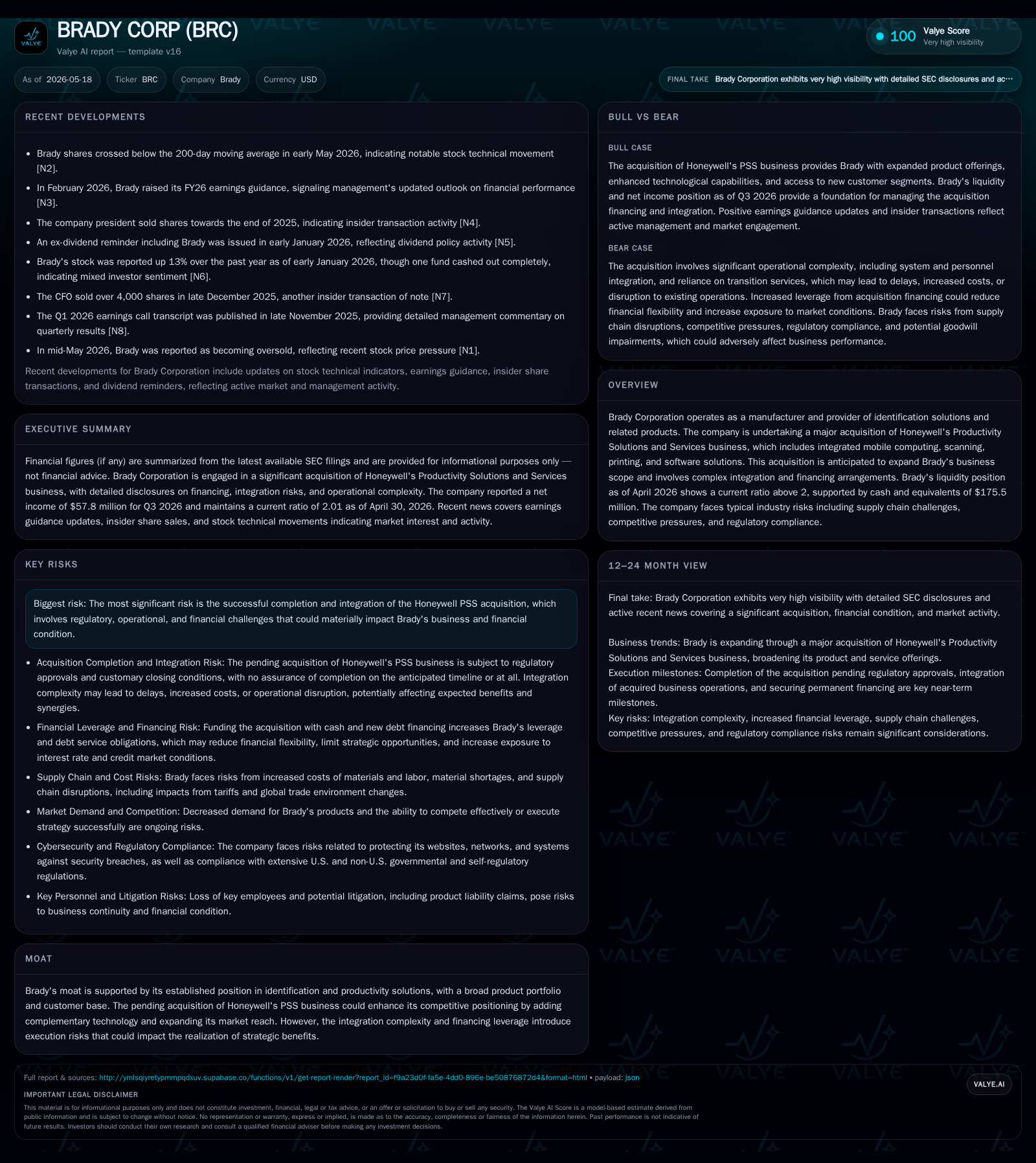
In its latest Q3 2026 filing, Brady Corporation reaffirmed expectations to close the significant acquisition of Honeywell's Productivity Solutions and Services (PSS) business in the second half of calendar 2026, although regulatory and integration risks persist. The acquisition is set to broaden Brady’s product offering by adding integrated mobile computing, scanning, printing, and software solutions, potentially enhancing revenue growth and cross-selling opportunities. Brady’s balance sheet remains robust pre-acquisition, with strong liquidity evidenced by a current ratio of 2.01 and a net cash position that provides financial flexibility despite upcoming increases in leverage from acquisition financing. Execution risk centers on regulatory approvals, integration complexity, and financing availability, which could affect synergy realization and operational stability.
Latest Operating Developments: Q3 Update and Acquisition Progress
Brady Corporation’s May 18, 2026 quarterly disclosure highlights its ongoing strategic pivot anchored on acquiring Honeywell International’s Productivity Solutions and Services (PSS) business [S2], [S3]. This planned transaction represents a transformative acquisition expected to close in the second half of calendar year 2026 but remains conditional upon customary regulatory approvals and closing conditions. Management maintains confidence in completion timing but explicitly recognizes inherent uncertainties due to regulatory review processes [S10].
Operationally, the transaction carries notable complexity beyond a typical standalone acquisition given its divestiture structure from Honeywell. Brady will initially depend on transition services agreements to maintain business continuity post-close while integrating separated systems, processes, and personnel associated with the acquired PSS business unit [S10], [S21]. These integration activities increase risk around timeline delays, incremental costs beyond initial estimates, and potential disruption to both parties’ ongoing operations.
Despite these integration uncertainties, Brady has raised full-year guidance reflecting confidence in near-term operational resilience even during acquisition-related developments [N1]. This signals effective core business momentum preceding the transformational deal closure.
Overview of Brady’s Business Model and Product Portfolio
Brady Corporation’s revenue originates principally from manufacturing and providing industrial identification solutions encompassing safety labels, signs, specialized markers, and related workflow-enhancing devices [S1]. Its products serve critical roles across regulated industrial environments requiring compliance labeling for safety standards as well as productivity tools that reduce errors in manufacturing and logistics.
The strategic expansion into mobile computing technologies via the PSS acquisition adds an adjacent technology stack comprising integrated scanners, printers, mobile computers, and supporting software solutions [S12]. This enhances Brady’s ability to offer bundled identification-plus-productivity solutions that deepen customer value propositions by digitizing asset tracking and operational workflows.
Customer engagement often entails recurring replenishment contracts for consumable supplies such as labels yet benefits from elevated switching costs due to customer-specific customization requirements and adherence to stringent industry regulations governing workplace safety labeling [S1]. Integration of PSS’s software assets broadens serviceable markets by addressing more data-driven customer workflows requiring end-to-end traceability capabilities.
Competitive Landscape and Industry Structural Considerations
Within its industrial identification niche paired with emergent productivity solutions exposure post-acquisition, Brady occupies a defensible position bolstered by brand reputation and broad product breadth [S1], [S2]. The market features fragmentation among regional specialty suppliers juxtaposed against larger players offering integrated platforms.
Pricing power is generally moderate given competitive pressures combined with customers’ cost sensitivity in procurement yet mitigated by regulatory compliance imperatives that limit substitutability [S1]. Supply chain volatility introduces cost variability notably around raw materials for labels and electronics parts for mobile computing devices within PSS.
Customer concentration risks remain manageable owing to diversified industrial end-markets served including manufacturing, healthcare, electronics assembly, energy sectors—all dependent on consistent product quality aligned with regulatory mandates.
Strategic Growth Drivers Fueled by the PSS Acquisition
The acquisition unlocks multiple avenues for enhanced growth driven by synergy capture between Brady’s existing labeling expertise with PSS’s technology-rich portfolio encompassing mobile computing hardware integrated with scanning and printing capabilities supported by proprietary software suites [S12], [N1].
Cross-selling opportunities emerge as Brady can now offer comprehensive identification plus data capture solutions appealing to customers modernizing operational workflows. Expansion into higher-margin software-driven offerings also enhances overall portfolio mix.
Moreover, geographical footprint expansion through inherited global sales channels facilitates penetration into underserved or new markets.
Aftermarket services potential augments recurring revenue streams as maintenance contracts for complex devices become accessible alongside consumables replenishment.
While these growth drivers are compelling structurally, the exact timing of revenue contribution depends heavily on closing execution and smooth post-acquisition integration progressing per plan without protracted delays or escalated costs [S22]
Risks and Challenges Centered on Acquisition Execution and Market Dynamics
A principal risk vector arises from pending regulatory approvals required under antitrust frameworks which could delay or jeopardize transaction closing beyond planned schedules [S10], [S25]. Failure or delay here would stall expected strategic benefits.
Integration presents multifaceted risks including dependence on transitional service agreements creating operational dependencies; segregation of information systems necessitating rapid IT restructuring; personnel retention challenges potentially eroding institutional knowledge; plus heightened integration costs reducing near-term margin uplift expectations [S10], [S22].
Additionally, macroeconomic variables such as supply chain inflationary pressures impacting material costs could compress margins further during this period. Demand volatility in underlying industries served might exacerbate earnings unpredictability.
All these factors contribute to execution uncertainty impacting realization of anticipated synergies within projected timelines.
Monitoring Brady: Near-Term Milestones and Key Demand Signals
Investors should closely observe updates around progress toward requisite regulatory clearances which remain critical gating items before deal closing can proceed as expected. Public announcements or delay notifications will materially influence outlooks.
Post-closing integration updates will provide indicators regarding system consolidations success, transition services performance reliability, employee retention metrics within PSS units acquired, plus synergy achievement milestones measured against targets.
Supply chain cost trends affecting both legacy Brady products and newly acquired lines merit tracking given implications for margin trajectory.
Client adoption rates within expanded product offerings following launch or cross-selling efforts will reveal market reception efficacy.
Finally, revisions to company guidance—upward or downward—post-acquisition closing will be revealing gauges of combined enterprise operational health.
Financial Health and Capital Structure in Light of Acquisition Plans
As of April 30, 2026, Brady holds $175.5 million in cash equivalents alongside total current assets approaching $679 million against current liabilities near $338 million yielding a robust current ratio above 2.0—a snapshot signifying solid short-term liquidity preservation pre-transaction closing [F1]
Total debt reported is relatively modest at approximately $26.9 million resulting in an overall net cash position before acquisition-induced borrowing—providing a flexible starting point for deploying incremental capital needed to fund the Honeywell PSS purchase [F1]
Financing arrangements include bridge facilities arranged through BMO Capital Markets up to $1.8 billion intended for immediate funding needs supplemented by internally held cash balances; permanent financing is anticipated before deal closure though no guarantees exist regarding terms or timing [S10], [S12].
This analysis synthesizes recent SEC filings alongside Brady Corporation’s evolving corporate disclosures into an integrated view suitable for buy-side industry analysts assessing strategic transformation risk-return profiles. The assessment refrains from investment research views or price forecasts per policy constraints but highlights critical operational contingencies shaping Brady's near-term outlook amid substantial acquisition-driven change.
Disclaimer: This is research-only, informational analysis and not investment advice. It may include AI-generated interpretation and general industry context. Always verify important details using primary sources.

Comments