
Dynamic Aerospace Systems Advances UAV Technology and Autonomous Logistics Amid Tight Liquidity
DAS progresses on hybrid VTOL drone innovation and autonomous delivery networks while grappling with significant liquidity challenges.
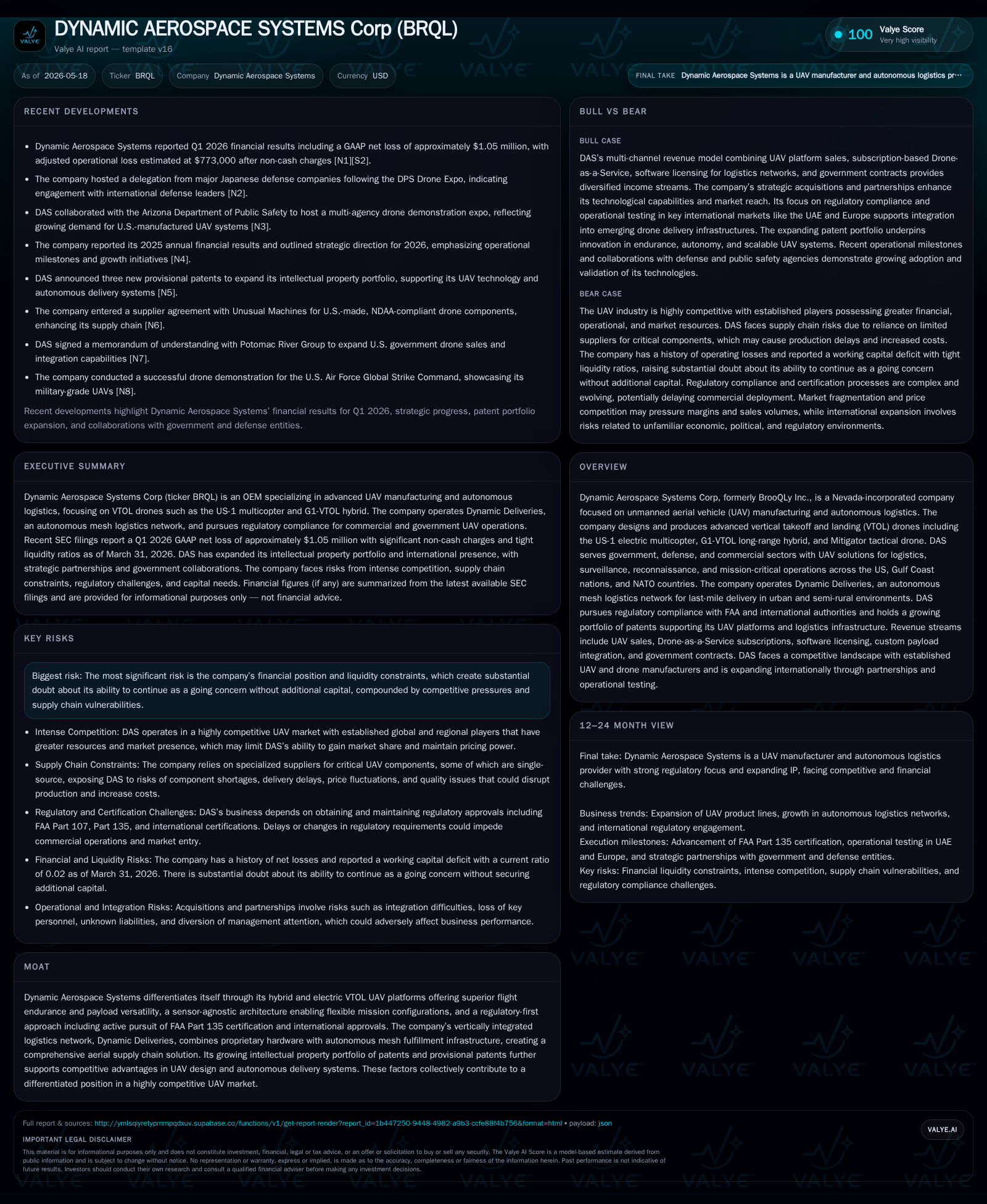
Dynamic Aerospace Systems Corp (BRQL) reported operational improvements in Q1 2026, reducing adjusted losses through cost discipline and strategic focus, despite a GAAP net loss pressured by non-cash expenses. The company’s business model centers on proprietary VTOL UAV platforms and an integrated autonomous logistics network, targeting government, defense, and commercial customers amid evolving regulatory regimes. Growth hinges on FAA Part 135 certification progress, expanding patent portfolios, and pilot adoption in U.S. public safety and international markets. However, pronounced liquidity constraints and tough competition pose serious execution risks near term.
Recent Quarter Highlights: Progress Through Operational Discipline
Dynamic Aerospace Systems Corporation’s latest quarterly report filed May 15, 2026 ([S2], [S3]) reveals meaningful operational strides despite financial headwinds. The company posted a GAAP net loss of approximately $1.05 million for Q1 2026. A significant share of this loss stems from non-cash accounting expenses including $399K stock-based compensation, $192K amortization of debt discount, $78K general amortization expense, plus depreciation and financing-related costs. After excluding these non-cash items along with $27K in one-time legal and accounting outlays mainly related to corporate restructuring and S-1 compliance activity, management estimated an adjusted operational loss near $773K (about $258K monthly), marking continued tightening of overheads via aggressive cost controls.
CEO Kent Wilson emphasized ongoing efforts to sharpen spending toward strategic initiatives aimed at long-term value creation while reducing extraneous operations. This balance between financial discipline and investment underpins the near-term narrative as DAS seeks to transition from developmental stages toward commercialization readiness.
Business Model and Product Overview: VTOL Platforms and Autonomous Networks
Dynamic Aerospace Systems operates as an OEM specializing in vertical takeoff and landing (VTOL) unmanned aerial vehicles (UAVs) coupled with a proprietary autonomous logistics infrastructure branded Dynamic Deliveries ([S1], valye_report_excerpt). The company's core airborne product suite includes:
- The US-1 Electric Multicopter: An advanced electric UAV featuring an integrated battery-airframe design enabling upwards of 70 minutes flight time with approximately 3kg payload capacity. Adapted for surveillance, search/rescue missions, urban logistics.
- G1-VTOL Hybrid Drone: A longer range hybrid-electric fixed-wing VTOL platform offering improved flight endurance suited for reconnaissance and tactical resupply roles.
- Mitigator Tactical Drone: Specialized for defense applications incorporating advanced sensor payloads including IR cameras & flow sensors.
Complementing hardware innovation is Dynamic Deliveries — a mesh-network autonomous logistics platform designed for last-mile delivery in complex urban or semi-rural environments. This system combines proprietary UAV hardware with distributed fulfillment nodes intended to optimize route efficiency and delivery times.
Revenue generation derives primarily from government contracts addressing defense/public safety gaps alongside commercial use-cases such as healthcare material transport and e-commerce order fulfillment across targeted geographies including the US homeland, Gulf Coast states, NATO allies ([S1]). Strategic IP investments safeguard DAS's proprietary energy-dense battery integration technology as well as autonomous delivery processes.
Competitive Environment and Industry Positioning
The UAV landscape is highly fragmented but increasingly competitive with incumbent defense contractors leveraging scale advantages alongside emerging startups pushing innovation ([S1]). Large industry players often benefit from privileged government procurement channels which pose barriers for mid-tier entrants like DAS. However, DAS’s deliberate focus on FAA Part 135 certification—a regulatory path that authorizes commercial passenger/cargo drone operations—alongside its vertically integrated logistics platform strengthens differentiation.
This combined offering places DAS at the intersection of regulated aerospace manufacturing and autonomous last-mile delivery service provision — a strategic niche enabling contract diversification between governmental ISR/military demand cycles and faster-growing commercial logistics segments. Peer comparison underscores the challenge faced by companies lacking extensive capital or entrenched customer pipelines but possessing agile regulatory approaches supportively backed by an expanding IP portfolio ().
Product Quality and Innovation: Patented Hybrid and Electric UAVs
DAS’s product suite incorporates several sector-leading innovations tightly aligned to market needs ([S1], valye_report_excerpt). The US-1’s patented battery-integrated airframe improves energy density over comparable drones that rely on externally mounted batteries or standard cells — enabling longer operational endurance critical for surveillance or missions requiring sustained flight periods.
The hybrid G1-VTOL platform marries flexibility with range extension thanks to mixed propulsion technology. Coupled with modular payload bays supporting sensoragnostic mission configurations, it enables custom tailoring for clients ranging from law enforcement surveillance teams to military resupply units.
Patent filings during Q1 2026 expanded coverage into autonomous drone delivery systems along with tactical interceptor technologies ([S11]). Such intellectual property developments create switching-cost barriers potentially deterring newcomer entrants while also allowing licensing opportunities or competitive protections in government procurement processes.
Growth Catalysts: FAA Certification, Commercial Adoption, and Market Expansion
Regulatory advancement stands as a primary growth driver. Progress toward FAA Part 135 certification is pivotal enabling unrestricted commercial drone flight beyond visual line-of-sight — a critical industry milestone unlocking widespread adoption ([S1],[N4]). Agencies such as the Arizona Department of Public Safety have partnered with DAS to showcase multi-agency drone demonstrations highlighting US-made capabilities embracing autonomy ([N4]).
Internationally, DAS tapped collaboration opportunities hosting delegations from prominent Japanese aerospace firms including Mitsubishi Heavy Industries ahead of anticipated regional expansions ([N3]).
The company carried approximately $740K total debt against limited cash reserves, with current assets totaling $64.7K heavily overshadowed by current liabilities exceeding $3.12 million yielding an extremely low current ratio near 0.02 [F1]. These metrics highlight substantial liquidity constraints and underscore the need for strategic capital actions to support ongoing operations.
Competitive pressures arise from better-capitalized rivals focused on scale economies or broader IP portfolios that may limit DAS’s pricing power or contract capture potential ([S1]). Supply chain vulnerabilities for specialized aerospace components add operational risk especially amid global disruptions.
Regulatory shifts remain uncertain internationally where compliance complexity increases costs; failure to navigate anti-corruption laws or data privacy regulations could impair operations or contract awards ([S19],[S24]). This layered regulatory environment demands continual adaptation to maintain competitive standing.
Upcoming Milestones to Monitor
Key catalysts investors should observe include:
- Announcement of FAA Part 135 certification status updates that would validate commercial operation readiness.
- Expansion metrics regarding pilot implementations of Dynamic Deliveries across initial urban centers demonstrating logistic viability.
- Developments on granted patents or intellectual property licensing arrangements enhancing competitive moat.
- Progression of contractual partnerships particularly involving U.S. public safety agencies or allied international defense delegations ([N4],[N3]).
- Updates on ongoing cost-reduction initiatives impacting monthly adjusted operational losses potentially signaling path to cash-flow sustainability.
- Any formal communication regarding plans or timelines for uplisting shares to a national exchange such as NYSE American which could improve capital access ([S11]).
Financial Profile Snapshot Summary
Latest Q1 2026 disclosures reveal that despite substantial operating losses reported under GAAP predominantly attributable to non-cash items such as stock-based compensation ($399K) and amortization expenses ($270K total), ongoing operational losses have been curtailed to roughly $773K when excluding one-time legal/accounting costs ([S3]). Balance sheet assessment shows total debt approximating $740K vis-à-vis limited liquid assets leading to liquidity constraints confirmed by a current ratio around 0.02 [F1], highlighting urgent refinancing or capital raise necessities for sustained operations.
This analysis emphasizes Dynamic Aerospace Systems’ technical advancements within the evolving UAV sector juxtaposed against very constrained financial resources posing existential challenges if not addressed through strategic capital actions or rapid revenue ramp-up. Monitoring commercialization milestones alongside cash flow trajectories will be critical to assess progression from promising aerospace innovation toward viable long-term enterprise sustainability.
Disclaimer: This report is for informational purposes only based on publicly filed documents with no investment advice implied.
Disclaimer: This is research-only, informational analysis and not investment advice. It may include AI-generated interpretation and general industry context. Always verify important details using primary sources.

Comments