
BluSky AI's Push into Modular AI Compute and the Challenges Ahead
Latest quarterly disclosures spotlight BluSky AI’s liquidity strain amid capital-intensive modular data center ambitions in a competitive AI infrastructure market.
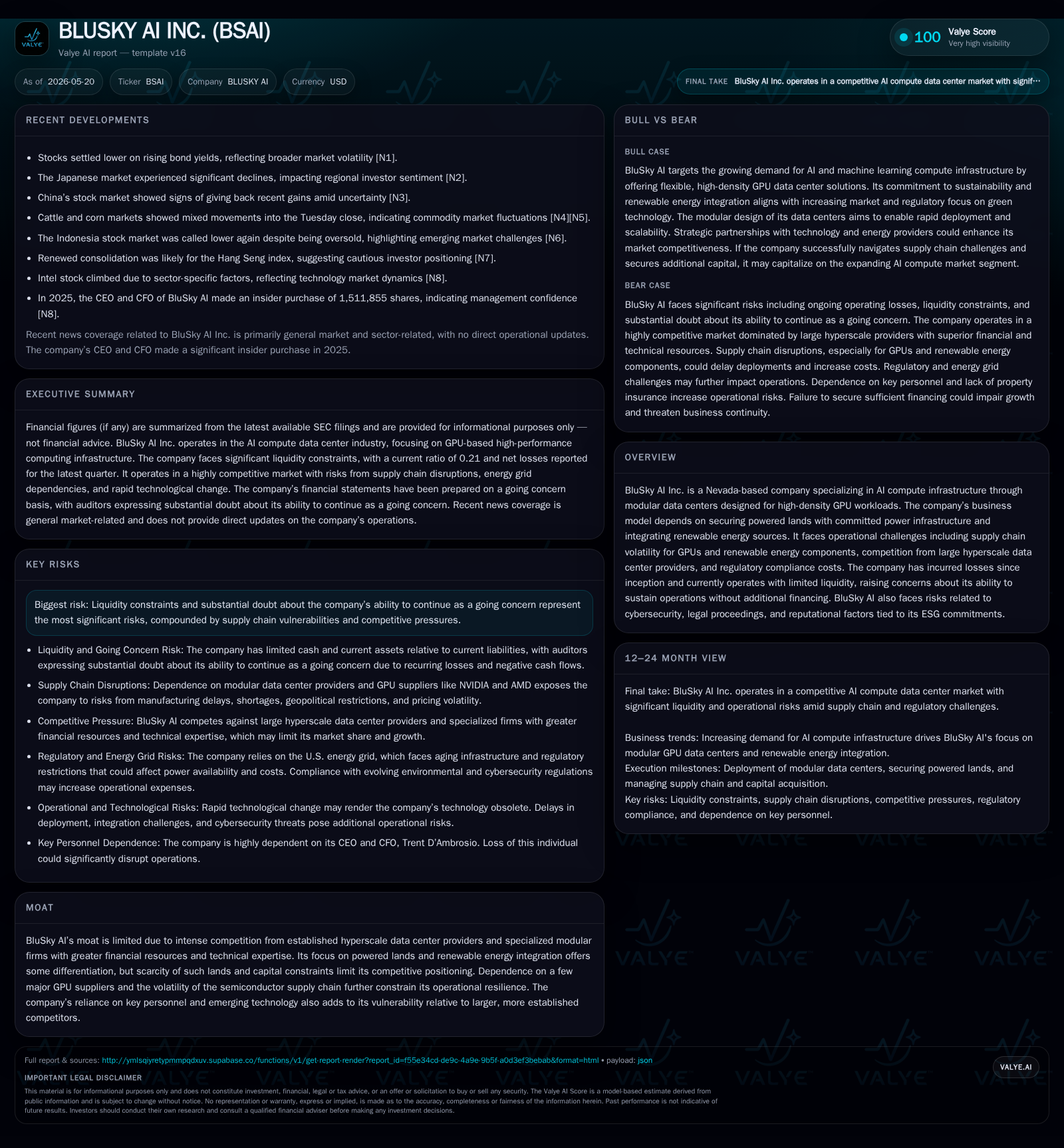
BluSky AI Inc. operates in the specialized niche of modular, high-density GPU data centers integrating renewable energy sources. Its latest 10-Q filing reveals critical liquidity constraints with a low current ratio of 0.21 and minimal cash reserves, underscoring substantial doubt about ongoing viability without fresh financing. The company’s business model depends heavily on securing powered lands and managing volatile GPU and renewables supply chains, while facing intense competition from hyperscale giants and modular providers with deeper resources. Growth hinges on accelerating capital deployment in renewable-powered infrastructure to meet surging AI compute demand, but execution risks, supply uncertainty, and regulatory compliance demands weigh heavily on near-term prospects.
Latest Quarterly Developments: Operational Status and Liquidity Concerns
As of quarter-end March 31, 2026, BluSky AI held approximately $563 thousand in cash and equivalents against current liabilities exceeding $3.37 million—yielding an alarmingly low current ratio of roughly 0.21 [F1]. This level of liquidity insufficiency reveals acute pressure to secure immediate financing or drastically improve cash flow.
Accompanying this cash crunch, auditors have explicitly expressed "substantial doubt" regarding BluSky AI's ability to continue as a going concern due to persistent net losses ($4.5 million loss at end-2025) and negative operating cash flows compounded by minimal working capital buffers [S1][F1]. Without rapid capital infusion or operational turnaround, the risk of insolvency becomes material.
No reported revenues underscore that BluSky remains in the nascent phase of commercializing its services; expenditure is dominated by build-out costs rather than customer billing [F1]. This quarterly update foregrounds immediate sustainability challenges that condition all strategic analysis.
Business Model Overview: Modular AI Data Centers and Power Infrastructure
BluSky AI operates in the emerging segment of scalable modular data centers tailored specifically for high-density GPU workloads essential for AI and machine learning applications [S1][S5]. The firm’s strategy revolves around acquiring "powered lands"—real estate sites pre-equipped or contractually secured with committed power infrastructure—to enable rapid deployment without protracted utility negotiations or grid delays typical in traditional data center builds [S13].
These modular units incorporate renewable energy sources—solar, wind, geothermal—to meet evolving regulatory sustainability mandates and attract customers seeking greener compute solutions [S12]. This environmental focus is intended as both differentiation and compliance strategy amid stringent regional energy regulations.
BluSky monetizes by deploying these flexible containerized compute pods equipped with GPUs onto secured land parcels; revenues depend on leasing capacity or related services to cloud operators or HPC clients requiring elastic GPU access. Pricing drivers hinge on volume of deployed nodes, power usage metrics, and contract durations.
However, this model demands heavy upfront capital for land acquisition, renewable installations, specialized cooling systems (often liquid cooling for thermal management at high GPU densities), and integration engineering—all imposing long lead times before revenue crystallization [S1][S14]
Industry Context: Competitive Pressures and Supply Chain Volatility
The modular AI data center space is fiercely competitive. BluSky confronts entrenched hyperscale cloud companies like Amazon AWS, Google Cloud, and Microsoft Azure who possess established scale economies, deep pockets for prolonged R&D investments in next-gen GPUs (including custom silicon), extensive utility partnerships, and sprawling global footprints [S13][S16].
Additionally, specialized modular data center firms backed by strategic investors have marked partnerships with leading GPU suppliers ensuring prioritized deliveries; BluSky lacks this clout.
Crucially, the global semiconductor supply chain remains fragile—geopolitical tensions and surging demand result in chronic GPU shortages and unpredictable pricing escalations from key vendors such as NVIDIA and AMD [S21][S13]. BluSky’s reliance on these few suppliers translates directly into procurement risk; any disruptions will extend project timelines or inflate costs.
Energy grid constraints compound these issues; aging infrastructure in high-demand zones introduces vulnerability to unstable power availability or costly dependence on backup generation systems despite renewables integration ambitions [S1][S22].
Product Quality and Customer Value Proposition
BluSky leverages pre-fabricated modular containers engineered for swift onsite assembly with cutting-edge liquid cooling suited for thermal demands of concentrated GPU clusters—a complex niche where design standardization clashes with the need for customization per jurisdictional energy codes or client requirements [S14].
This technical setup aligns well with customers demanding scalable AI compute power rapidly deployable outside traditional hyperscale data center timelines. Integration of quantum encryption technologies aims to strengthen cybersecurity credentials amidst rising cyberattack risks against data infrastructure environments [S12].
Nonetheless, the technological novelty represents double-edged sword risk: unforeseen compatibility issues may arise between different modules or renewable systems; equipment obsolescence cycles are short given rapid GPU advances; maintaining state-of-the-art performance while controlling costs requires continuous innovation investment beyond company’s apparent constrained resources.
Customer retention also hinges on successful operational uptime guarantees in distributed sites across varying states—a challenge given BluSky’s emerging status vulnerable to engineering setbacks or delayed deployments [S15][S17]
Growth Opportunities: Market Demand and Renewable Energy Integration
AI workloads continue an explosive growth trajectory globally—a structural demand tailwind for specialized high-performance computing infrastructure featuring heavy GPU utilization [S1]. BluSky's focus on modular scalability responds directly to enterprise needs for flexible capacity without committing to traditional hyperscale capex-heavy builds.
Furthermore, embedding renewables into data centers addresses escalating corporate ESG criteria and impending government mandates tying operational licensing or incentives to carbon footprints [S12]. This linkage could enhance BluSky’s appeal amid sustainability-conscious clientele potentially willing to pay premiums or prioritize renewably powered providers.
Geographic diversification into states offering favorable renewable subsidies or streamlined permitting could unlock pockets of cost advantage if BluSky executes agile site acquisition strategies leveraging powered land scarcity dynamics effectively [S13].
However, realization depends heavily on securing financial backing capable of funding multi-million-dollar builds at scale while navigating complexity in local regulatory frameworks.
Risk Factors: Liquidity, Supply Interruptions, Regulatory Compliance, and Competitive Landscape
Liquidity remains the paramount risk—current assets falling dramatically short of liabilities signals that without meaningful fundraising BluSky cannot sustain ongoing capital expenditures or operational payrolls beyond the near term [F1]. Dilution risk looms should capital infusions come through equity issuance under depressed stock valuations influenced by penny stock trading restrictions [S17][S22].
Supply chain fragility encompasses not only GPUs but also critical renewables hardware (solar panels, inverter tech) which face global bottlenecks delaying rollout schedules [S14][S21]. Extended lead times can negate first-mover advantages necessary in fast-moving AI infrastructure markets.
Regulatory compliance burdens incrementally drive up fixed costs—in particular meeting rising cybersecurity standards using quantum encryption tech introduces both cost escalation and operational complexity risks originally unaccounted for during initial planning phases [S12][S18].
Securing binding GPU supply contracts alleviating procurement uncertainties would be another critical de-risking development.
Additionally, moves toward landing early anchor tenants or government contracts transitioning from feasibility studies toward revenue-generating arrangements would mark important validation events given zero top-line reported historically.
Regulatory approvals across targeted jurisdictions affecting permits for powered land use under renewable schemes deserve attention as potential bottlenecks delaying scheduled rollouts.
Financial Profile: Current Balance Sheet Snapshot and Implications for Sustainability
Operating losses remain substantial with cumulative deficits surpassing $34 million since inception reflecting ongoing burn without revenue offsetting costs sustained primarily through equity issuances to suppliers and staff compensation alternatives given liquidity constraints [F1][S10]
This financial posture confirms that absent transformative capital inflows or rapid operational breakthroughs improving cash conversion cycles significantly BluSky faces existential viability questions casting long shadows over its strategic pursuits.
This analysis synthesizes the most recent SEC filings alongside firm-specific operating details within the broader structural context of the modular AI compute industry. All commentary adheres strictly to disclosed evidence without conjecture beyond documented disclosures.
Disclaimer: This is research-only, informational analysis and not investment advice. It may include AI-generated interpretation and general industry context. Always verify important details using primary sources.

Comments