
BT Brands Abandons Merger, Reassesses Growth in Restaurant Operations
Termination of the Aero Velocity merger shifts BT Brands’ strategic focus back to its core restaurant business amid operational and market challenges.
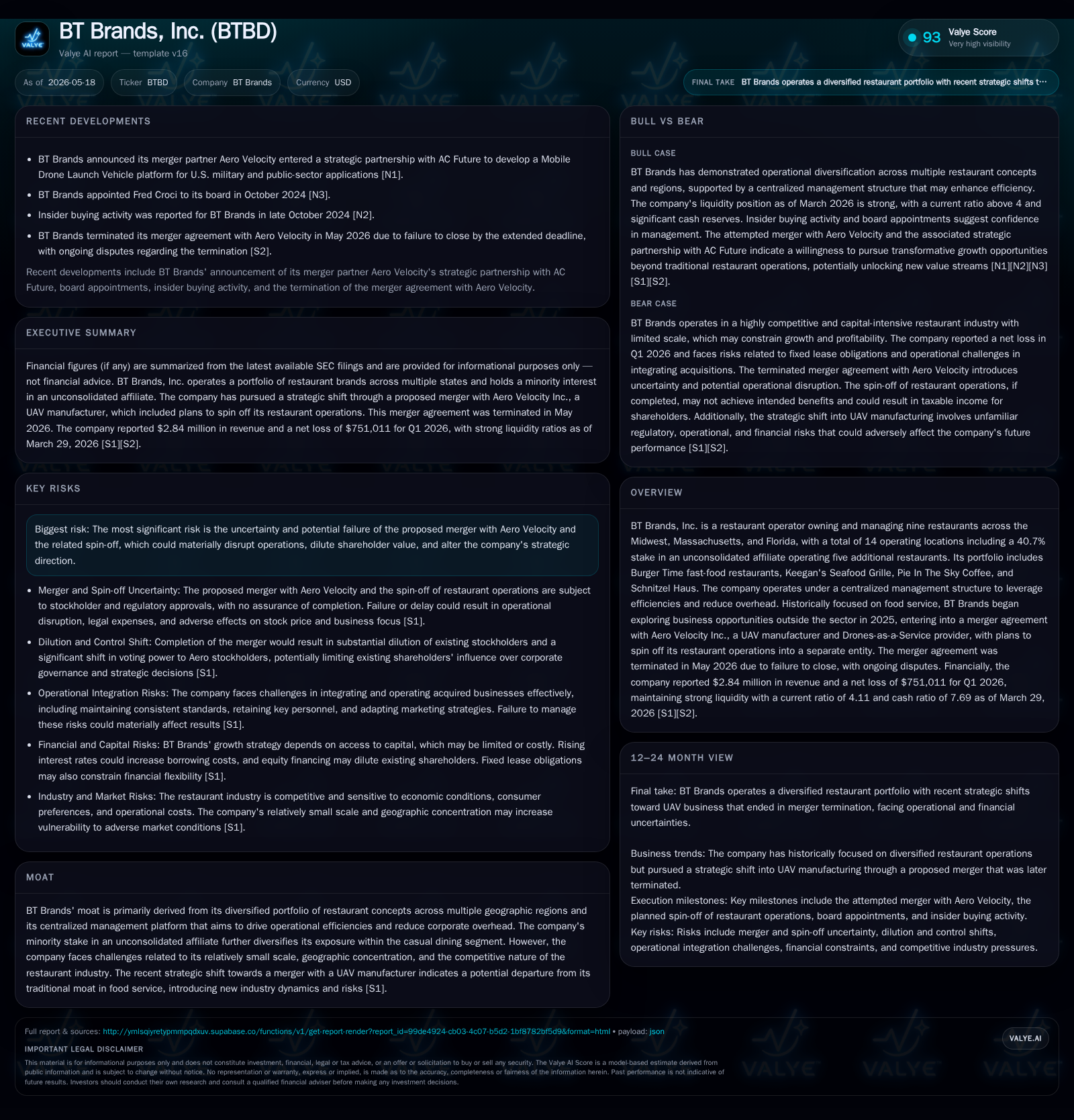
BT Brands, Inc. officially terminated its planned merger with Aero Velocity Inc. as announced in early May 2026, abandoning its strategy to pivot into the UAV sector. This development places renewed emphasis on the company’s existing portfolio of nine company-operated restaurants and minority stakes in additional locations spread across the Midwest, Massachusetts, and Florida. While central management efficiencies remain a strength, BT Brands now faces intensified pressure to stabilize its food service operations without the anticipated capital or growth from the failed transaction. Competitive pressures persist alongside risks stemming from legal disputes and geographic concentration. Financially, BT Brands maintains healthy liquidity and a positive net cash position, but ongoing operating losses underscore turnaround challenges ahead.
Latest Quarterly Developments: Merger Termination and Operating Updates
In May 2026, BT Brands formally terminated its previously announced merger agreement with Aero Velocity Inc., a private UAV manufacturer and Drones-as-a-Service provider [S3]. The termination notice was delivered on May 1, 2026 pursuant to contractual provisions linked to delayed SEC registration statement effectiveness and the failure to close the transaction by the extended deadline of April 30, 2026. The company reports no material termination fees or penalties are payable [S3]. This event marks an abrupt halt to BT Brands’ strategic departure from food service towards aerospace technology services and dissolves plans to spin off its restaurant operations into a separate public entity. The management dispute following termination adds uncertainty around any residual transaction-related costs or distractions [S3].
BT Brands’ Restaurant Portfolio: Diverse Concepts Under Centralized Management
BT Brands remains fundamentally a multi-concept regional restaurant operator. As of late 2025, it owns and operates nine full-time restaurants spanning fast-food (six Burger Time locations primarily in North Central U.S.), casual dining (Keegan’s Seafood Grille in Florida), coffee/bakery (Pie In The Sky Coffee in Massachusetts), and fine dining (Schnitzel Haus in Florida) [S1]. In addition to these directly controlled units, it holds a significant minority stake (40.7%) in Bagger Dave’s Burger Tavern, an unconsolidated affiliate managing five casual-dining outlets across Michigan, Ohio, and Indiana [S1]. Some locations have been shuttered recently — notably three Burger Time sites closed between 2024-2025 — signaling portfolio pruning or underperformance issues.
The company operates under a centralized management structure designed to leverage shared overhead functions, improve cost efficiency across varied formats, and streamline decision-making. This approach attempts to deliver scale advantages despite an overall relatively small footprint compared with national chains or larger regional operators [S1]. However, geographic concentration largely in Midwestern states plus select East Coast markets leaves BT Brands exposed to localized economic shifts.
Competitive Position and Industry Challenges in Regional Restaurant Market
BT Brands occupies a niche within regional multi-brand operators competing amid a highly fragmented U.S. casual dining and fast-food landscape. Its moat is modest—anchored by diversified concepts that appeal across customer segments ranging from quick-service burger clientele to niche fine dining focused on German fare—but limited scale reduces leverage over supply chain costs and marketing reach.
Price competition remains fierce as national chains continue aggressive promotions while inflationary pressures squeeze margins at unit-level operations. The company faces typical industry headwinds such as rising labor costs, commodity price volatility, shifting consumer preferences toward convenience or health-conscious options, as well as digital ordering infrastructure investments.
Centralized management could mitigate some overhead burden; however, sustaining competitive relevance requires continuous investment in brand innovation and consistent same-store sales growth — areas where BT Brands has yet to demonstrate clear momentum given recent closures [S1]
Strategic Shifts: Attempted Merger with Aero Velocity and Its Fallout
The September 2025 announced merger with Aero Velocity represented a bold bid for transformative change beyond food service into ancillary technology markets centered on unmanned systems for commercial and military applications [S1][N1]. The intended structure involved spinning off BT’s restaurant assets into a standalone entity (BT Group) while leveraging Aero’s product development pipeline.
The deal faced multiple closing hurdles including regulatory reviews and SEC clearance delays that ultimately prevented registration statements from becoming effective within contractual timelines; this led BT Brands to exercise termination rights in early May 2026 despite opposition claims from Aero [S3][S11]
With the transaction abandoned indefinitely amid ongoing disputes about termination validity, BT Brands must now reconcile legacy expenses related to merger planning along with investor uncertainty about its strategic vision post-failure. Shareholder dilution risks tied to issuance of preferred stock under the merger terms are now irrelevant but previous capital market anticipation may have pressured valuation earlier.
Growth Prospects: Resilience Amid Strategic Headwinds
Absent external diversification through mergers or acquisitions outside food service, BT Brands must rely on organic growth levers including driving same-store sales uplift across core brands. Key growth drivers potentially include expanding takeout/delivery channels especially for fast-food units; improving menu innovation tailored regionally; optimizing labor scheduling; and enhancing marketing effectiveness via loyalty programs or digital engagement.
The centralized management platform affords some facility for cost controls that could improve margins if volume stability returns. Brand awareness campaigns focused on differentiated concepts such as Pie In The Sky Coffee's bakery specialty or Schnitzel Haus’s themed experience could stimulate customer retention.
However, no new external expansion initiatives were disclosed post-merger collapse limiting near-term growth paths primarily to executional improvements within existing operations.
Risks and Constraints: Impact of Failed Merger and Industry Competitiveness
BT Brands confronts multiple risk vectors intensified by its aborted merger. Operational disruption tied to uncertainty among employees or partners during the pending deal could have residual effects on morale or supplier relationships despite deal failure clearance [S1][S3]. Litigation connected with lease disputes at historically closed venues poses potential unforeseen liabilities.[S1]
Industry-wise, geographic concentration leaves BT vulnerable to local economic downturns or demographic shifts adversely impacting traffic patterns at its outlets. The competitive intensity among regional casual dining chains alongside national fast-food giants constrains pricing power. Also notable is limited scale restricting purchasing leverage over food costs which are increasingly volatile.
Strategically, failure to pivot away from declining segments or secure alternative ventures may inhibit long-term shareholder value creation absent marked improvements in core business profitability.
Key Upcoming Corporate Milestones and Execution Indicators
Market participants should prioritize monitoring subsequent quarterly filings throughout 2026 for updates around:
- Management's articulation of renewed strategic initiatives focused wholly on restaurant operations post-merger cancellation [S2].
- Metrics evidencing same-store sales trends across major brands versus prior quarters showing unit closures.
- Any disclosures regarding resolution progress in litigation matters that could strain cash flow.
- Potential announcements identifying new growth opportunities whether through local partnerships or incremental acquisitions within food service segments.
- Investor communications clarifying capital allocation priorities given currently strong liquidity alongside operating losses.
Such milestones will provide clarity on how effectively management navigates stabilization after high-profile strategic setbacks.
Financial Health Overview: Liquidity and Capital Structure Snapshot
As of March 29, 2026, BT Brands reported total debt of approximately $2.07 million against current assets near $5.24 million yielding a robust current ratio of roughly 4.11—indicating solid short-term liquidity buffers [F1][S2]. Meanwhile net debt approximates negative $5.09 million reflecting meaningful cash offsets relative to outstanding borrowings [F1]. This capital structure provides financial flexibility amidst ongoing challenges.
Nevertheless operating income remained negative as of latest interim periods highlighting persistent profitability hurdles typical for small-scale multi-concept restaurateurs dealing with margin compression inherent in highly competitive markets [F1]. Maintaining this runway will depend heavily on executing cost controls without sacrificing top-line momentum needed for sustainable turnaround.
This analysis integrates information available as of mid-May 2026 primarily drawn from SEC filings including the latest quarterly report (10-Q), recent event reports (8-K), annual disclosures (10-K), supplemented by public news sources. Readers should consider that emerging developments beyond this timeframe may influence BT Brands’ operational trajectory significantly.
Financial position in context
As of 2026-03-29, companyfacts shows $2mm of total debt [F1]. Companyfacts also indicates net debt of roughly $-5mm for the latest available period [F1]. Current assets of $5mm and current liabilities of $1273857 imply a current ratio near 4.11x for 2026-03-29 [F1].
Disclaimer: This is research-only, informational analysis and not investment advice. It may include AI-generated interpretation and general industry context. Always verify important details using primary sources.

Comments