
Grayscale Bitcoin Mini Trust ETF's Volatile Trajectory and Strategic Outlook
Examining how Bitcoin’s price swings and evolving regulatory landscapes shape Grayscale Bitcoin Mini Trust ETF’s financial performance and strategic path.
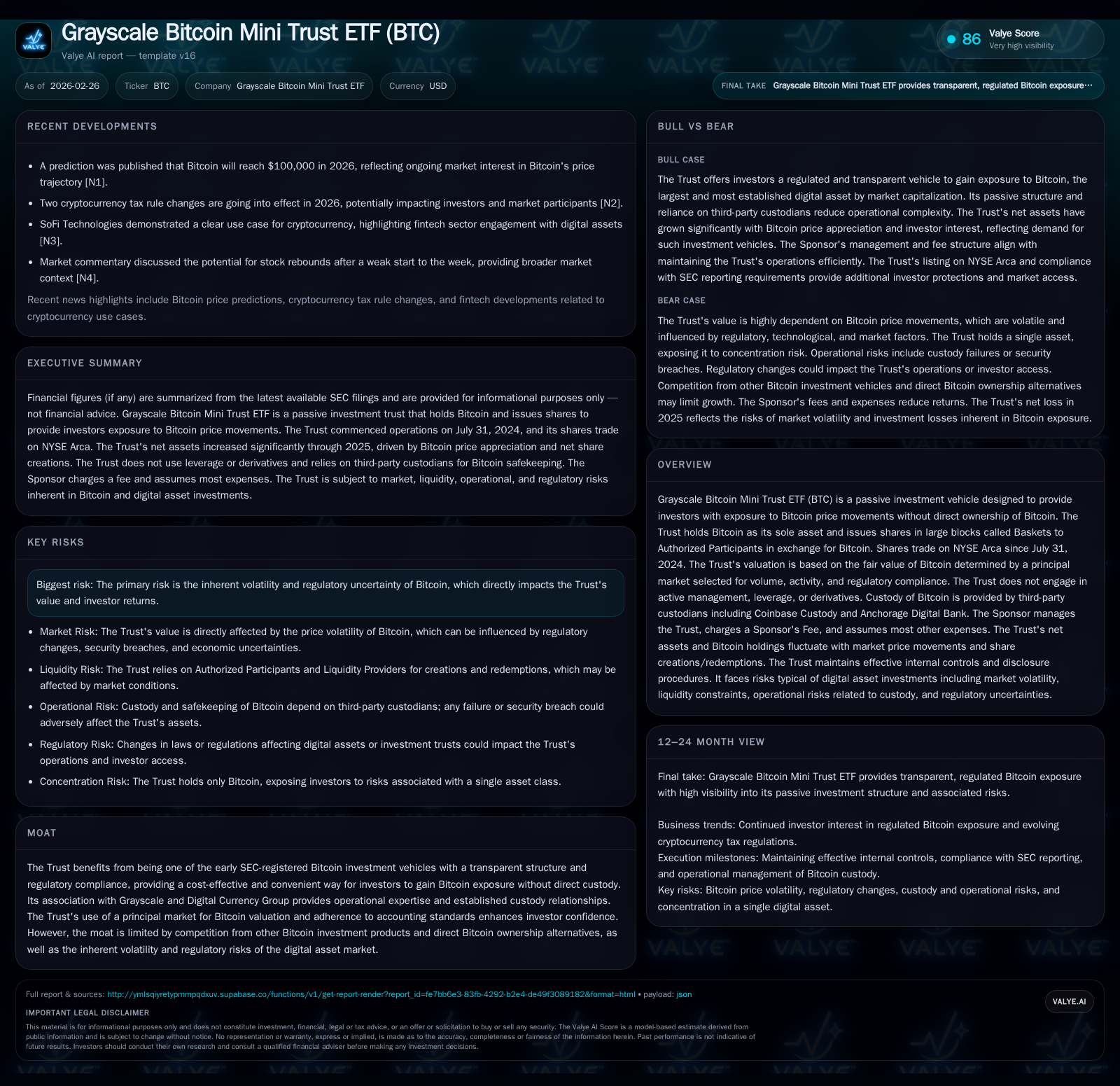
Since commencing trading in mid-2024, the Grayscale Bitcoin Mini Trust ETF (BTC) has mirrored Bitcoin’s volatile price movements, showing a dramatic swing from a positive net income of $978 million in 2024 to a negative $437 million in 2025. The Trust operates as a passive vehicle without leverage or derivatives, with its value highly sensitive to Bitcoin’s market dynamics. Regulatory developments at both U.S. and international levels impose ongoing compliance demands that could influence growth trajectories. The Trust relies on an Authorized Participant framework for share creation and redemption, with fees steadily eroding NAV per share over time, and lacks dividend or buyback programs. Going forward, investor attention will focus on regulatory clarity, arbitrage efficiency, and market liquidity as key determinants of operational stability and growth prospects.
Historical Performance Amid Bitcoin Price Swings
The Grayscale Bitcoin Mini Trust ETF launched on July 31, 2024, offering investors passive exposure to Bitcoin without direct ownership of the cryptocurrency [S1]. Its net income exhibited extreme volatility reflective of Bitcoin's price fluctuations: a robust $978 million profit for fiscal year 2024 sharply reversed to a net loss of $437 million in 2025, representing a -144.7% year-over-year change [F1]. Operating cash flow also declined significantly from -$816 million in 2024 to -$1.12 billion in 2025 (-37.2% YoY), underscoring the impact of Bitcoin market dynamics rather than active management decisions.
These figures highlight the fundamental business model whereby the Trust's valuation correlates directly with Bitcoin prices measured by an Index Price derived from principal trading venues selected based on volume, activity, and regulatory compliance standards [S1][S2]. Throughout this period, the Trust's NAV per share tracked this index closely but was adjusted downward by accrued expenses deducted as fractional Bitcoin per share over time.
Historical performance (annual)
| FY | Net ($mm) | CFO ($mm) | Net YoY |
|---|---|---|---|
| 2025 | -437 | -1119 | -144.7% |
| 2024 | 978 | -816 |
Source: SEC companyfacts cache [F1].
This volatility underlines the passive vehicle nature—without leverage or derivatives—that exposes investors directly to the digital asset's price trends with limited scope for managed risk mitigation.
Regulatory Environment and Its Impact on Growth Potential
Regulatory scrutiny remains one of the largest external risk factors for BTC’s growth trajectory. The Trust adheres to comprehensive AML (anti-money laundering) and KYC (know-your-customer) requirements for its Authorized Participants who must be registered broker-dealers following strict due diligence protocols including OFAC sanctions screening [S5]. These layers reflect tighter FinCEN guidelines around convertible virtual currency mixing and reporting mandates stemming from increased law enforcement focus following high-profile prosecutions such as those involving Tornado Cash developers [S4].
Digital asset markets continue facing pressure from regulators across federal agencies (SEC, DOJ, CFTC) aiming to increase transparency and consumer protections [S6]. These may result in heightened costs and licensing hurdles for participants that affect the Trust indirectly via its counterparties and custodians. International regulations like EU’s MiCA impose additional compliance burdens globally [S8].
Such evolving frameworks could either dampen expansion by restricting operational flexibility or enhance legitimacy if they encourage institutional adoption through clearer guardrails.
Structural Mechanics of Share Creation and Redemption
Central to the Trust's mechanism is the creation/redemption process involving "Baskets" of exactly 10,000 shares exchanged exclusively with Authorized Participants [S1]. Each Basket corresponds to a specific fractional amount of Bitcoin based on daily NAV calculations made at 4:00 p.m. New York time using an Index Price aggregated from major trading platforms subject to rigorous volume/activity thresholds [S1][S2][S7]. This ensures fair valuation reflecting real-time market conditions.
Creation/redemption orders settle on T+1 or T+2 basis contingent upon trade date agreements with settlement involving actual delivery or receipt of whole and fractional Bitcoins associated with each Basket’s underlying asset value [S1]. This process enables efficient market-making arbitrage opportunities mitigating premium/discount deviations between secondary market share prices and underlying net asset values.
The Sponsor reserves rights to adjust Basket sizes or implement share splits/reverse splits to maintain desirable trading ranges facilitating liquidity [S1], though no such changes have materialized through early 2026.
Financial Results: Earnings and Cash Flow Volatility
BTC’s financial results fluctuate almost entirely due to shifts in Bitcoin prices rather than internal investment decisions or operating leverage effects. Net income swung dramatically from $978 million gain in FY24 to a loss of $437 million in FY25 while negative operating cash flows deepened accordingly [F1].
The absence of leverage or derivative positions means that cash generation is tied primarily to Sponsor fee collections offset by operational expenses paid partially through depletion of custodial asset balances [S2]. This results in gradual attrition of NAV per share as fees accrue over time against an inherently volatile asset base.
Although cash outflows rose by more than a third YoY into 2025 (-$1.12 billion), these are consistent with ongoing costs relative to asset size rather than aggressive investment strategies or financing activities.
Capital Allocation, Fees, and Return Metrics
The Sponsor collects fees calculated as an annualized percentage deducted daily from the Trust’s holdings, which effectively reduces each Share’s attributable fraction of Bitcoin over time [S1][S2]. Despite this attrition mechanism being transparent and predictable, it does not contribute directly towards investor returns other than supporting administrative operations.
Currently, there is no dividend distribution or share buyback program designed to return capital; instead, shareholders may redeem Shares back into Baskets via Authorized Participants thereby recovering proportional underlying Bitcoins less accrued expenses [S1]. Traditional return metrics such as ROE are not applicable given the trust structure holding passively managed crypto assets without equity-like operations.
This capital allocation approach aligns with peer digital asset trusts but limits direct yield generation and relies heavily on favorable market appreciation for total return.
Outlook: Market Drivers and Operational Constraints
Looking ahead into 2026, multiple factors interplay shaping BTC’s prospects. Notably, Nasdaq projects Bitcoin's price could reach $100,000 within the year under certain growth scenarios propelled by increased adoption among retail and institutional users [N1]. Concurrently, new tax rule adjustments effective January 2026 regarding cryptocurrency transactions introduce complexity across reporting regimes but could improve regulatory clarity long term [N2].
Operationally, stable relations with key custodians such as Coinbase Custody and Anchorage Digital Bank remain critical given the complexity involved in asset safeguarding during transfers or sponsor-driven changes—any disruptions here could negatively impact investor confidence [S13].
On balance, growth depends heavily on maintaining alignment between compliant market participation frameworks while navigating regulatory evolutions including potential legislation around crypto custody licenses and anti-money laundering enforcement intensification [S4][S5][S6].
What to Watch: Indicators for Future Milestones
Investors should closely monitor several indicators relevant for BTC’s trajectory:
- Sponsor announcements regarding any Basket size modifications or share split/reverse split actions aimed at improving secondary market liquidity [S1]
- Regulatory developments especially AML/KYC mandates affecting Authorized Participants or potential new SEC rulings defining digital asset securities classification status of Bitcoin or related instruments [S17][S18]
- Legal proceedings involving Digitial Currency Group affiliates which might create reputational spillovers influencing Share liquidity or pricing dynamics [S15]
- Efficiency metrics around arbitrage effectiveness between Basket NAVs versus secondary market prices that signal whether authorized participants are successfully mediating premium/discount gaps
- Stability assessments of custodian ecosystems ensuring secured storage amidst increasing cyber threat landscapes
Overall, while BTC benefits from first-mover advantages as one of the earliest SEC-registered passive Bitcoin investment vehicles coupled with robust operational governance supported by Grayscale Investments' expertise, it confronts potent headwinds tied chiefly to volatile crypto markets plus evolving but uncertain regulatory frameworks that frame its strategic outlook through mid-decade.
This analysis incorporates publicly available financial disclosures up to February 25, 2026 ([F1], [S#]) alongside relevant news insights ([N#]). It aims solely to provide detailed company-specific context without offering investment recommendations.
Disclaimer: This is research-only, informational analysis and not investment advice. It may include AI-generated interpretation and general industry context. Always verify important details using primary sources.

Comments