
BTCS Inc. Consolidates Ethereum Leadership Through Validator and DeFi Integration
BTCS's latest quarterly report reveals operational progress and capital strategy risks amid its focused Ethereum ecosystem expansion.
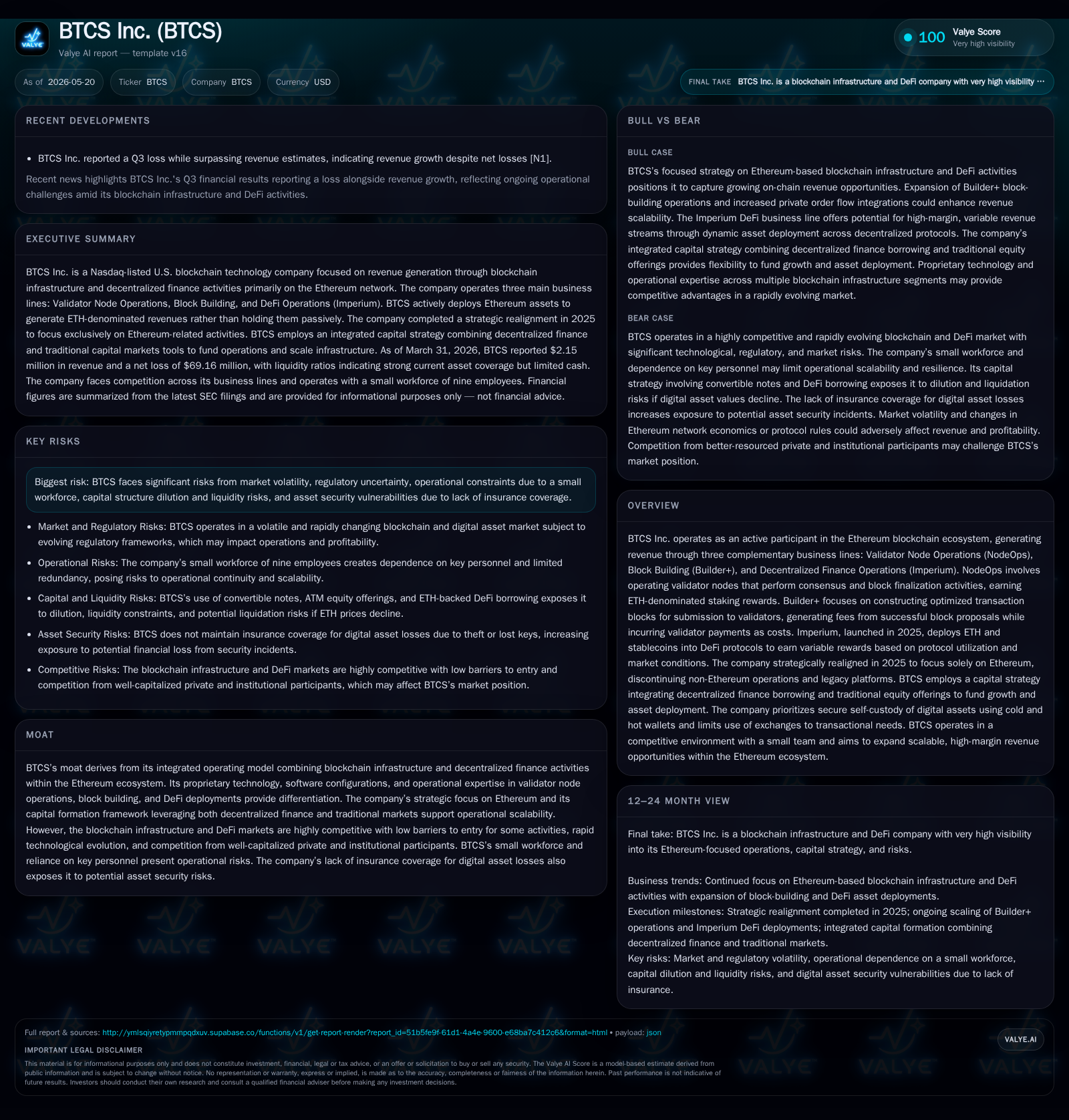
In its 2026 first quarter filing, BTCS Inc. detailed advances in its Ethereum-centric business lines: Validator Node Operations, Block Building, and decentralized finance via Imperium. The company’s strategic pivot to focus exclusively on Ethereum infrastructure, combined with a flexible capital formation approach that integrates DeFi borrowing and traditional equity issuance, underscores a prioritization of scalable revenue growth while exposing it to financing risks such as potential Form S-3 eligibility loss. BTCS’s integrated model merges blockchain infrastructure with DeFi liquidity deployment, positioning it uniquely in a competitive, rapidly evolving sector characterized by volatile digital asset prices and regulatory uncertainty.
Recent Operating Highlights and Strategic Update
BTCS Inc.’s latest quarterly report filed on May 14, 2026 [S2] offers the freshest insight into its operational trajectory. The company continues to expand its core infrastructure via Validator Node Operations (NodeOps) and its proprietary block-building platform (Builder+), solidifying revenue sources denominated in ETH staking rewards and transaction fees. Builder+ notably benefits from enhanced private order flow integrations which improve fee generation efficiency. Additionally, the Imperium business line, which launched in 2025 targeting decentralized finance (DeFi) ecosystems by deploying ETH and stablecoins into lending and liquidity protocols, shows signs of growing contribution.
However, the filing also flags critical capital strategy challenges related to the company's loan agreements that could impair BTCS's eligibility to use the streamlined Form S-3 registration statement for future equity offerings. Losing this eligibility would obstruct efficient public market access for capital raising or implementing share repurchase programs [S2]. This constitutes a material limitation on financing flexibility that investors should watch closely as execution on growth opportunities depends heavily on cost-effective capital access.
Integrated Business Model Centered on Ethereum Ecosystem
BTCS operates three synergistic revenue-generating segments primarily focused on the Ethereum network [S1]. Validator Node Operations generate ETH-denominated staking rewards by running validators that perform consensus validation and propose blocks. These rewards are protocol-defined but also subject to network conditions.
Builder+ contributes via constructing optimized transaction blocks leveraging private order flow; it earns fees from successful block proposals but pays validators directly in digital assets to secure block inclusion — these "Validator Payments" represent substantial non-cash costs and require sophisticated fee market management. Imperium extends BTCS’s operational footprint into DeFi by actively deploying ETH-backed liquidity into smart-contract financial protocols that dynamically yield revenues based on usage rates and market conditions.
ETH holdings are treated not as idle investments but as operational assets fueling all three business lines. This integrated design allows BTCS to capture economic value at multiple points along Ethereum’s transaction execution value chain: from consensus validation through block proposal to flexible capital deployment in financial applications.
Competitive Positioning in Blockchain Infrastructure and DeFi
BTCS competes within highly fragmented blockchain infrastructure markets featuring low barriers to entry for certain segments such as block building but requiring robust technology platforms to sustain consistent profitability [S4]. Validator node operations face competitors ranging from independent operators to institutional entities; performance reliability and security underpin competitive advantage since staking rewards are largely protocol-standardized.
In block building (Builder+), competition intensifies around software execution speed, transaction flow access (including MEV relay ecosystem participation), latency minimization, and yield optimization strategies. The fast-evolving nature of transaction execution markets drives frequent shifts in competitive positions.
On the DeFi front via Imperium, competition includes individual liquidity providers, trading firms, funds, and other infrastructure companies deploying assets across open permissionless protocols — resulting in compressed returns necessitating skilled risk management and tactical asset allocation.
While many competitors are privately held thus less constrained by public company regulatory demands [S18], BTCS aims to differentiate through its combined infrastructure-DeFi operating model bolstered by proprietary technology stacks, agile capital deployment strategies combining TradFi and DeFi elements (the "DeFi/TradFi flywheel"), and disciplined operational execution.
Revenue Drivers: Node Operations, Block Building, and Imperium DeFi Ventures
NodeOps revenues depend primarily on the number of active validator nodes operated successfully on the Ethereum network multiplied by prevailing ETH staking yields — effectively representing recurring protocol-determined income streams modulated by uptime efficacy and network inflation parameters [S1]
Builder+ revenue arises from fees captured when BTCS’s constructed blocks are accepted onto the chain; fee size depends on transaction volume within blocks, auction price dynamics in proposer-builder separation (PBS) mechanisms, composition of included transactions (MEV extraction potential), minus Validator Payments made as part of securing block proposals [S1,S4]. Operational efficiency improvements that reduce latency or increase private order flow integrations can lift incremental yields.
Imperium’s returns vary with deployed digital asset volumes across lending or liquidity protocols balanced against utilization rates of those protocols; interest rates fluctuate dynamically responding to supply-demand conditions within decentralized markets [S1]. Imperium essentially complements traditional staking returns by enabling more flexible capital allocation allowing BTCS to shift deployments toward higher-yielding or lower-risk opportunities promptly.
Growth Drivers: Capital Efficiency and Network Participation
BTCS's expansion prospects lie in scaling foundational infrastructure while optimizing capital deployment within dynamic network environments [S5]. Builder+'s growth potential hinges on adding further private order flow partnerships—such flows offer higher-value transactions that can meaningfully enhance fee capture beyond public mempool opportunities.
Validator node operation capacity is naturally capped by minimum staking requirements per node (32 ETH) but can be incrementally expanded through accretive deployments responsive to protocol condition forecasts. BTCS continuously evaluates validator scaling balanced against capital costs under volatile ETH pricing.
Imperium represents a pivotal growth vector where deploying ETH collateralized borrowing within DeFi allows BTCS to fund operations while recycling digital assets efficiently [S5]. This "flywheel" effect—using TradFi equity raises alongside decentralized borrowing—facilitates agile scaling subject to careful liquidation risk management due to price volatility applicable to ETH collateral
Network-level factors including upcoming Ethereum protocol upgrades or changes impacting validator economics or block building rules constitute structural considerations influencing capacity planning.
Risks and Operational Constraints
Several risk dimensions temper BTCS’s growth story [S1,S2,S9]:
- Regulatory Uncertainty: Given ongoing scrutiny by SEC, CFTC, and other authorities over digital asset activities—including staking services, block building transactions subject to exotic rules (PBS/MEV), and DeFi lending—legal interpretations may require operational adaptations or curtailments.
- ETH Price Volatility: Revenues denominated in ETH expose BTCS both directly through staking rewards value fluctuation and indirectly through collateral valuation risks triggering forced liquidations within Imperium’s borrowing positions.
- Small Workforce: Operating with only nine full-time employees constrains redundancy across critical functions such as cybersecurity monitoring or operational contingency planning; reliance on key personnel amplifies human capital risk [S18].
- Digital Asset Security: While cold storage wallets reduce third-party custody exposure risks, absence of insurance against theft or loss leaves the Company materially vulnerable if wallet keys are compromised [S14].
- Capital Market Access: Potential loss of Form S-3 eligibility following any default under loan covenants threatens flexible equity issuance capability; this risk impacts ongoing funding ability for operations or strategic initiatives [S2].
- Competitive Pressures: Rapid technological evolution among competitors with varied capitalization levels requires continual investment in proprietary technology stacks lest margins compress further.
Key Upcoming Milestones and Market Signals
Investors should monitor several near-term developments that will illuminate BTCS's operating momentum:
- Confirmation of sustained eligibility for simplified securities offerings under Form S-3 will signal continued capital access ease versus more onerous registration processes that delay funding agility [S2].
- Quarterly disclosures shedding light on net validator nodes deployed or average effective staking yields provide direct proxies for NodeOps scaling success.
- Progress reports around Builder+ private order flow integration volumes or block proposal success rate metrics will clarify growth trajectory in high-margin block-building activities.
- Expansion metrics for Imperium’s total value deployed in DeFi protocols alongside realized ROI percentages will help gauge returns consistency amid market fluctuations.
- Regulatory guidance outcomes impacting Ethereum staking or DeFi borrowing frameworks would materially affect operating feasibility assumptions embedded in BTCS’s model.
Concise Financial Profile Reflecting Trajectory and Liquidity
As of March 31, 2026, BTCS held $284k in cash equivalents with total current assets approximating $128 million against $44 million current liabilities yielding a healthy current ratio near 2.9x [F1]. Total debt stands modestly at roughly $200k last reported mid-2019 levels relative to cash liquidity implying net cash positive leverage albeit this older debt figure should be carefully contextualized given probable subsequent refinancings or unreported short-term borrowings [F1].
Financial results continue challenged by volatile ETH market pricing which impacts net income negatively; net loss reported exceeded $33 million as of year-end 2025 reflecting operating investments aligned with strategic repositioning rather than immediate profitability targets [F1]. Management commentary highlights need for scaled revenue realization across NodeOps, Builder+, and Imperium streams alongside prudent liquidity management tied closely to successful ongoing capital raises integrating both traditional equity channels and decentralized finance borrowing facilities [S2,S5].
This analysis synthesizes recent regulatory filings up to May 2026 along with sector context relevant for understanding BTCS Inc.’s evolving Ethereum-focused blockchain infrastructure business without offering investment advice. All financial specifics derive strictly from cited public disclosures respecting Valye News compliance guidelines.
Disclaimer: This is research-only, informational analysis and not investment advice. It may include AI-generated interpretation and general industry context. Always verify important details using primary sources.

Comments