
Burford Capital's Revenue and Cash Flow Retreat Amid Portfolio Duration and Market Dynamics
Burford Capital Ltd experienced significant revenue and cash flow declines in 2025 due to portfolio timing effects, while maintaining strategic capital allocation amidst evolving legal finance regulations.
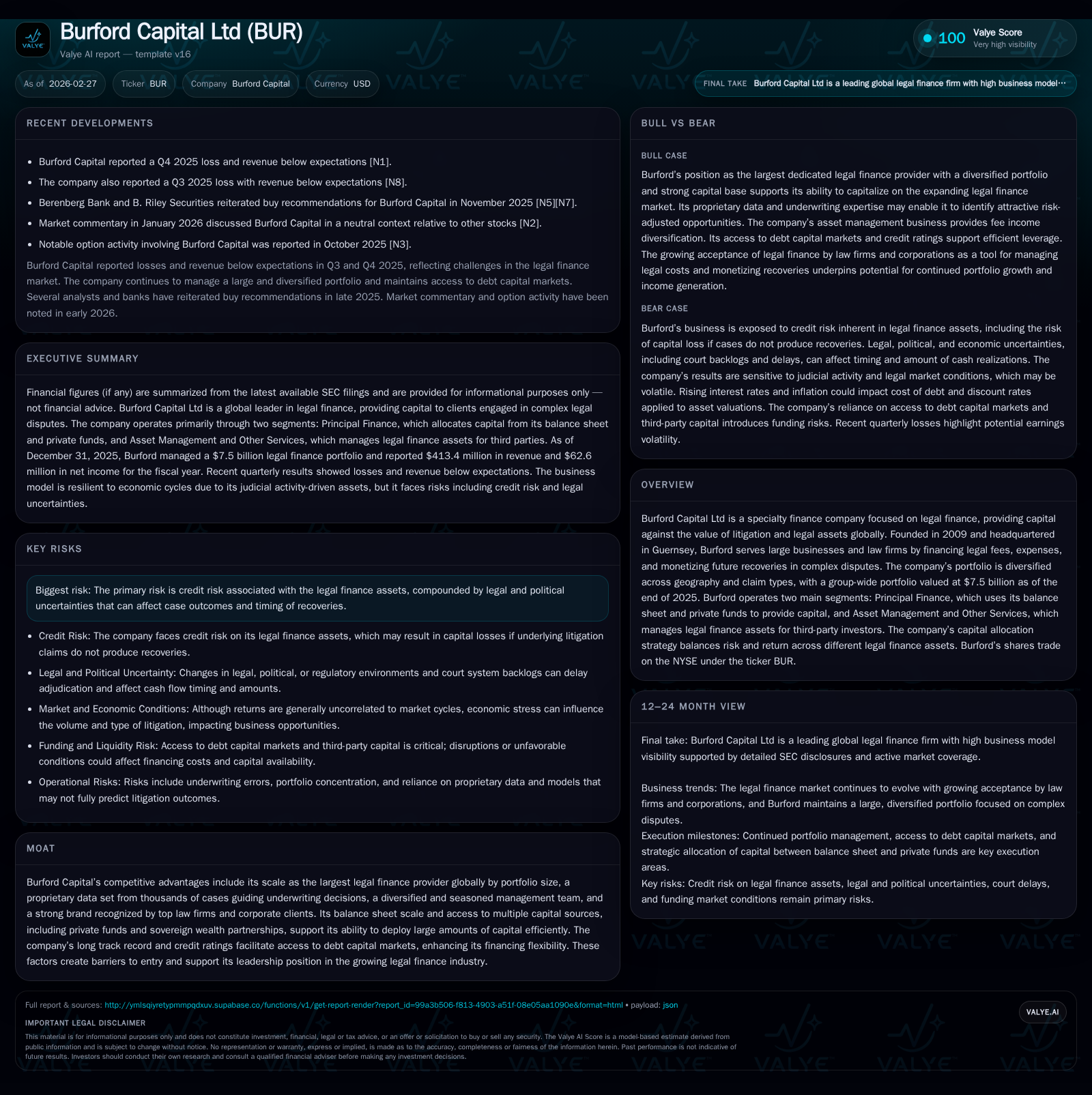
Burford Capital, the world’s largest legal finance firm by portfolio size, recorded a notable 24% decline in revenue and a 57% drop in net income for FY2025 compared to the prior year. These setbacks largely reflect prolonged litigation case durations which lowered realized returns despite solid operating income margins. The company balances risk through diversified portfolios segmented into Principal Finance and Asset Management, though economic factors like market volatility and regulatory uncertainty continue to shape opportunity pipelines. Burford’s liquidity remains robust with moderate leverage and ongoing access to debt markets, but operating cash flow turned negative, signaling potential near-term pressures on free cash generation.
Overview
Burford Capital Ltd is a specialty finance firm headquartered in Guernsey that provides capital against the value of legal disputes globally. Founded in 2009, it has grown to become the largest legal finance provider by portfolio size—$7.5 billion as of December 31, 2025—and services large corporations and law firms requiring funding for complex disputes.
The business operates principally through two segments: Principal Finance, utilizing Burford's own balance sheet alongside minority stakes in private funds, and Asset Management plus Other Services that manage legal finance portfolios on behalf of third-party investors.
Historical Performance
Fiscal year 2025 marked a challenging year operationally and financially for Burford. Revenues declined to $413 million from $546 million the prior year—a substantial 24% drop. Operating income also fell sharply by over 40% to $232 million. Most pronounced was the net income decline of about 57% to $62.6 million, highlighting pressure on bottom-line profitability.
Operating cash flow swung negative $29 million after two years of positive or improving trends, reflecting possible timing mismatches in legal asset recoveries or elevated reinvestments into ongoing financing commitments.[F1][S1]
Historical performance (annual)
| FY | Rev ($mm) | Net ($mm) | CFO ($mm) | OpInc ($mm) | Rev YoY | Net YoY |
|---|---|---|---|---|---|---|
| 2025 | 413 | 63 | -29 | 232 | -24.3% | -57.3% |
| 2024 | 546 | 146 | 217 | 391 | -49.8% | -76.0% |
| 2023 | 1087 | 611 | -275 | 816 | +240.5% | +1901.3% |
| 2022 | 319 | 31 | -466 | 195 |
Source: SEC companyfacts cache [F1].
Capital returns and efficiency (annual)
| FY | Div ($mm) | Buybacks ($mm) | FCF ($mm) |
|---|---|---|---|
| 2025 | 15 | -29 | |
| 2024 | 5 | 216 | |
| 2023 | 27 | 4 | -278 |
| 2022 | 28 | 4 | -467 |
Source: SEC companyfacts cache [F1].
The pronounced revenue contraction is attributed largely to extensions in litigation durations across key matters in their portfolio leading to deferment of case resolutions and related revenue recognition under US GAAP fair value accounting standards.[S1][N1]
Drivers Behind Past Growth
Since inception in 2009 when it raised $130 million of capital, Burford has exhibited rapid expansion driven by broadening market acceptance of litigation finance as an asset class. Its underwriting capability leverages a proprietary data set from thousands of cases enabling calibrated risk assessment. It has expanded relationships with nearly all top US and global law firms providing competitive barriers via scale, branding, data assets, and access to debt markets.[S1][S14]
Investment into higher-risk/higher-return cases through the balance sheet has been supplemented by managing multiple private funds catering to varied risk appetites including sovereign wealth fund partnerships.[S15]
Future Growth Prospects
Burford identifies growth opportunities aligned with macro developments such as increased corporate insolvencies, regulatory scrutiny intensifying securities fraud claims, and geopolitical tensions potentially leading to more complex international trade litigation.[S16] Economic downturns tend to increase dispute incidence but with latency as cases take time to develop.
Innovation via AI-powered underwriting tools aims to enhance selection precision. The company also explores expansion into complementary legal services beyond litigation financing offering potential incremental fee income streams.[S18]
However, growth is tempered by uncertainties around court system delays which compressed portfolio turnover during the pandemic aftermath.[S1] Additionally, regulatory risk remains salient—various jurisdictions are debating or enacting laws that may affect enforceability or disclosure requirements of legal finance arrangements.[S4][S11][S13]
Competition is intensifying as multi-strategy investors enter litigation financing arenas; yet Burford maintains leadership partly due to public listing transparency and scale advantages.[S14]
Forecasts / Milestones / Expectations
The company has not provided explicit formal revenue guidance for upcoming periods post-FY2025.[N1] Market observers should monitor quarterly updates focusing on portfolio realization timing changes, new capital deployment pace in Principal Finance segment, and asset management fee growth.
Key inflection points will include outcomes from regulatory reform efforts particularly in UK and US markets where legislative momentum could impose additional compliance costs or transactional constraints.[S5][S11]
Further debt issuances or refinancing actions expected given continuous capital needs for growth among legal finance providers.[S12]
Returns / Capital Allocation
Return on equity approximates a modest 2.6% for FY2025—a notable decline versus prior years considering the earnings contraction juxtaposed with stable equity base near $2.4 billion.[F1]
Free cash flow remains negative at around $29 million taking into account operating cash flow offset by minimal capex requirements related mainly to administrative IT investments.[F1]
Dividend payments were suspended in FY2025 as part of prudent capital conservation during volatile markets; however, a history of regular dividends exists through prior years alongside modest share buybacks totaling $15 million last year albeit below historical levels.
Leverage ratios remain conservative relative to bond covenant limits with net debt-to-tangible-assets at approximately 23%, supported by recent successful bond issuances extending maturities well beyond expected weighted average life of financed assets.[S12][S19]
Capital allocation prioritizes high-return assets on balance sheet with selective use of third-party funds covering lower risk/return profiles; discussions continue regarding sovereign wealth fund arrangement extensions which could unlock incremental capacity.[S15][S19]
Industry Dynamics & Risks
Legal finance is an evolving alternative asset class gaining traction but complicated by unpredictable litigation outcomes influenced by judicial discretion and client behavior—risks exacerbated by COVID-related court delays forcing timeline extensions or increased settlement prevalence.[S1][S22]
Regulatory regimes remain fragmented globally with resistance against harmonizing EU rules for third-party funding while UK efforts seek legislative amendments reversing adverse Supreme Court precedents affecting funding agreements’ enforceability.[S4][S5]
Competition from newly interested financial players raises origination cost pressures though Burford benefits from long-standing industry presence and market visibility.[S14]
Privileged information management is crucial both tactically for underwriting accuracy and legally for client confidentiality; breaches could materially harm litigant positions and investor confidence alike.[S6]
Macroeconomic trends such as rising insolvencies or trade-related disputes offer market-tailwinds but are counterbalanced by cost of borrowing fluctuations amid changing interest rates impacting asset discounting models.[S16]
Conclusion
Burford Capital stands as a pioneering leader within legal finance facing a transitional phase marked by slower realized returns due mostly to judicial process delays and portfolio aging rather than fundamental demand erosion. The firm’s comprehensive capital structure affords resilience but growing regulatory complexities necessitate vigilance.
Future performance will hinge on Burford’s execution against expanding opportunity sets while navigating heightened volatility around case adjudications and policy developments—underscoring the niche but inherently cyclical nature of legal finance investing.
This analysis synthesizes data through fiscal year end December 31, 2025 alongside disclosures up to February 2026 without making investment recommendations.
Disclaimer: This is research-only, informational analysis and not investment advice. It may include AI-generated interpretation and general industry context. Always verify important details using primary sources.

Comments