
Nuburu Navigates NYSE Compliance Amid Strategic Expansion in Blue Laser Defense Technology
Facing financial and listing challenges, Nuburu advances its defense-focused blue laser platform through targeted acquisitions and technology integration.
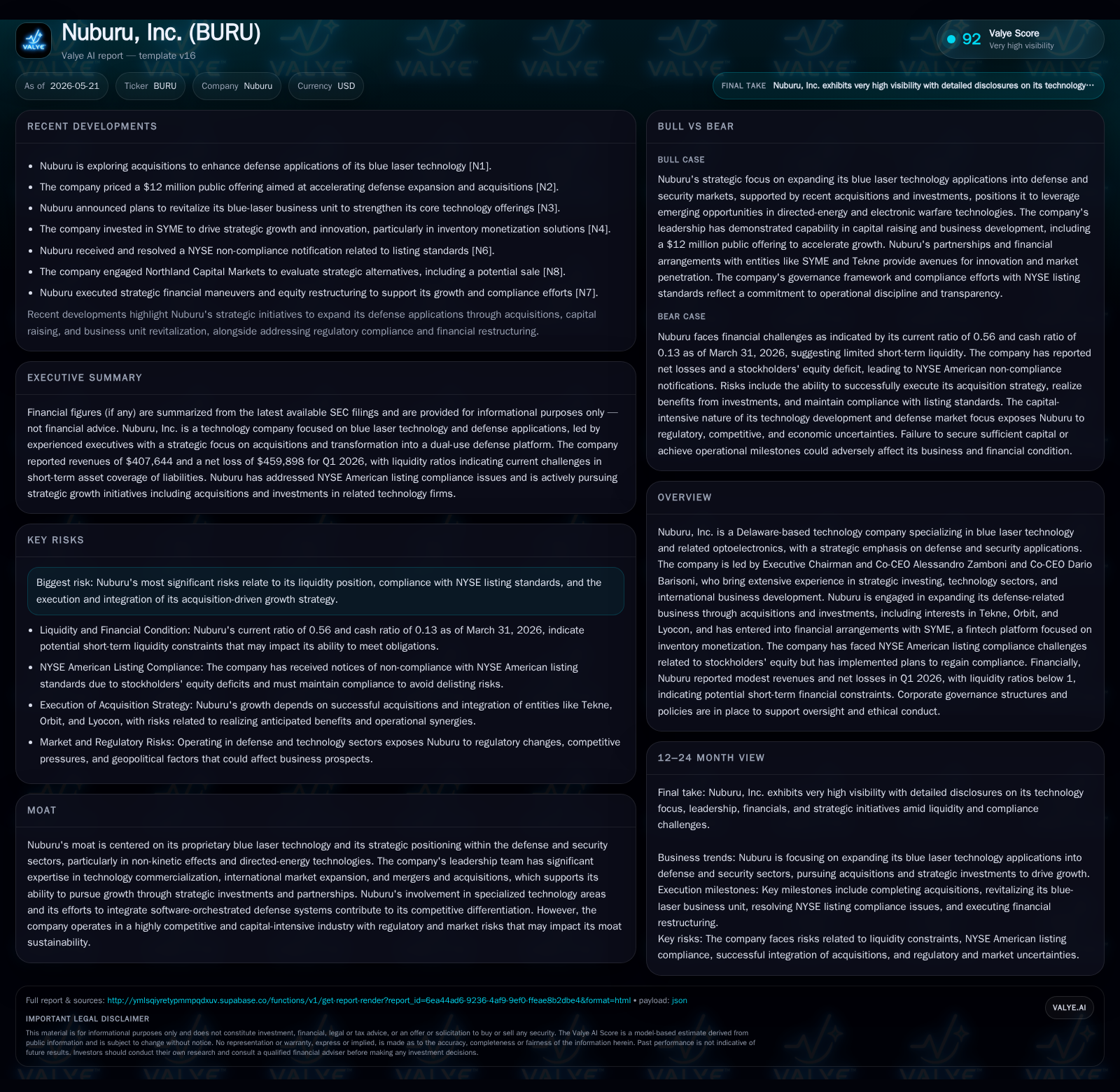
Nuburu's latest quarterly filing reveals ongoing operating losses, liquidity pressures, and a critical NYSE American noncompliance notice due to stockholders’ equity deficits. The company pursues growth by expanding its proprietary blue laser technology platform through acquisitions such as Tekne, Orbit, and Lyocon, aiming to strengthen its position in directed-energy and non-kinetic defense systems. While growth is driven by rising defense demand for advanced technologies, Nuburu faces significant risks from capital constraints, integration complexities, and regulatory hurdles.
Recent Quarterly Developments
Nuburu's May 20, 2026 10-Q filing highlights significant near-term financial challenges. The company reported no revenue during Q1 2026 while incurring substantial operating losses consistent with its developmental stage focused on advanced defense R&D rather than commercial sales [F1]. Cash and equivalents stood at about $8.3 million against current liabilities exceeding $63 million, yielding a current ratio of 0.56 that indicates working capital deficits potentially constraining operations without additional financing or operational improvements [F1][S2].
NYSE American has issued noncompliance notices citing a stockholders’ equity deficit surpassing $15 million as of December 31, 2025—a breach of listing standards requiring minimum equity thresholds given ongoing operating losses [S3][S24]. Nuburu is executing a compliance plan targeting restoration of listing eligibility by October 2026 through liability reduction and transformation initiatives.
Business Model and Technology Differentiation
At the heart of Nuburu's offering is its proprietary ultra-short wavelength blue laser technology that distinguishes itself from conventional fiber or infrared lasers prevalent in industrial or military segments. This innovation delivers higher power density and precision critical for directed-energy applications where engagement speed and effect range are decisive.
The primary customer base comprises defense entities procuring non-kinetic effects systems designed to disable or disrupt threats without traditional munitions. Pricing likely reflects government procurement norms involving complex customization, software licensing for integrated control systems, and long-term service agreements [S1]
Switching costs are elevated due to the technical complexity of blue laser manufacturing coupled with intellectual property protections and integration requirements within defense platforms. Additionally, software-orchestrated command-and-control integration enhances real-time targeting capabilities—a growing necessity in modern battlefield environments.
Industry Context and Competitive Positioning
Nuburu operates within a niche segment of directed energy technologies aimed at emerging defense applications characterized by heavy capital investment requirements and stringent regulatory oversight on dual-use technologies. Competitors typically deploy alternative laser wavelengths such as infrared or solid-state; however, Nuburu’s patented blue laser provides performance advantages in select mission profiles.
Supply chain challenges include sourcing specialized rare earth materials essential for diode manufacture alongside rigorous quality controls mandatory for military-grade reliability.
Unlike broad-spectrum aerospace-defense contractors focusing on mass production (e.g., Lockheed Martin or Raytheon), Nuburu maintains a leaner profile centered on technological innovation within high-barrier niches demanding sustained R&D investment.
Acquisition Strategy and Integration Risks
Nuburu has pursued inorganic growth through acquisitions including controlling interests in Tekne (dual-use drone components), Orbit (with planned equity infusion up to $5 million), and Lyocon to extend capabilities beyond laser sources into hardware assemblies and system integration domains [S1][S3][S10]
Partnerships with fintech platform SYME aim to facilitate inventory monetization as part of broader efforts to alleviate liquidity constraints [S1]
However, integrating multiple acquisitions across different geographies (e.g., Tekne’s Italian operations) introduces organizational complexity risks alongside the challenge of aligning diverse product lines under a unified strategic vision while managing working capital demands.
Successful realization of synergies remains essential to meeting financial stability targets amid NYSE compliance pressures.
Growth Drivers
Key growth factors include escalating global defense budgets prioritizing modernization with directed energy systems gaining traction due to advantages in asymmetric warfare scenarios.
Nuburu’s blue laser-based non-kinetic effectors offer utility across air defense countermeasures, electronic warfare support, and precision disabling of hostile sensors—capabilities increasingly sought amid geopolitical tensions favoring technological superiority without kinetic escalation [S1].
Advancement depends on securing government contracts validating scalability beyond prototype stages. Cross-selling opportunities across acquired businesses may enable comprehensive solutions addressing multiple threat vectors.
Continued patent development combined with software enhancements will be critical competitive differentiators as adoption progresses.
Risks and Watchpoints
Liquidity remains precarious given the disparity between cash reserves ($8.3 million) and current liabilities ($63.4 million) reported at quarter end—highlighting funding vulnerabilities absent new capital inflows [F1]
NYSE compliance risk persists due to stockholders’ equity deficits threatening delisting if corrective measures falter despite ongoing remediation efforts [S24].
Execution risk centers on effective integration of acquisitions like Tekne while achieving cost synergies under resource constraints.
Patent foreclosure threats pose significant competitive risks by potentially undermining core intellectual property assets.
Regulatory uncertainties related to export controls on dual-use directed energy systems add external pressure affecting production timelines and international market access.
Near-Term Milestones to Monitor
Investors should track developments regarding NYSE American’s evaluation of Nuburu’s compliance plan progress toward the October 2026 deadline [S24]
Updates on Orbit’s equity infusion implementation and Tekne’s restructuring—including acquisition or lease of manufacturing facilities—will provide insight into integration success [S10][S22].
Contract awards or demonstration program initiations within defense sectors would signal validation of technology scalability essential for revenue inflection.
Governance actions such as executive compensation adjustments may reflect management focus amid transformation efforts.
Financial Overview
As of March 31, 2026, Nuburu held approximately $8.3 million in cash against total debt near $40 million resulting in net debt around $31.5 million indicative of substantial leverage exposure [F1]. Operating income remains negative consistent with developmental-stage investment outpacing commercial revenue generation which remained nil up to year-end reporting dates [F1]. Current liabilities substantially exceed current assets underscoring short-term funding gaps consistent with disclosed liquidity pressures [F1].
While acquisition-related financing arrangements may provide episodic relief, they also highlight reliance on external capital markets vulnerable to macroeconomic fluctuations and company-specific risk perceptions common among emerging technology defense contractors.
This analysis is based on SEC filings through May 20, 2026 supplemented by sector context; it does not constitute investment advice.
Disclaimer: This is research-only, informational analysis and not investment advice. It may include AI-generated interpretation and general industry context. Always verify important details using primary sources.

Comments