
BrightView Holdings: Operational Scale Meets Margin Pressure as Weather and Liquidity Shape the Outlook
BrightView, the largest U.S. commercial landscaping provider, leverages national scale and essential service contracts but faces margin headwinds from weather volatility, cost variability, and a constrained cash position. The path forward hinges on execution of operational initiatives and the company’s ability to defend its market position in a fragmented, competitive industry.
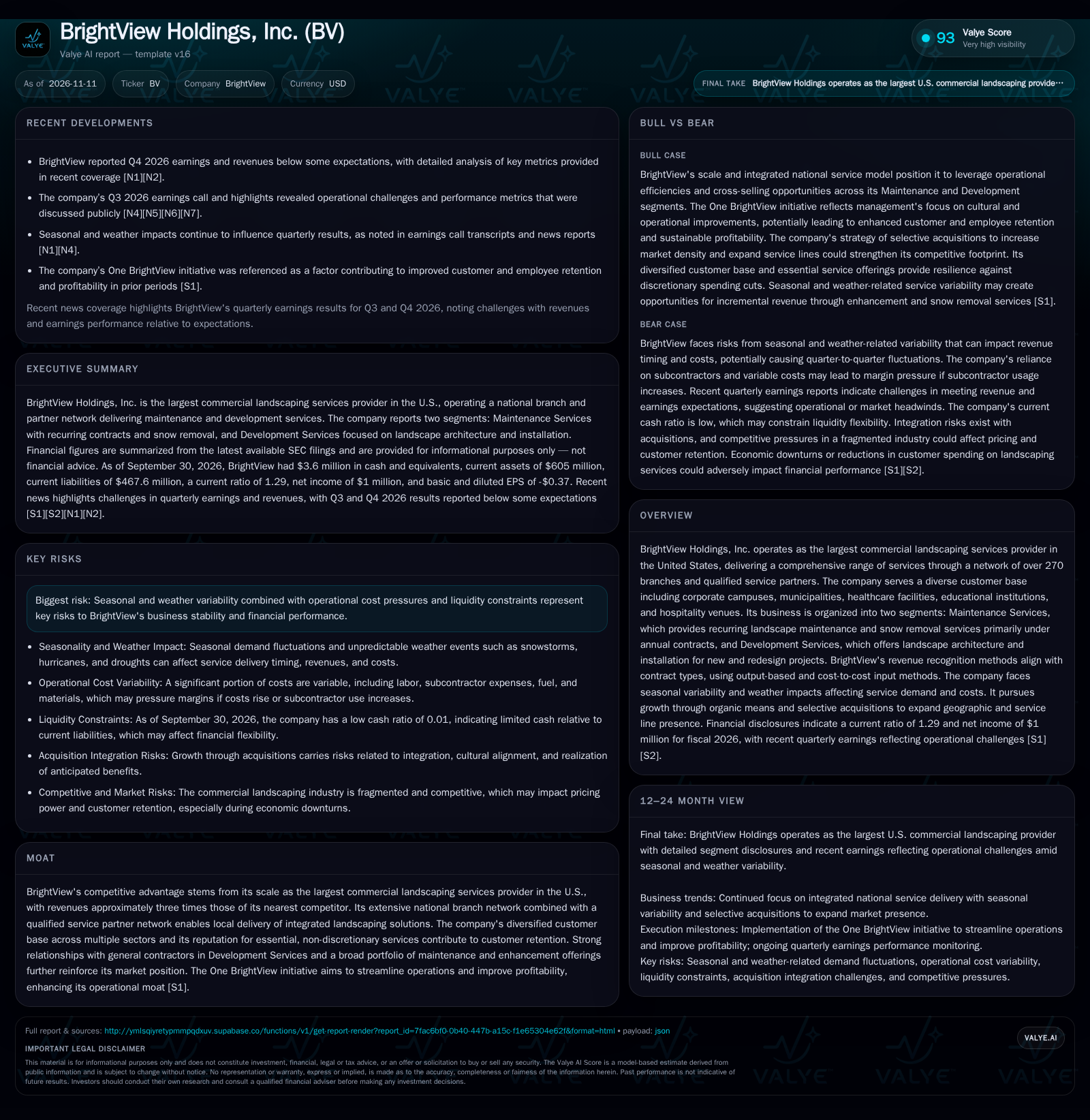
BrightView Holdings remains the dominant U.S. commercial landscaping player, with revenues three times larger than its nearest competitor and a vast national branch network. The company’s core Maintenance Services segment relies on recurring contracts with diverse, non-discretionary customers, while Development Services provides project-based growth. Despite the operational advantages of scale and recent efforts to streamline through the One BrightView initiative, recent quarterly earnings have missed expectations amid seasonal and weather-driven volatility. Tight liquidity, with a cash ratio of 0.01 as of September 2026, underscores the importance of margin management and disciplined capital allocation going forward. Execution on operational improvements and retention of large, essential-service clients will be critical to sustaining the company’s leadership and profitability in the coming quarters. [S1] [S2] [N1] [N2]
BrightView Holdings stands as the undisputed leader in U.S. commercial landscaping, wielding a national service footprint and an essential-service brand that spans corporate campuses, municipalities, hospitals, and more. With the One BrightView initiative aiming to drive operational improvements, the company’s ability to convert its scale into durable earnings and cash flow will be tested as it navigates unpredictable seasonal swings and rising cost variability. In this context, execution on cost management, customer retention, and selective growth will determine whether BrightView sustains its leadership or faces intensified margin and market-share pressure.
Recent Earnings Misses and Tight Liquidity Define the Near-Term Backdrop
BrightView’s most recent quarterly earnings (Q3 and Q4 2026) came in below analyst and public expectations, underscoring ongoing operational headwinds. Weather variability and seasonality were cited as key factors impacting both revenues and costs, with snow removal and maintenance services particularly affected by unpredictable conditions. As of September 30, 2026, the company reported a cash balance of $3.6 million, current assets of $605 million, current liabilities of $467.6 million, and a current ratio of 1.29. Full-year net income was modest at $1 million, with EPS of -$0.37, reflecting margin pressure and cost variability. These facts signal that while BrightView retains significant scale, it enters the next fiscal cycle with constrained potential financial flexibility and a need for disciplined execution. [S1] [S2] [N1] [N2]
How BrightView’s Recurring Contracts and Cost Structure Shape Its Profitability
BrightView’s core Maintenance Services business is built on recurring annual contracts—typically one to three years in duration and cancellable with 30-90 days’ notice—serving a wide range of essential-service customers. This contract structure provides a degree of revenue visibility and customer retention, as landscape maintenance is often considered non-discretionary for risk management and reputation. Snow removal services add seasonal revenue, but both segments are exposed to weather-driven variability, which can swing revenues and costs quarter to quarter.
On the cost side, the company’s economics are dominated by variable costs: employee wages, subcontractor fees, purchased materials, and equipment operations. This variable-heavy cost base allows some flexibility, but it also exposes BrightView to inflation risk, labor market dynamics, and rapid cost escalation if subcontractor reliance grows. Selling, general, and administrative expenses include both fixed (management, rent, software) and semi-variable components. Interest expense from long-term debt adds another layer of fixed cost, making sustained margin improvement dependent on both revenue growth and strict cost control.
BrightView’s capital needs are moderate for a services business, but working capital swings can be significant due to seasonality and weather. The company’s use of non-GAAP metrics such as Adjusted EBITDA and Adjusted Free Cash Flow suggests management’s focus on operational cash generation as a core performance indicator. [S1] [S2]
Scale as a Double-Edged Sword in a Fragmented Commercial Landscaping Industry
BrightView’s primary competitive advantage is its sheer scale: its revenues are roughly three times larger than its next largest competitor, and its network of over 270 branches enables national coverage. This allows BrightView to serve large, multi-location clients—such as Fortune 500 corporate campuses, municipalities, and hospital systems—who demand consistent service quality across geographies. The company’s service partner network further extends its reach and local execution.
However, the U.S. commercial landscaping industry remains highly fragmented, with many regional and local competitors able to undercut pricing or tailor services to local preferences. This fragmentation limits pricing power and makes customer retention an ongoing challenge, especially if service quality or responsiveness falters. The company’s relationships with general contractors in its Development Services segment provide access to large, project-based contracts, but these are less predictable and more exposed to construction cycles.
Competitive risks also stem from the relative ease of entry at the local level, limited switching costs for many customers, and the potential for rising labor and materials costs to compress margins industry-wide. While the One BrightView initiative seeks to leverage scale for operational efficiency and retention, the company’s ability to translate size into superior margins and customer loyalty will be tested as competitors adapt and as clients scrutinize costs during economic downturns. [S1]
Operational Streamlining and Retention Drive Margin Expansion
The most favorable scenario for BrightView is one in which the One BrightView initiative successfully streamlines processes, reduces administrative overhead, and improves both employee and customer retention. If these operational improvements translate into lower churn, reduced subcontractor reliance, and better labor productivity, the company could see enhanced margins even in the face of ongoing weather and seasonal variability.
Upside could also come from cross-selling additional services—such as enhancements, irrigation, or specialty turf care—to its large installed base of recurring contract customers. Selective acquisitions that build density in existing markets or add new, higher-margin service lines may further bolster profitability.
Evidence that would confirm this scenario includes: a sustained improvement in Adjusted EBITDA margin (if disclosed), rising customer retention rates, consistent or growing Maintenance Services revenue despite seasonal volatility, and a trend toward positive EPS and free cash flow. Additionally, news of successful integration of acquisitions or positive customer feedback on operational changes would support the case for margin expansion.
Weathering Volatility: Steady Share in a Challenging Margin Environment
The most plausible path forward is that BrightView maintains its industry-leading market share and core customer base but continues to experience margin volatility driven by weather, seasonality, and variable input costs. Maintenance Services revenue remains relatively stable due to the essential nature of the work and the stickiness of multi-year contracts, but growth is modest and closely tracks economic activity in commercial, municipal, and institutional end markets.
Development Services continues to provide project-based upside, but with variability tied to construction cycles and general contractor demand. The company manages to offset some cost pressures through incremental operational improvements and limited pricing actions, but these are partially offset by rising labor and materials costs. Liquidity remains tight but manageable, with careful working capital management and disciplined capital allocation.
Confirmation of this scenario would include continued maintenance of the current ratio above 1.2, relatively stable Maintenance Services revenue, modest fluctuations in net income, and no significant deterioration in customer retention or contract renewal rates (if disclosed). Persistent margin compression or further declines in quarterly earnings would tilt the scenario toward the downside.
Margin Erosion Accelerates Amid Cost Surges and Weather Disruptions
A negative outcome unfolds if weather volatility intensifies (e.g., unusually mild winters or extreme drought), leading to reduced snow removal revenues or increased costs for emergency services. Simultaneously, rising wages, fuel, and subcontractor costs could further compress margins—especially if BrightView is unable to pass through these costs via higher contract pricing or if customers become more price-sensitive.
Integration missteps in acquisitions or failure to deliver on the promised benefits of the One BrightView initiative could compound these pressures, making it difficult to defend market share against aggressive regional competitors.
Downside confirmation would come from a declining current ratio, persistent negative EPS, deteriorating Adjusted EBITDA or free cash flow (if disclosed), and evidence of customer churn or contract non-renewals. Unexpected liquidity events or adverse credit developments would also signal mounting financial stress.
Milestones That Will Shape BrightView’s Next Chapter
Year-over-year trends in Maintenance Services revenue, as this segment’s stability is critical to offsetting volatility in Development Services and weather-driven impacts.
Quarterly and annual Adjusted EBITDA margin (if disclosed), as a signal of operational efficiency and ability to manage variable costs.
Updates on customer retention and contract renewal rates—particularly for large, multi-location accounts—would help gauge the effectiveness of the One BrightView initiative and overall service quality.
Disclosures or commentary on subcontractor utilization versus self-performed services, as shifts here could materially impact margin structure.
Evidence of successful or problematic integration of recent acquisitions, especially as BrightView pursues selective M&A to expand market density or service lines.
Trends in SG&A expenses as a percentage of revenue, which would reflect progress (or lack thereof) on operational streamlining and cost discipline.
External economic indicators such as commercial construction activity and municipal budget trends, which influence demand for both Maintenance and Development Services.
Disclaimer: This is research-only, informational analysis and not investment advice. It may include AI-generated interpretation and general industry context. Always verify important details using primary sources.

Comments