
Skyworks Solutions After the Qorvo Merger: Scale, Diversification, and the Integration Test
Skyworks’ combination with Qorvo marks a pivotal expansion of its RF and analog platform, diversifying end markets and manufacturing scale, but exposes the company to integration execution risk and sustained customer concentration. The next phase hinges on realizing cost synergies, deepening non-mobile penetration, and navigating competitive and technological volatility.
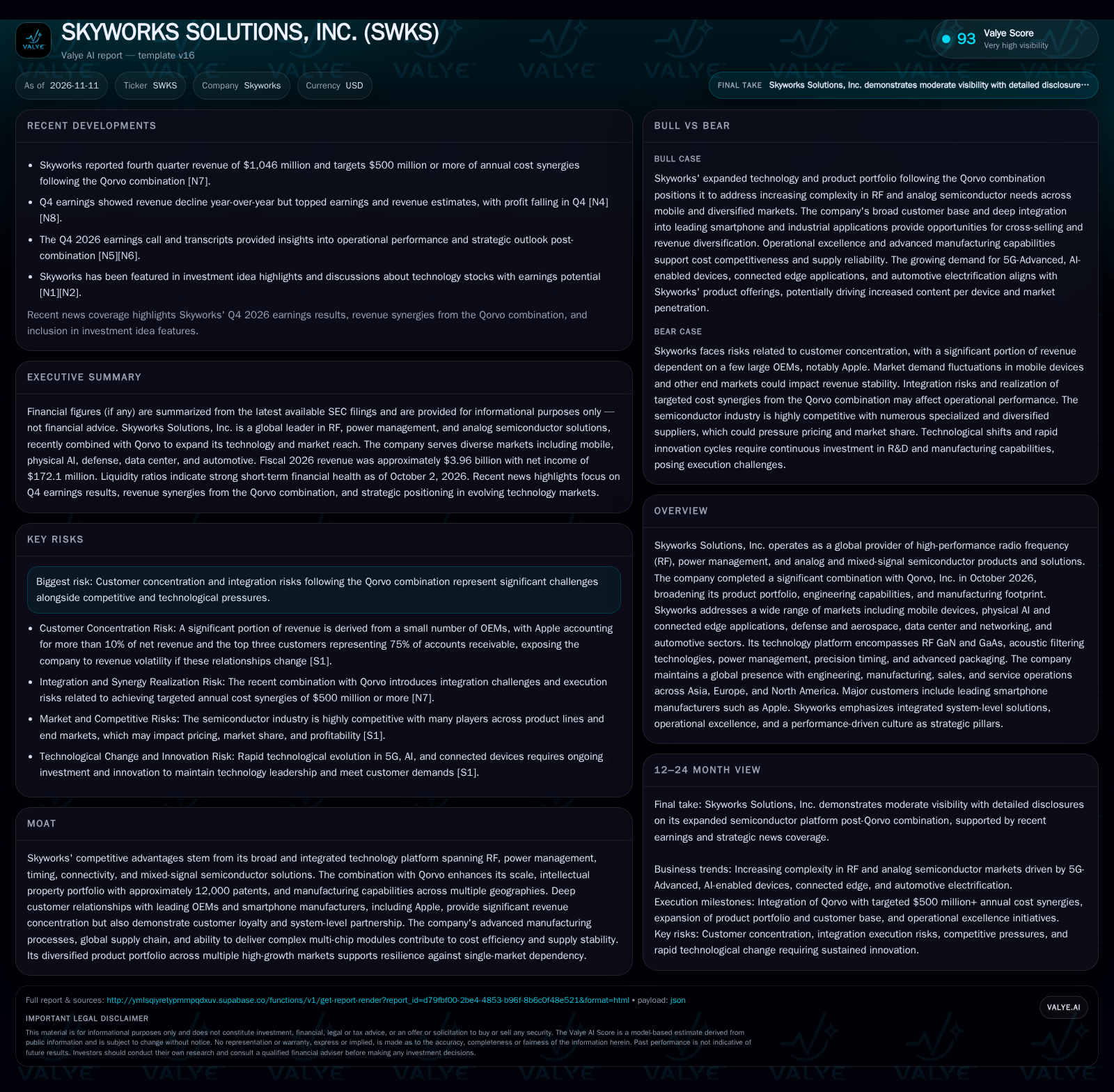
Skyworks Solutions’ merger with Qorvo significantly broadens its product and technology base across RF, power management, and analog semiconductors, targeting $500M+ in annual cost synergies. While the combined entity’s reach now spans mobile, AI, edge, defense, data center, and automotive markets, fiscal 2026 results show revenue and profit declines alongside continued dependence on a few large customers—most notably Apple. The challenge ahead is converting new scale and portfolio breadth into sustainable margin expansion and more balanced revenue streams. [S1] [N7] [N4] [N8]
The merger of Skyworks Solutions and Qorvo in late 2026 creates a formidable player in the RF and analog semiconductor industry, with ambitions that stretch well beyond its mobile device roots. The enlarged company brings together complementary technologies—spanning RF GaN, GaAs, acoustic filtering, and power management—while gaining a manufacturing footprint and customer reach that few can match. Yet, despite this scale and diversification, Skyworks’ fiscal 2026 numbers reflect persistent headwinds: revenue and profit have declined, customer concentration remains acute, and the benefits of the Qorvo deal are yet to be fully realized in the financials. The next chapter will test whether operational integration, cost discipline, and new market penetration can deliver on the promise of the merger.
Merger with Qorvo Reshapes Skyworks’ Scope, But Integration and Revenue Challenges Persist
Skyworks closed its acquisition of Qorvo on October 5, 2026, a move designed to dramatically expand its technology base, product lineup, and access to diversified end markets. The stated goal is to capture $500 million or more in annual cost synergies, leveraging the combined manufacturing, engineering, and supply chain resources [S1] [N7]. However, the fiscal 2026 financials do not yet reflect Qorvo's full contribution, and Skyworks reported $3.96 billion in revenue and $172.1 million in net income, with Q4 revenue of $1,046 million representing a year-over-year decline despite beating consensus estimates [S1] [N4] [N8]. Customer concentration remains a defining feature, with Apple accounting for over 10% of net revenue and the top three customers making up 75% of accounts receivable as of October 2, 2026 [S1]. The company reported a current ratio of 5.01 for the period. [S1]
How Scale and Portfolio Breadth Could Reshape the Economics of RF and Analog Semiconductors
Skyworks’ business model is built on selling a diverse mix of RF front-end modules, power management ICs, filters, and analog/mixed-signal components, historically to mobile device OEMs and, increasingly, to automotive, industrial, and infrastructure customers [S1]. The economics of this model are shaped by high fixed costs in R&D, fabrication, and packaging, with variable costs driven by materials and assembly. The acquisition of Qorvo adds further scale in GaAs and GaN RF manufacturing, acoustic filtering, and advanced module assembly, which could provide meaningful fixed-cost leverage if volume grows across a wider set of end markets.
The $500 million synergy target is expected to come from manufacturing rationalization, supply chain optimization, and consolidated R&D [N7]. However, the actual realization depends on successful integration—often a source of friction in large semiconductor mergers, where overlapping facilities, product lines, and management structures must be rationalized without disrupting customer delivery or innovation cadence. If integration succeeds, Skyworks could achieve higher gross margins and improved operating leverage, especially as content per device rises in 5G-Advanced, AI-enabled, and automotive applications. On the other hand, pricing remains a persistent pressure in semiconductors, particularly when competing for high-volume sockets in mobile and consumer devices, and the path to higher-mix, higher-margin end markets is not guaranteed.
Competitive Dynamics: From Mobile RF to a Multi-End-Market Platform
Skyworks’ moat rests on proprietary RF, filtering, and power management technology, a broad patent portfolio, and deep relationships with top-tier OEMs [S1]. The Qorvo merger enhances these attributes by adding complementary filtering, GaN/RF capabilities, and a global manufacturing footprint. However, the competitive landscape remains fierce. In mobile, Skyworks faces large, vertically integrated rivals and specialized RF competitors with deep device integration. In automotive, industrial, and emerging AI/edge markets, it contends with both legacy analog giants and nimble, niche players.
The real test is whether Skyworks can translate its expanded platform into sustained share gains outside mobile. The company’s ability to offer integrated, system-level solutions—combining RF, power, filtering, and analog/mixed-signal blocks—may provide a technical and cost advantage for customers seeking to simplify sourcing and accelerate time-to-market. However, this advantage is not insurmountable: switching costs can be high in automotive and industrial, but are lower in consumer devices where design cycles are fast and price competition is acute. The breadth of the combined portfolio could enable more cross-selling and content expansion, but success will depend on both execution and continued investment in differentiated technology.
Cost Synergies and Non-Mobile Expansion Unlock Margin and Growth Upside
In a favorable scenario, Skyworks achieves or exceeds its $500 million cost synergy target ahead of schedule, streamlining its global footprint and reducing overlapping operating expenses. Integration proceeds smoothly, retaining key engineering talent and avoiding supply chain disruptions. The company successfully leverages its expanded portfolio to win new business in automotive, physical AI, connected edge, and industrial markets, leading to a more balanced revenue mix and reducing reliance on a handful of mobile OEMs.
Content per device rises in 5G-Advanced smartphones, next-gen automotive platforms, and edge AI applications, driving both higher volumes and richer ASPs. Gross and operating margins improve as manufacturing and R&D synergies flow through, and the company’s scale allows it to negotiate better component pricing and optimize capital deployment. Confirmation of this scenario would come from sustained gross margin expansion, increasing revenue contributions from non-mobile segments, successful cross-selling to legacy Qorvo and Skyworks customers, and a visible decline in customer concentration metrics.
Integration Progresses, but Market Headwinds and Concentration Limit Near-Term Upside
The most plausible outcome is a gradual realization of cost synergies alongside persistent external and internal challenges. Integration takes longer than anticipated, with near-term disruption to certain product lines or customer programs. While some synergy benefits are realized within the first 12-18 months, incremental gains are slower due to operational complexity and the need to maintain customer service levels.
Revenue growth in non-mobile segments is positive but not enough to offset cyclical or secular declines in mobile, particularly if flagship OEM demand is soft. Customer concentration remains high, with Apple and a few others still accounting for a disproportionate share of revenue and receivables. Margins improve modestly as cost savings are offset by pricing pressure and the costs of integration. Evidence supporting this scenario would include continued revenue and profit volatility, slow but steady improvement in non-mobile revenue mix, and management commentary emphasizing ongoing integration and diversification efforts.
Integration Stumbles or OEM Demand Shocks Expose Structural Vulnerabilities
A negative outcome could be triggered by significant integration missteps: facility closures, supply chain snafus, or talent losses that disrupt customer delivery and erode market share. Cost synergies prove difficult to realize as product and technology overlap leads to friction, customer confusion, or delayed product launches. In parallel, a major OEM customer—such as Apple—reduces orders due to design changes, insourcing, or competitive displacement, amplifying the impact of Skyworks’ customer concentration.
Non-mobile market expansion fails to materialize at the expected pace, leaving the company exposed to cyclical demand swings in consumer electronics. Margins compress as fixed costs remain high and pricing pressure intensifies, especially if inventory builds up or competitors undercut on price. Downside confirmation would include missed synergy milestones, rising operating expenses post-merger, a spike in customer attrition or inventory write-downs, and a sharp drop in revenue from key accounts.
Testing the Post-Merger Thesis: What Should Investors Scrutinize?
Annualized cost synergies realized versus the $500 million target, and management’s timeline and confidence in hitting these milestones.
Quarterly gross margin and operating margin trends, as evidence of integration benefits and pricing discipline.
Revenue mix by end market—especially growth rates in automotive, physical AI, edge, and industrial segments versus legacy mobile.
Customer concentration metrics: percent of revenue and receivables from the top three customers, with particular attention to Apple.
Retention of key technical and commercial personnel, especially from Qorvo, to gauge integration health (if disclosed).
Capital expenditures and R&D investment levels, to ensure continued technology leadership and platform differentiation.
Inventory turnover and working capital trends, as early signals of supply chain or demand-side friction post-merger.
Any major design wins or customer announcements in new segments, which would validate cross-selling and portfolio expansion.
Disclaimer: This is research-only, informational analysis and not investment advice. It may include AI-generated interpretation and general industry context. Always verify important details using primary sources.

Comments