
Solesence’s Patented Scalp Care Bet: Innovation, Cost Pressures, and the Test for Sustainable Growth
Solesence, Inc. has doubled down on differentiated scalp care with new patented products and leadership hires, but persistent high operating costs and shipment delays challenge its path to durable profitability.
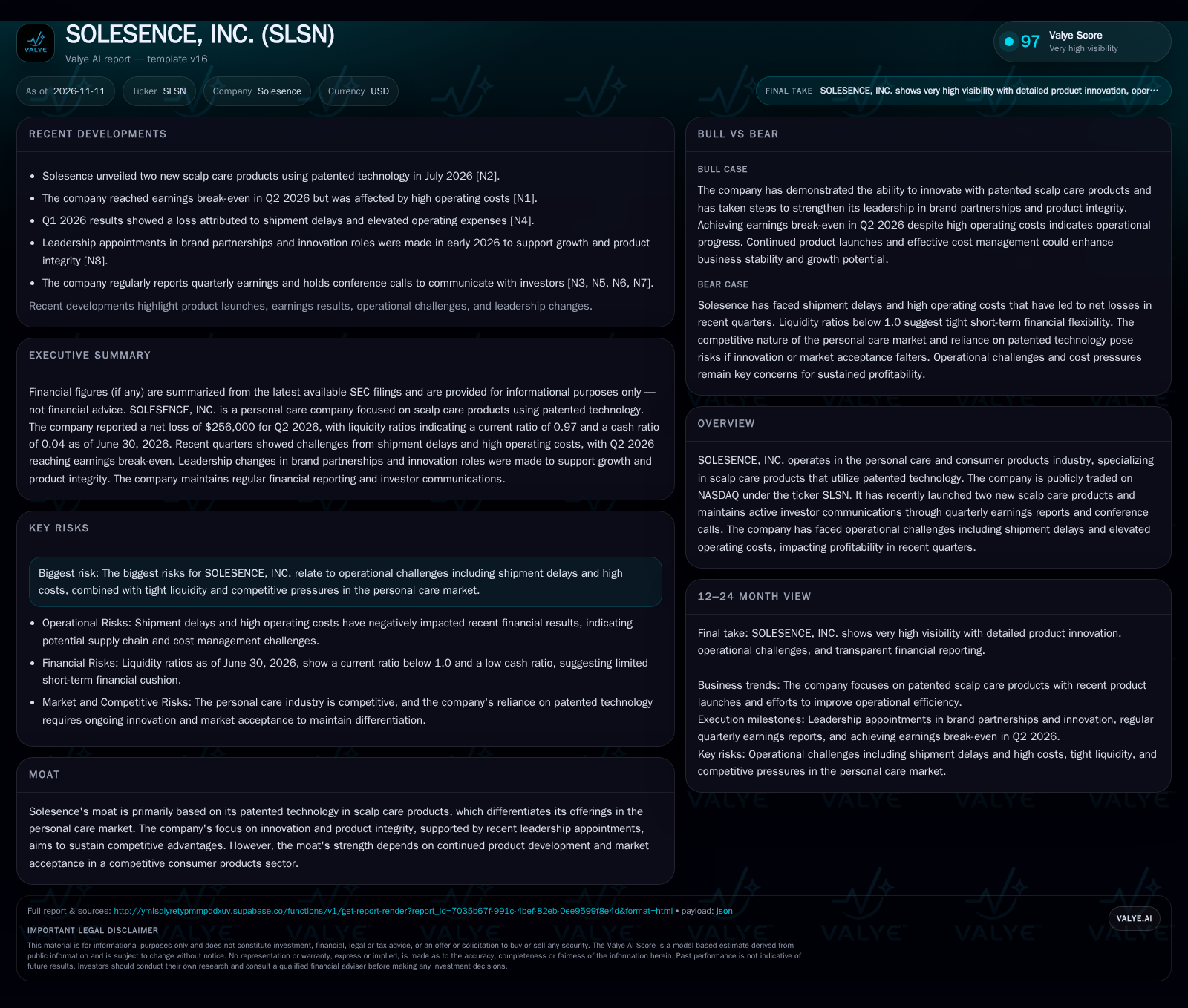
Solesence has launched two new scalp care products leveraging patented technology, reached earnings break-even in Q2 2026 despite ongoing high operating costs, and faces a tight liquidity profile with a current ratio below 1.0. The company’s future will depend on its ability to convert innovation and recent leadership changes into margin improvement and sustained growth in a competitive personal care market. Operational execution, cost control, and consumer traction with its differentiated offerings are critical near-term variables. [S2] [N1] [N2]
Solesence, Inc. is betting on patented scalp care innovation to carve out a defensible niche in the crowded personal care sector. The company’s July 2026 launch of two new products underscores a commitment to technical differentiation, but persistent shipment delays and high operating costs have constrained profitability.
Recent Product Launches and Operational Strains Shape the Outlook
In July 2026, Solesence launched two new scalp care products built on its patented technology platform, a move that reinforces the company’s focus on technical innovation within the personal care category. This product expansion comes after a quarter in which the company achieved earnings break-even, though persistent high operating costs and shipment delays continued to pressure results. The company reported cash and liquidity metrics for the period; these figures do not by themselves establish operating runway, investment capacity, financial flexibility, or financing capacity. [N2] [N1] [S2] [N4]
Profit Dynamics: Fixed Costs, Volume Leverage, and Product Mix Challenges
Solesence’s business model relies on leveraging patented technology to command premium pricing for differentiated scalp care products. In theory, such innovation should enable higher margins and some insulation from price-based competition. However, the company’s cost structure appears heavily burdened by fixed costs—likely including R&D, regulatory compliance, and specialized manufacturing—meaning that scale and consistent sales growth are essential for operating leverage to materialize. Shipment delays, as reported, exacerbate the challenge by disrupting revenue recognition and inventory turnover, while ongoing high operating costs suppress profitability even as new products come to market.
Absent clear evidence of recurring revenue contracts or long-term customer relationships, it is plausible that Solesence’s revenue is predominantly transactional, leaving the company exposed to volume fluctuations and requiring continuous innovation to maintain consumer interest. A sustainable path likely requires both cost containment and successful scaling of new products to drive a more favorable fixed-to-variable cost mix.
Defensibility Hinges on Patented Technology and Execution in a Crowded Market
Solesence’s core competitive asset is its portfolio of patented scalp care technologies, which theoretically provide a moat against generic competition and allow for product differentiation in a market often characterized by commoditized offerings. However, the personal care sector is intensely competitive, with established multinationals and agile niche brands alike vying for consumer attention. The strength of Solesence’s moat will depend on the perceived efficacy and uniqueness of its products, the ability to secure distribution, and the company’s marketing reach.
Switching costs for consumers in this category are typically low; brand loyalty can be fickle, and new entrants can quickly erode share if innovation stalls or consumer expectations shift. Solesence’s recent leadership hires in brand partnerships and innovation suggest an awareness of the need to both strengthen product integrity and build market presence. Still, long-term defensibility will rest on maintaining a pipeline of credible product innovation and demonstrating that patented technology translates into tangible consumer benefits.
Breakout Margin Expansion if Innovation Meets Market Demand
If Solesence’s new scalp care products gain strong consumer traction and the company successfully scales sales volumes, the business could achieve meaningful operating leverage. Higher volumes would allow fixed costs to be spread across a broader revenue base, potentially driving margin expansion and freeing resources for further product development or marketing. Patented technology could support premium pricing and foster repeat business if efficacy and differentiation are validated by consumers.
Evidence supporting this scenario would include sequential revenue growth, improving gross and operating margins, and positive cash flow from operations. Additional confirmation would come from expansion into new distribution channels, successful line extensions, or third-party endorsements that validate Solesence’s technology. Falsification would be indicated by stagnant or declining sales, persistent high costs without margin improvement, or a need for dilutive capital raises to fund ongoing operations.
Incremental Progress Amid Persistent Cost and Execution Pressures
The most plausible trajectory for Solesence is one of incremental improvement, where modest revenue growth from recent product launches is partially offset by ongoing high operating costs and execution risks.
Confirmation of this scenario would be evidenced by continued break-even or near break-even results, gradual improvement in cash flow, and steady—if unspectacular—adoption of new products. Signs of falsification would include renewed shipment disruptions, cost overruns that widen losses, or evidence that new products are failing to gain market traction.
Liquidity Squeeze and Market Pushback Could Force Strategic Retrenchment
With a current ratio under 1.0 and a cash ratio near zero, the company has little margin for error if cash flow does not improve quickly. In the event of ongoing losses and weak product acceptance, Solesence may be forced to seek external capital on unfavorable terms, curtail innovation investments, or even consider asset sales or restructuring.
A failure to stabilize shipments and costs, combined with lackluster consumer response to new products, would strongly support this scenario.
Milestones That Will Define Solesence’s Next Chapter
Sequential revenue and gross margin trends following the July 2026 product launches—sustained growth would indicate successful market adoption.
Updates on shipment and supply chain reliability; further delays could undermine both sales and retailer confidence.
Operating expense trajectory relative to revenue growth—improving ratios would support the case for eventual operating leverage.
Cash flow from operations in upcoming quarters; positive inflection would reduce liquidity risk.
Customer retention or repeat purchase rates for new scalp care products—a useful metric would be disclosed reorder rates or loyalty measures.
Evidence of expanded distribution, new retail partnerships, or international market entry.
Any announcements of external capital raises, credit facility renewals, or changes in working capital arrangements.
Leadership commentary on cost containment initiatives and progress toward operational efficiency targets.
Disclaimer: This is research-only, informational analysis and not investment advice. It may include AI-generated interpretation and general industry context. Always verify important details using primary sources.

Comments