
E-Smart Corp.: Severe Liquidity Strain, Persistent Losses, and the Uncertain Path to Operational Survival
With scant disclosure on its business model and no current legal or regulatory clouds, the company's ability to endure and adapt in a dynamic market hinges on urgent operational, strategic, or financial intervention.
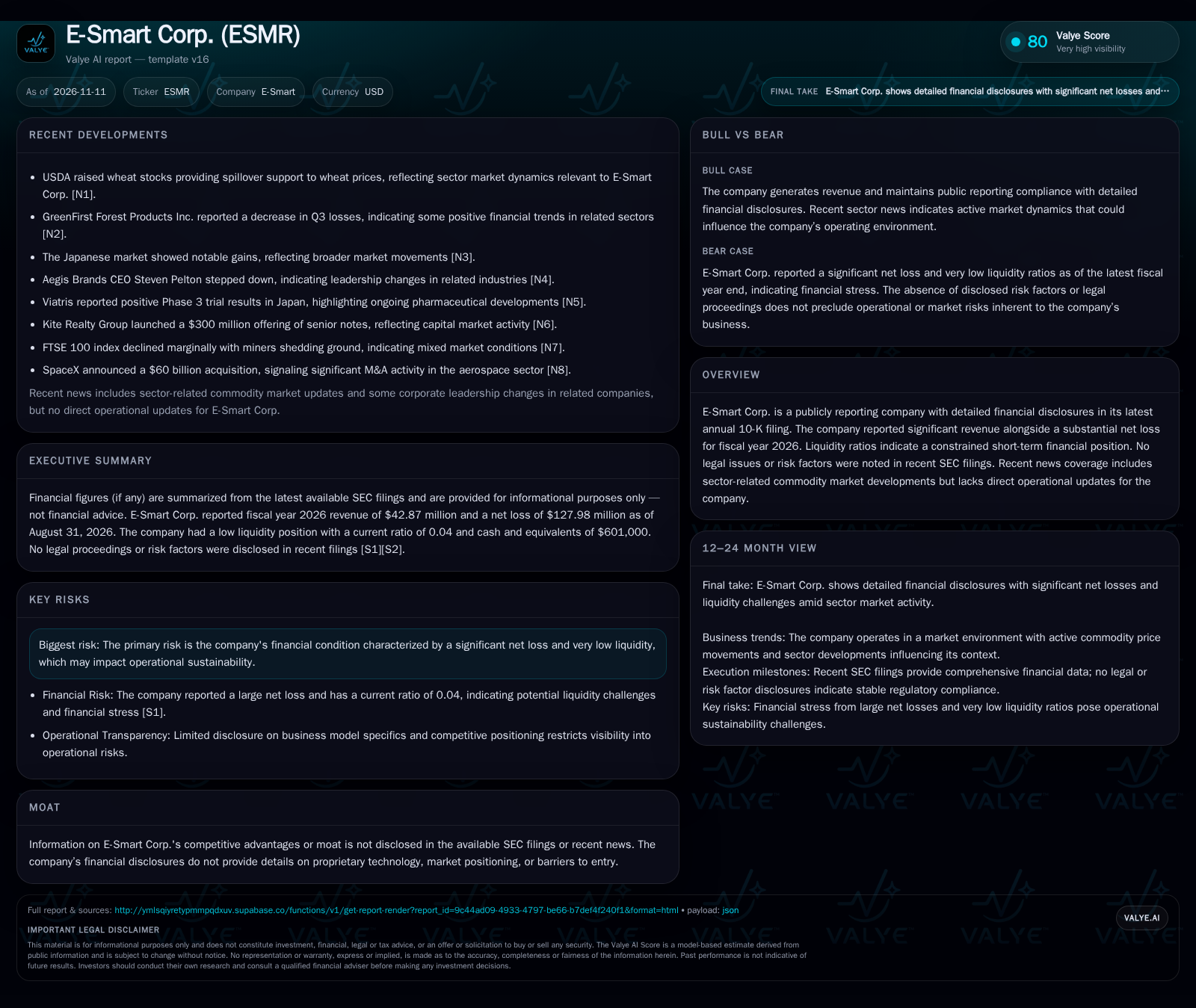
E-Smart Corp. generated $42.87 million in revenue in fiscal 2026 but posted a substantial net loss and faces an extreme liquidity shortfall, with current liabilities vastly exceeding current assets. The absence of legal or risk disclosures provides little comfort given the financial strain, and without visibility into its business model or competitive edge, the company's survival prospects depend on near-term capital or structural action. [S1] [S2]
E-Smart Corp. stands at a precarious financial crossroads: while it reported $42.87 million in revenue for fiscal 2026, a net loss of $127.98 million and an alarming current ratio of 0.04 reveal a company in acute liquidity crisis. With only $601,000 in cash against $268.9 million in current liabilities, E-Smart’s immediate viability appears deeply challenged. The lack of legal or regulatory entanglements offers little reassurance, as the company’s opaque business model and absence of competitive disclosures leave stakeholders with more questions than answers. The next phase for E-Smart will almost certainly require decisive action—whether through emergency financing, drastic restructuring, or potential asset sales—if it is to remain a going concern. [S1] [S2]
Acute Liquidity Crisis Overshadows Top-Line Performance
E-Smart Corp. reported fiscal 2026 revenue of $42.87 million, demonstrating the company's ability to generate sales at a meaningful scale. However, this topline achievement is eclipsed by a net loss of $127.98 million and an extraordinarily reported current ratio of 0.04 as of August 31, 2026. With only $601,000 in cash and cash equivalents to cover $268.9 million in current liabilities, the company is in a state of severe liquidity distress. No legal proceedings or risk factors were disclosed in the latest SEC filings, but the operational risks posed by this financial structure are considerable. Unless E-Smart can rapidly secure additional funding or restructure its obligations, its ability to continue operations is in jeopardy. [S1] [S2]
Revenue Scale Meets Negative Operating Leverage and Capital Strain
E-Smart's $42.87 million in annual revenue suggests it has access to a market with tangible demand, but the magnitude of its net loss—over three times its sales—implies deeply negative operating leverage and a likely mismatch between fixed cost structure and revenue generation [S1]. Without detailed disclosure on its business model, it is unclear whether E-Smart operates as a product manufacturer, service provider, or platform, leaving open questions about its gross margin profile, pricing power, and customer retention.
The company reported cash and liquidity metrics for the period; these figures do not by themselves establish operating runway, investment capacity, financial flexibility, or financing capacity. This points to either structurally unprofitable operations, a legacy of aggressive expansion or investment, or both. In such a scenario, capital requirements are not only persistent but urgent, and the company may face punitive terms if seeking emergency financing. If the business is asset-light, rapid cost realignment may be possible, but asset-heavy operations would make restructuring more painful and time-consuming.
A critical aspect to consider in evaluating E-Smart’s financial distress is the interplay between fixed and variable costs within its cost structure. If the company’s fixed costs constitute a large proportion of total expenses, then revenue fluctuations can disproportionately impact profitability, exacerbating losses during periods of stagnant or declining sales. Conversely, a variable cost-heavy model might offer greater operational flexibility, enabling the company to scale expenses in line with revenue changes. Understanding this dynamic would be essential in assessing the feasibility and speed of any cost realignment efforts. Furthermore, the capital intensity of the business influences not only cash burn but also the potential for asset monetization; asset-light firms may pivot or downsize more rapidly, while asset-heavy companies face longer timelines and higher restructuring costs.
Opaque Competitive Landscape and Unknown Differentiators
The absence of disclosures regarding E-Smart's core business activities, customer segments, or proprietary technology makes it impossible to identify a durable moat or unique competitive advantage. In most sectors, companies with persistent losses and liquidity shortfalls are highly vulnerable to market share erosion, talent attrition, and predatory competitor behavior. Without evidence of sticky customer relationships, switching costs, or intellectual property barriers, E-Smart may be exposed to substitution by better-capitalized peers or new entrants.
The company’s survival could depend on niche positioning, regulatory barriers, or relationships that are not publicly disclosed. However, without clear evidence of such defenses, the base assumption is that E-Smart operates in a competitive or even commoditized environment, with limited pricing power and little insulation from external shocks.
The lack of transparency around E-Smart’s competitive positioning also raises questions about the sustainability of its revenue base. In industries characterized by network effects or strong switching costs, companies may endure short-term financial setbacks while maintaining customer loyalty and market share. Without evidence of such dynamics, however, E-Smart may be vulnerable to rapid customer attrition, especially if competitors offer superior pricing, technology, or service quality. Additionally, the presence or absence of regulatory barriers can materially affect competitive risk; sectors with high compliance costs or licensing requirements often limit new entrants, providing incumbents with some protection. The absence of disclosed regulatory challenges may imply a relatively open market, increasing competitive pressure and reducing pricing leverage.
Emergency Capital and Strategic Refocus Offer a Lifeline
The most plausible bullish scenario for E-Smart is a rapid and successful capital raise—through debt, equity, or asset sales—paired with decisive cost-cutting or a pivot to higher-margin offerings. If the company can secure bridge financing or attract a strategic investor, it may gain the runway needed to restructure operations, renegotiate liabilities, or divest non-core assets.
Confirmation of this scenario would come from announcements of new financing, material reductions in SG&A or operating expenses, or asset monetization initiatives. Early signs of a turnaround would include stabilization or reversal of negative cash flow, improved gross or operating margins, and a reported liquidity-ratio trends. Evidence of customer retention, contract renewals, or new product launches could further support the case for recovery.
Continued Cash Burn and Mounting Solvency Pressure
Absent an immediate capital injection or operational overhaul, E-Smart is likely to continue incurring significant losses and burning through its reported cash balance. The business may attempt incremental cost reductions or seek to renegotiate terms with creditors, but the scale of its liabilities relative to liquid assets suggests that such measures would be insufficient to restore solvency.
In this scenario, evidence would include continued negative net income, persistent or worsening cash flow deficits, and little improvement in the current ratio. Delays in vendor payments, workforce reductions, or asset impairment charges would further signal deteriorating operating flexibility. If the company continues to avoid legal proceedings or bankruptcy filings, it may reflect forbearance by creditors or ongoing negotiations, but the fundamental imbalance between assets and liabilities would remain unresolved.
Liquidity Exhaustion Triggers Restructuring or Liquidation
If E-Smart is unable to raise capital, restructure its obligations, or materially improve cash flow, the exhaustion of its remaining liquidity could trigger default, creditor action, or bankruptcy proceedings. In this scenario, operations could be disrupted by asset seizures, forced divestitures, or legal actions initiated by suppliers, lenders, or employees seeking unpaid wages or severance.
Indicators confirming this scenario would include missed payments, default notices, legal filings, or abrupt cessation of business activities. Public disclosure of bankruptcy protection filings, asset auctions, or court-supervised restructuring processes would confirm that the company has entered a formal insolvency process.
In a scenario where liquidity constraints become acute, the timing and sequence of creditor actions will be critical in determining operational continuity. Secured creditors typically have priority claims on assets and may initiate foreclosure or liquidation proceedings more swiftly than unsecured creditors. The company’s ability to negotiate standstill agreements or restructuring plans hinges on creditor composition and willingness to cooperate. Additionally, operational disruptions from workforce reductions or supplier insolvencies could create a negative feedback loop, further impairing revenue generation and accelerating financial deterioration. The presence of contingent liabilities or off-balance-sheet obligations, if any, would compound risks, potentially triggering unexpected cash outflows and complicating restructuring efforts.
Milestones That Will Determine E-Smart Corp.'s Survival Trajectory
Any announcement of new debt or equity financing, bridge loans, or asset sales would directly impact near-term survival odds.
Disclosure of cost reduction initiatives, workforce restructuring, or divestitures would signal active management response to financial stress.
Updates on customer contract renewals, new business wins, or revenue visibility would help clarify the company’s ability to generate sustainable cash flow.
Evidence of creditor negotiations, payment extensions, or covenant waivers would reveal the degree of external support or forbearance.
If disclosed, gross margin and operating margin trends would clarify whether losses are due to fixed cost overhang or structurally unprofitable business lines.
Public filings of default notices, lawsuits, or bankruptcy protection would confirm an acute downside scenario.
Any strategic partnership, acquisition interest, or takeover bid—if announced—could offer a non-dilutive route to operational stability.
Disclaimer: This is research-only, informational analysis and not investment advice. It may include AI-generated interpretation and general industry context. Always verify important details using primary sources.

Comments