
Blackstone Digital Infrastructure Trust: Capital Readiness, Execution Stakes, and the Next Phase in U.S. Data Center REITs
With nearly $2 billion in cash and a mandate to acquire stabilized, hyperscale-leased data centers, Blackstone Digital Infrastructure Trust’s investment thesis now hinges on disciplined capital deployment and the ability to convert its financial firepower into durable income streams.
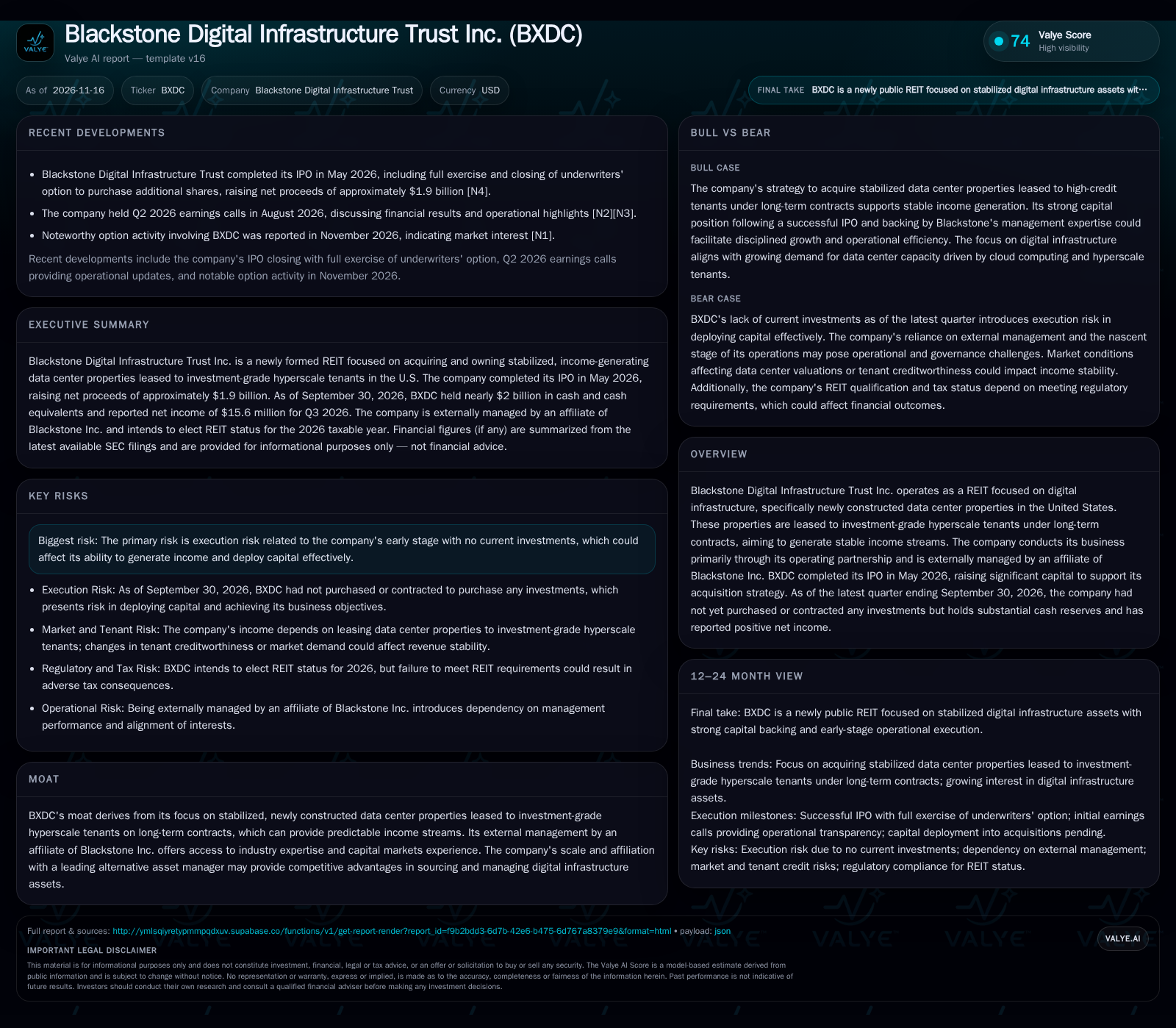
Blackstone Digital Infrastructure Trust (BXDC) is a newly public, externally managed REIT focused on acquiring stabilized U.S. data centers leased to investment-grade hyperscale tenants. After raising $1.9 billion in its May 2026 IPO, BXDC had not yet deployed capital into properties as of September 30, 2026, but reported positive net income primarily from interest on cash. The company's success now depends on its ability to source and close accretive acquisitions amid a competitive and evolving digital infrastructure landscape. Execution risk is central, as the transition from cash-rich newcomer to income-generating REIT remains unproven.
Blackstone Digital Infrastructure Trust (BXDC) enters the public REIT universe with a focused mandate—acquire and own newly built, stabilized U.S. data centers leased to hyperscale, investment-grade tenants. Backed by nearly $2 billion in IPO proceeds and Blackstone’s institutional heft, the company’s thesis is straightforward: convert financial resources into predictable, tax-advantaged income. Yet as of September 2026, BXDC had not closed a single property acquisition, and its reported earnings reflect interest on idle cash rather than rental income. The coming quarters will test whether BXDC can leverage its balance sheet and sponsor relationships to rapidly source, diligence, and close attractive deals in a fiercely competitive digital infrastructure market.
IPO Proceeds and Uninvested Capital Define Initial Operating Profile
As of September 30, 2026, Blackstone Digital Infrastructure Trust reported holding approximately $1.96 billion in cash and cash equivalents out of total assets of $1.98 billion, following a $1.9 billion IPO completed in May 2026, including full exercise of the underwriters’ option [S1] [N4]. Despite this substantial capital base, BXDC had not purchased or contracted to purchase any data center investments by the end of Q3 2026 [S1]. Net income of $15.6 million for the quarter was driven predominantly by interest earned on cash balances, rather than operating revenue from real estate assets [S1]. These facts highlight that BXDC’s business model and value proposition remain untested in practice, with the company’s near-term trajectory hinging on its ability to deploy capital into suitable digital infrastructure opportunities.
How BXDC’s REIT Model Could Capture Value from Hyperscale Leasing
BXDC’s stated model is to acquire stabilized, newly constructed data centers leased long-term to investment-grade hyperscale customers. In theory, this approach offers several economic advantages: high occupancy rates, predictable rental income, and reduced credit risk thanks to tenant quality. The company reported cash and liquidity metrics for the period; these figures do not by themselves establish operating runway, investment capacity, financial flexibility, or financing capacity.
The economics of stabilized data centers typically involve high upfront capital expenditure, but relatively low ongoing operating costs once properties are fully leased and commissioned. With external management by a Blackstone affiliate, BXDC may benefit from institutional sourcing, diligence, and operational efficiencies, although this structure introduces additional management fee layers and potential alignment issues.
At present, BXDC’s financials are shaped by interest income on its uninvested IPO proceeds. The company’s future earnings power will depend on its ability to source properties at attractive cap rates, negotiate favorable lease terms, and manage lease rollover and renewal risk. Operating leverage could emerge as assets are acquired and fixed costs are spread over a growing revenue base, but the timing and magnitude of this effect remain uncertain until acquisitions commence.
Positioning Against Established Data Center REITs and New Entrants
BXDC enters a U.S. data center REIT landscape dominated by large incumbents with established portfolios, such as those specializing in hyperscale and colocation facilities. These peers often possess strong tenant relationships, operational scale, and access to low-cost capital. BXDC’s Blackstone affiliation may offer a sourcing and credibility advantage, particularly in off-market or large-scale transactions, but the company will compete directly for assets with both public REITs and private infrastructure funds.
The digital infrastructure market is characterized by robust demand from cloud and hyperscale tenants, but also by aggressive competition for stabilized, core properties—driving up valuations and compressing cap rates. If BXDC cannot secure deals at attractive pricing, its ability to deliver differentiated returns may be constrained. Additionally, the external management model, while providing access to Blackstone’s platform, could be a disadvantage if fee structures erode net returns versus internally managed peers.
The threat of technological obsolescence (e.g., shifts in server density, cooling requirements, or edge computing adoption) and the emergence of alternative financing vehicles (such as private infrastructure funds) could further intensify competition for prime assets. BXDC’s ultimate positioning will depend on its pace and discipline in capital deployment, as well as its success in building a reputation with hyperscale tenants.
Rapid, Disciplined Acquisitions Transform BXDC into an Income Powerhouse
The most favorable outcome for BXDC would see the company quickly deploy its $1.9 billion in cash into a portfolio of stabilized, high-quality data centers leased to investment-grade hyperscale tenants under long-term contracts. If BXDC leverages its Blackstone affiliation to access off-market deals or portfolio transactions at attractive cap rates, it could establish immediate scale and benefit from operating leverage as G&A is spread over a growing revenue base.
Confirmation of this scenario would require announcements of sizable property acquisitions, rapid asset onboarding, and disclosure of lease terms confirming long duration, high occupancy, and strong tenant credit. Early evidence would also include a shift in revenue composition from interest income to rental income, and guidance on dividend distributions consistent with REIT requirements. A meaningful increase in distributable cash flow and positive market reaction to initial deals would further validate the thesis.
Measured Deployment, Market Competition, and Initial Portfolio Friction
The most plausible near-term trajectory is that BXDC will deploy its capital gradually over several quarters, facing a competitive market for core data center assets. Deals may be lumpy and timing uncertain, with the company potentially paying elevated prices for stabilized properties in a crowded landscape. Initial acquisitions could involve a mix of single-asset and portfolio transactions, with some ramp-up time to reach full occupancy and optimal lease structuring.
This scenario would be confirmed by a steady cadence of acquisition announcements, incremental growth in property-level revenue, and gradual transition from interest income to rental income in financial statements. Some friction—such as higher-than-expected acquisition costs, delays in closing, or the need to accept less-than-ideal lease terms to achieve scale—would not be surprising. Dividend initiation may be delayed until a sufficient income-generating base is established.
Execution Delays and Overheated Market Threaten Income Conversion
A negative chain of events would involve BXDC struggling to identify and close accretive data center acquisitions, either due to intense competition, inflated valuations, or limited availability of suitable stabilized assets. Prolonged capital deployment could result in continued reliance on interest income, with the risk that rising interest rates or falling cash yields erode earnings. If BXDC is forced to accept lower-credit tenants or shorter lease terms to deploy capital, the promise of stable, predictable income could be compromised.
Confirmation of this scenario would be a lack of material acquisition announcements over multiple quarters, persistent dominance of interest income in reported results, and potential downward revisions to income or dividend guidance. Market skepticism could be reflected in sustained trading below net asset value, management turnover, or increased scrutiny of the external management structure and fee alignment.
Milestones That Will Determine Whether BXDC Delivers on Its Digital REIT Ambitions
The timing, size, and quality of BXDC’s first data center acquisitions—announcements and deal closings will be the earliest signal of execution.
Shift in revenue composition from interest income to rental income—quarterly earnings should show a clear inflection as properties are acquired and leased.
Average lease duration, occupancy rates, and tenant credit profile—if disclosed, these metrics will demonstrate whether BXDC is achieving its targeted risk-adjusted returns.
Acquisition cap rates and purchase price discipline—a useful metric would be the weighted average cap rate on acquired assets versus market benchmarks.
Dividend initiation and payout ratio—timing and size of the first dividend, and its sustainability, will be critical for REIT investors.
External management fees and expense ratios—ongoing disclosures will clarify the net economic impact of the Blackstone management arrangement.
Market reaction to initial deals and portfolio ramp—any significant premium or discount to NAV in BXDC’s share price may signal investor confidence or skepticism regarding execution.
Disclaimer: This is research-only, informational analysis and not investment advice. It may include AI-generated interpretation and general industry context. Always verify important details using primary sources.

Comments