
Baozun Inc. Tightens Share Capital Amid E-Commerce Service Evolution
Baozun’s April 2026 capital adjustments mark tactical efforts to navigate margin pressures while reinforcing its integrated e-commerce service platform amid intensifying competition.
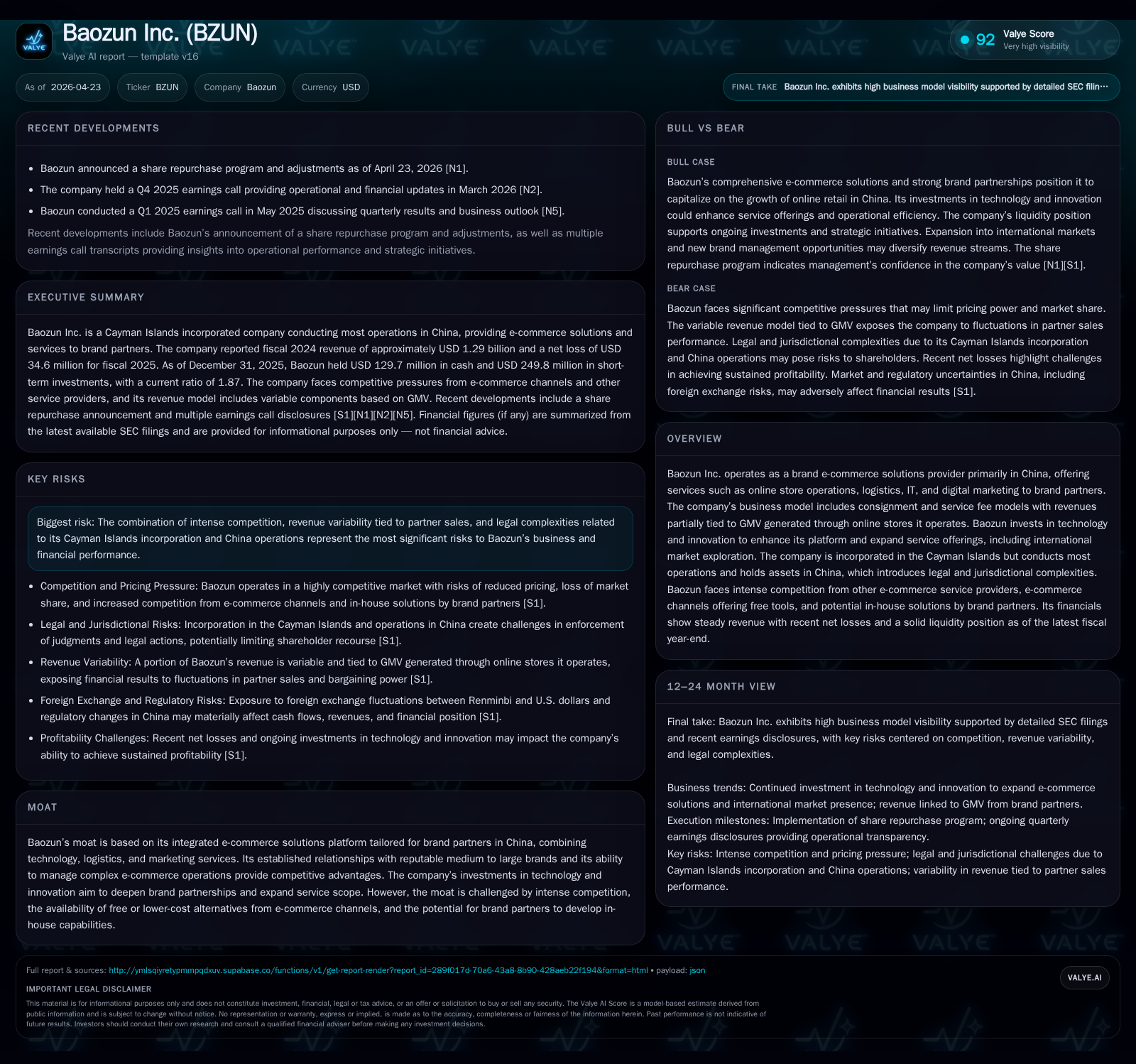
Baozun Inc.’s latest April 2026 6-K filing reveals changes in authorized share capital signaling strategic capitalization adjustments against a backdrop of challenging profitability. The company’s core model combines consignment and service fee revenues tied to partner GMV, supported by integrated digital marketing, logistics, and IT solutions primarily servicing Chinese brands. Despite steady revenue growth, Baozun faces diminishing margins driven by competitive pricing pressures and evolving brand partner strategies, compounded by regulatory complexities from its Cayman-China structure. Growth is fueled by technology investments improving platform scalability and international expansion efforts, but persistent net losses indicate an ongoing path toward sustainable profitability remains uncertain.
Recent Quarterly Developments Reflect Focused Capital Structure Management
Baozun’s April 9, 2026 Form 6-K filing [S2] reports a formal monthly return filed with The Stock Exchange of Hong Kong Limited indicating movements in the company’s authorized share capital and issued shares during March 2026. While the disclosure itself does not detail the magnitude or specific terms of the capital change, such filings typically denote strategic recalibrations of share authorization possibly related to governance tuning or future financing flexibility. The filing is signed by CEO Vincent Wenbin Qiu, affirming leadership continuity at the helm during these operational adjustments.
Importantly, this capital movement signals Baozun’s tactical response to an operating environment where margin management is critical during heightened competition and evolving channel dynamics. This recent update complements sequential interim disclosures (including the March 30, 2026 filing [S3]) clarifying annual report filing intentions (Form 20-F) consistent with U.S. SEC compliance.
Recognizing that capital structure signals investor confidence and refines equity capacity under pressure becomes essential when interpreting this update as more than procedural—it frames a backdrop for subsequent operational resilience dialogues.
Overview of Baozun’s Brand-centric E-Commerce Service Model
Baozun Inc. operates as a leading e-commerce solutions provider primarily for established medium to large brand partners seeking to scale their online retail presence across China’s fragmented digital commerce ecosystem [S1][S19][F1]. Its revenue model bifurcates between consignment (commission-based on Gross Merchandise Volume—GMV) and fixed service fees paid by brands for outsourced operations.
At the service level, Baozun integrates multiple facets: online store operations on major platforms (notably Tmall), supply chain logistics facilitated via joint ventures (e.g., with Jiangsu Shanggao Supply Chain), IT infrastructure support including cloud-based platforms and AI-driven analytics, plus digital marketing aimed at consumer engagement optimization [S1][S11]. This multi-pronged approach naturally erects switching costs as brands find value in end-to-end managed services that otherwise demand extensive internal capabilities.
Technology investments remain pivotal; Baozun’s ongoing platform enhancement drives scalability for more complex brand portfolios while attempting to contain rising operational costs—a balance crucial as capex has trended moderately lower after peaking earlier [F1]. Initiatives also extend overseas with nascent ventures like Baozun International targeting replication of domestic success in foreign markets though barriers such as cultural differences present challenges [S11][S15].
Competitive Dynamics and Baozun's Differentiation in China’s E-Commerce Ecosystem
Competition within the Chinese brand e-commerce services landscape is fierce [S19]. Key rivals include other professional e-commerce enablers offering similar consignment or fee-based services alongside large platforms like Tmall that provide free DIY store tools reducing reliance on outsourced operators. Additionally, some brands enhance or build in-house e-commerce capabilities reducing dependence on third-party providers like Baozun.
Baozun's moat rests on its integrated suite combining logistics expertise, IT innovation, and marketing services forming a sophisticated one-stop solution attractive to brands seeking at-scale digital transformation yet lacking internal bandwidth [S19]. Established relationships with reputable medium-to-large brands help reinforce customer lock-in despite non-exclusivity clauses prevalent in contracts [S19].
Nonetheless, competitive pressures compress pricing power as brands negotiate fee structures often tied variably to GMV volumes [S19]. Market fragmentation and evolving consumer preferences force adaptability; regulatory scrutiny over foreign investment structures further complicates direct ownership benefits given Baozun’s Cayman Islands incorporation juxtaposed with China-based operations under Variable Interest Entity (VIE) arrangements [S7][S9]. This adds layers of legal complexity affecting long-term certainty.
Growth Drivers: Technology Investment, Brand Partnership Depth, and New Market Expansion
Baozun’s growth levers are directly linked to sustained technology investment enhancing its proprietary platform capabilities enabling better data analysis, customer experience personalization via AI tools, streamlined logistics coordination through joint ventures like Jiangsu Shanggao Supply Chain Co., Ltd., as well as expanded digital marketing reach enabling client brands to scale sales effectively [S1][S11][F1].
Deeper engagement with existing brand partners fosters incremental GMV capture by expanding product categories or elevating service scopes under both consignment and service fee models. Adding new medium-size customers potentially increases total addressable market though comes with onboarding complexity.
International expansion represents a material upside avenue albeit nascent; replicating China’s e-commerce ecosystem success in overseas markets carries risks from unfamiliar competitive landscapes, regulatory environments and consumer behaviors requiring patient investment [S11][S15]. Nevertheless, these moves diversify geographic risk concentration that currently centers heavily on China.
Challenges to Sustainable Growth: Competitive Threats and Margin Pressures
Despite revenue growth momentum (+4% YoY in 2024 [F1]), Baozun grapples with margin compression resulting from competitive pricing pressures inherent in consignment/revenue-share contracts tied directly to partner GMV fluctuations [S19]. Negotiated reductions or shifts away from variable pricing components can depress revenue quality affecting profitability.
Persistent net losses (-$34.6 million in FY2025) reflect ongoing investments into technology development and international ventures offsetting modest operating income gains ($8.1 million FY2025) indicating early-stage profitability recovery [F1]. Rising labor costs connected with outsourcing partnerships such as Hangzhou Juxi Technology Co., Ltd., once notable but dwindling recently highlight cost management challenges [S1].
Legal/jurisdictional risks attributable to the Cayman Islands/China VIE structure introduce operational uncertainty particularly amid tightening PRC regulatory scrutiny surrounding foreign listings which could impact access to capital markets or impose compliance burdens [S7][S20]. Also, dependency on major e-commerce channels like Tmall presents concentration risks if channel access terms deteriorate or if these platforms expand free toolkits eroding third-party provider relevance [S19].
What Investors Should Monitor: Operational Milestones and Regulatory Developments
Near-term focus should include monitoring consistency of GMV generated across key brand partners given revenue variability impact on top line and margin health. Successful rollouts of technological upgrades enhancing automation or storefront management efficiency could signal improved operating leverage potential [N1][S11].
Customer retention metrics revealing continued trust amid proliferating alternatives also serve as demand markers validating Baozun's value proposition integrity. Progress in international expansions such as tangible initial sales traction abroad can confirm diversification efforts reducing China-concentration risk exposed by geopolitical tensions.
Regulatory developments remain critical given incident risks related to remote VIE control enforcement or offshore listing compliance mandates under new PRC CSRC rules potentially impacting future fundraising options or trading status [S20][S21]. Timely filings confirming adherence will underpin investor confidence.
Financial Performance Summary: Profitability Trajectory and Liquidity Position
Historical performance (annual)
| FY | Rev ($mm) | Net ($mm) | CFO ($mm) | OpInc ($mm) | Rev YoY | Net YoY |
|---|---|---|---|---|---|---|
| 2025 | -35 | 60 | 8 | -36.5% | ||
| 2024 | 1291 | -25 | 14 | -16 | +4.0% | +35.3% |
| 2023 | 1241 | -39 | 63 | -29 | +1.9% | +58.6% |
| 2022 | 1218 | -95 | 55 | 5 | -17.4% |
Source: SEC companyfacts cache [F1].
Capital returns and efficiency (annual)
| FY | Div ($mm) | Buybacks ($mm) | FCF ($mm) |
|---|---|---|---|
| 2025 | 3 | 1 | 45 |
| 2024 | 0 | 13 | -4 |
| 2023 | 0 | 0 | 40 |
| 2022 | 65 | 25 |
Source: SEC companyfacts cache [F1].
Baozun reported revenues of approximately $1.29 billion for fiscal year ending December 31, 2024 showing steady moderate growth (+4% YoY) after earlier faster expansion rates [F1]. Operating income turned positive in FY2025 ($8.09 million), improving from losses recorded over prior two years (-$15.7 million in 2024; -$29 million in 2023), reflecting nascent progress towards controlling expenses versus top-line growth expansion. However, net income remained negative (-$34.6 million), impacted by continued R&D investment amortization and other expenses diluting bottom-line results.
Operational cash flow surged impressively by over threefold from $13.9 million (FY2024) to $60 million (FY2025), highlighting better cash generation capacity supporting working capital needs despite non-cash charges [F1]. Capital expenditure expenditures declined moderately aligned with technology platform stabilization trends ($15.2 million FY2025 vs $18 million prior year), indicating selective reinvestment balancing innovation alongside fiscal discipline.
Balance sheet liquidity stood robustly at approximately $130 million cash & equivalents at FY-end providing a comfortable buffer for ongoing operations alongside $520+ million shareholders’ equity sustaining solvency ratios above industry norms (current ratio ~1.87) [F1].
The company maintained dividend payments ($3.17 million FY2025) albeit modestly scaled relative to cash flows reflecting cautious shareholder returns policy amid profitability turn challenges while continuing limited buybacks totaling $1.46 million indicating tactical use of shares for employee compensation rather than aggressive repurchase strategy currently [F1][S6][S8].
This analysis synthesizes the latest reported SEC filings up to April 23, 2026 alongside earnings calls reflecting Baozun Inc.’s operational positioning within China’s competitive e-commerce solutions landscape without providing investment advice or price forecasts.
Disclaimer: This is research-only, informational analysis and not investment advice. It may include AI-generated interpretation and general industry context. Always verify important details using primary sources.

Comments