
So-Young International’s Strategic Moves Signal Shifts in Operating Stability
Recent leadership changes and steady financial losses underscore operational challenges amid evolving regulatory pressures in So-Young’s platform business.
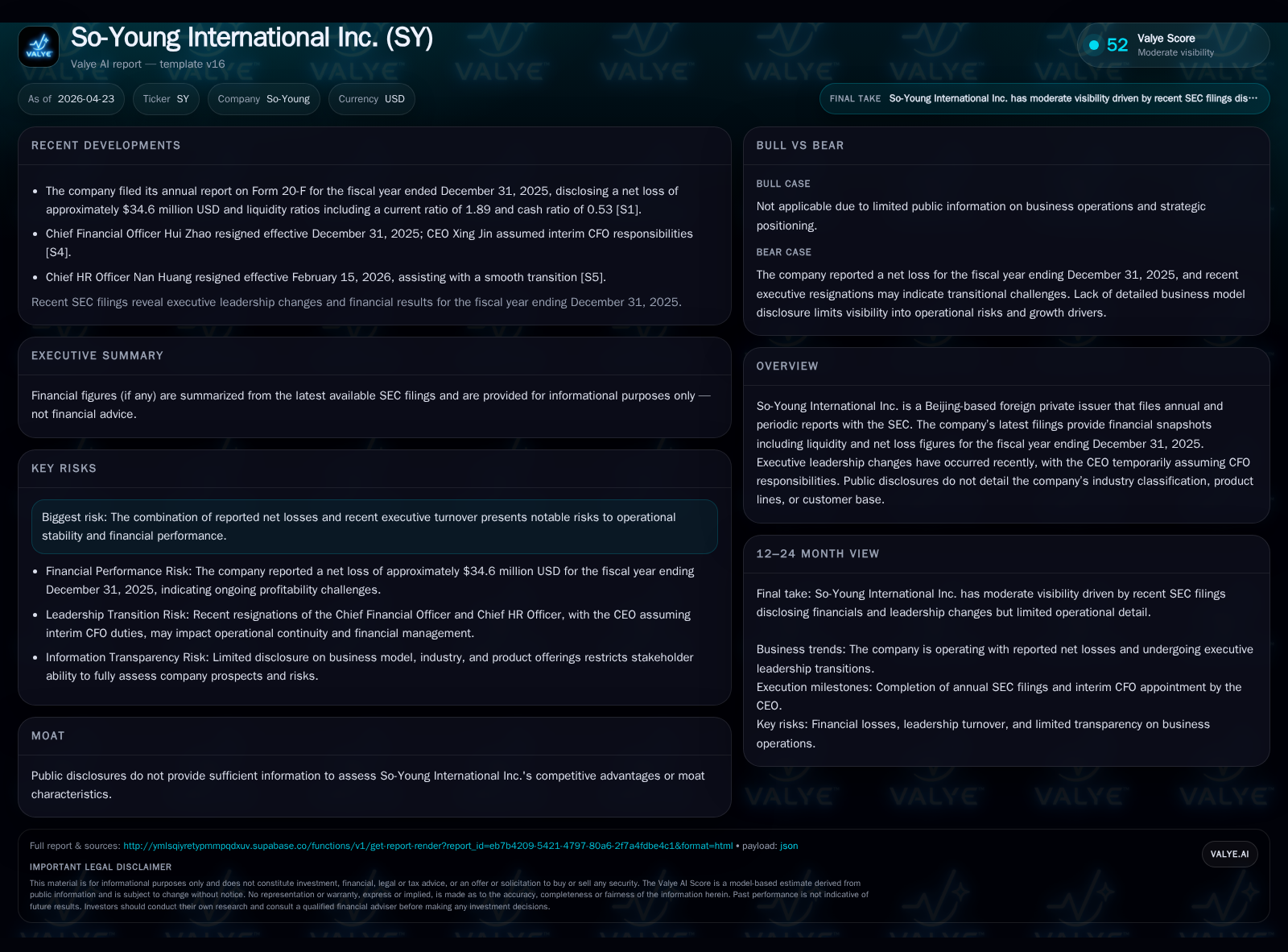
So-Young International’s latest quarterly filing reveals key executive turnover with the CEO temporarily adopting CFO responsibilities, signaling potential governance strains. The company continues to operate at a net loss despite modest improvement in operating income year over year, reflecting persistent profitability hurdles. Against a backdrop of increasing regulatory scrutiny on China’s internet medical aesthetic sector, So-Young’s multi-tiered practitioner platform faces both opportunities from rising digital adoption and risks including user trust issues and tightening capital flow controls. Monitoring forthcoming execution on regulatory compliance and financial stabilization will be crucial for assessing trajectory.
Recent Quarterly Operating Developments and Leadership Changes
So-Young International Inc.'s most recent SEC filing via Form 6-K dated March 25, 2026 [S2] confirms the ongoing leadership transition with CEO Xing Jin concurrently serving as interim CFO from December 31, 2025, following the resignation of Chief Financial Officer Hui Zhao for personal reasons [S8]. This dual role assumption by the CEO signals potential short-term governance strain or strategic reevaluation within the company’s executive ranks. Additionally, the departure of Chief HR Officer Nan Huang effective February 15, 2026 [S3] underscores recent personnel volatility in senior management.
No accompanying disclosure detailed immediate operational turnarounds or revenue growth acceleration in these filings. Instead, ongoing financial challenges remain evident as the firm grapples with losses amid evolving market dynamics.
Understanding So-Young’s Business Model: Platform Services in Medical Aesthetic Internet Ecosystem
According to the latest annual Form 20-F filed April 23, 2026 [S1], So-Young International operates primarily as an online platform that links consumers seeking medical aesthetic services with qualified practitioners across China’s extensive market. The platform leverages multi-tiered growth systems where practitioners are regularly assessed against consumer feedback metrics; unsatisfactory ratings can lead to service downgrades within the ecosystem. This evaluative mechanism serves both to incentivize quality delivery by providers and to maintain user trust in a sector traditionally challenged by inconsistent service quality.
Revenue generation likely derives from transaction fees on services booked via the platform, promotion of branded content including short-form video series aimed at enhancing practitioner visibility, and ancillary monetization routes tied to marketing exposure within the ecosystem. However, public disclosures stop short of granular segment breakdowns.
The core value proposition centers on offering consumers transparent access to vetted practitioners while supplying providers with digital tools to grow their reputations and customer base — an approach characteristic of emerging models in China’s booming but fragmented medical aesthetic field.
Competitive Context and Industry Structural Factors in China’s Regulatory Environment
So-Young navigates a competitive landscape formed by peer internet platforms that capitalize on rising demand for cosmetic medical services among Chinese millennials and Gen Z demographics. Yet its operational model is deeply enmeshed within a challenging regulatory matrix shaped by authorities such as the State Administration for Market Regulation (SAMR).
Since SAMR's establishment in March 2018 consolidating anti-monopoly enforcement powers [S1], policies have increasingly tightened control over internet platforms’ business practices. Amendments issued through April 2024 impose rigorous compliance requirements impacting growth strategies, including content oversight and competitive behavior restrictions.
Capital allocation is also circumscribed by PRC foreign exchange controls dictating cash transfers between So-Young's Cayman Islands holding entity and mainland Chinese subsidiaries under variable interest entity (VIE) arrangements. These restrictions may delay funding inflows needed for operating scale or development initiatives [S1]. Additionally, cooperation with major app distribution platforms such as Apple App Store and domestic Android marketplaces exposes the company to risks associated with abrupt policy or contractual shifts unfavorable to its application deployment and user acquisition efforts [S1].
Growth Drivers: Digital Adoption, Multi-Tiered Provider Feedback Systems, and Branding Expansion
Despite latent uncertainty around rapid adoption curves common to healthcare-related platforms in China [S1], structural tailwinds persist supporting So-Young's growth potential. Increasing mobile internet penetration coupled with shifting Chinese consumer preferences toward minimally invasive aesthetic procedures drive higher demand for accessible digital booking channels.
The platform's multi-tiered practitioner evaluation framework creates a network effect conducive to higher quality service offerings by enabling dynamic provider ranking tied directly to consumer satisfaction. This mechanism improves reliability perception critical to mitigating skepticism towards online medical content.
Brand extensions such as practitioner-curated short-form video campaigns add differentiation by enhancing practitioner-consumer engagement beyond transactional interactions.
These elements collectively form a multi-dimensional growth architecture embedded within China's fast-evolving digital health aesthetics market.
Constraints: Regulatory Risks, Market Skepticism, Executive Turnover, and Negative Net Earnings
The principal constraints weighing on So-Young include persistent regulatory risks that permeate all aspects of operations — notably intensified SAMR anti-monopoly enforcement standards limiting aggressive expansion tactics [S1]. Additionally, uncertainties arise from possible alterations or enforcement actions affecting app store partnerships which underpin mobile user accessibility.
User confidence barriers reflect enduring issues around online medical aesthetics credibility; failure to effectively educate users on platform value creates hurdles for scaling active user bases given ingrained skepticism toward health information sourced via digital channels [S1].
Executive turnover — exemplified most recently by the CFO replacement sequence culminating in CEO Xing Jin assuming financial leadership duties — introduces operational execution risk during pivotal strategic periods [S2][S3][S8]. Retentions challenges may further affect talent continuity critical for navigating regulatory complexities.
Financially speaking, So-Young reported continuous net losses through the recent fiscal year with only partial amelioration of operating income deficits [F1]. Sustained negative earnings indicate margin compression issues possibly linked to heavy investments in technology infrastructure or marketing amidst evolving competitive pressures.
Key Near-Term Milestones to Monitor for Execution and Demand Signals
Market observers should closely track several upcoming developments as indicators of So-Young’s operational stabilization:
- Subsequent quarterly filings post-March 2026 assessing revenue traction shifts or margin improvement trends.
- Appointment of a permanent CFO following current interim arrangement with CEO Xing Jin [S2][S8].
- Updates regarding regulatory compliance outcomes or changes impacting app distribution agreements influencing consumer access.
- User engagement metrics reflecting conversion rates from platform visits to actual treatment bookings or practitioner loyalty signals entrenched through feedback loops within the multi-tiered system.
- Management commentary clarifying strategic responses to prevailing anti-monopoly policies or FX capital mobility constraints documented within mainland subsidiaries’ operations.
These tactical updates will serve as critical benchmarks informing assessments whether So-Young can materially advance beyond operating challenges into sustainable growth phases.
Financial Profile: Earnings Trajectory, Cash Flow Pressures, Liquidity, and Capital Structure
Supporting evidence from So-Young's fiscal year ending December 31, 2025 confirms persistent financial stress albeit marginal progress compared to prior years [F1]. The company's operating loss narrowed substantially from approximately $85.6 million in 2024 to $40.9 million in 2025 (a roughly 52% improvement) while net losses declined from $80.8 million to $34.6 million over the same period — indicating some containment of profitability erosion but not yet approaching break-even levels.
Cash flow dynamics reveal worsening operating cash outflows declining markedly from negative $3.5 million in 2024 to negative $15.1 million in 2025 with concurrent capex surging more than twofold from $8.6 million to $28.1 million — underscoring intensified spending presumably related to platform development or scaling infrastructure investments.
Liquidity remains adequate based on a current ratio near 1.9x supported by cash & equivalents totaling roughly $59.8 million as of year-end 2025; however equity has contracted steadily over three years downward from $344 million at end-2023 to $222 million at end-2025 implying ongoing net asset depletion attributable largely to cumulative losses.
Dividends were modestly paid amounting to about $2.7 million versus previous years’ higher distributions despite lack of profitability evidencing cautious shareholder returns management amid restricted cash generation capabilities.
Historical performance (annual)
| FY | Net ($mm) | CFO ($mm) | OpInc ($mm) | Capex ($mm) | Net YoY |
|---|---|---|---|---|---|
| 2025 | -35 | -15 | -41 | 28 | +57.1% |
| 2024 | -81 | -4 | -86 | 9 | -2794.8% |
| 2023 | 3 | 3 | -9 | 7 | +131.5% |
| 2022 | -10 | -16 | -15 | 2 |
Source: SEC companyfacts cache [F1].
Capital returns and efficiency (annual)
| FY | Div ($mm) | Buybacks ($mm) | FCF ($mm) |
|---|---|---|---|
| 2025 | 3 | 2 | -43 |
| 2024 | 6 | 2 | -12 |
| 2023 | 18 | -4 | |
| 2022 | 2 | -19 |
Source: SEC companyfacts cache [F1].
In aggregate this profile reveals an enterprise still entrenched in scaling phase complexities compounded by macroeconomic headwinds yet striving for stabilization through operational adjustments and capital discipline.
This analysis synthesizes publicly filed SEC disclosures up through April 23, 2026 [S1][S2][S3][F1] without conjectural extrapolation beyond documented facts or numerical figures provided therein regarding So-Young International Inc.'s business operations, industry positioning, risk factors and financial standing.
Disclaimer: This is research-only, informational analysis and not investment advice. It may include AI-generated interpretation and general industry context. Always verify important details using primary sources.

Comments