
Helen of Troy’s Strategic Reset Targets Growth Amid Operational Challenges
A newly appointed CEO leads Helen of Troy through organizational changes aimed at revitalizing brand innovation and growth, following recent operational strains.
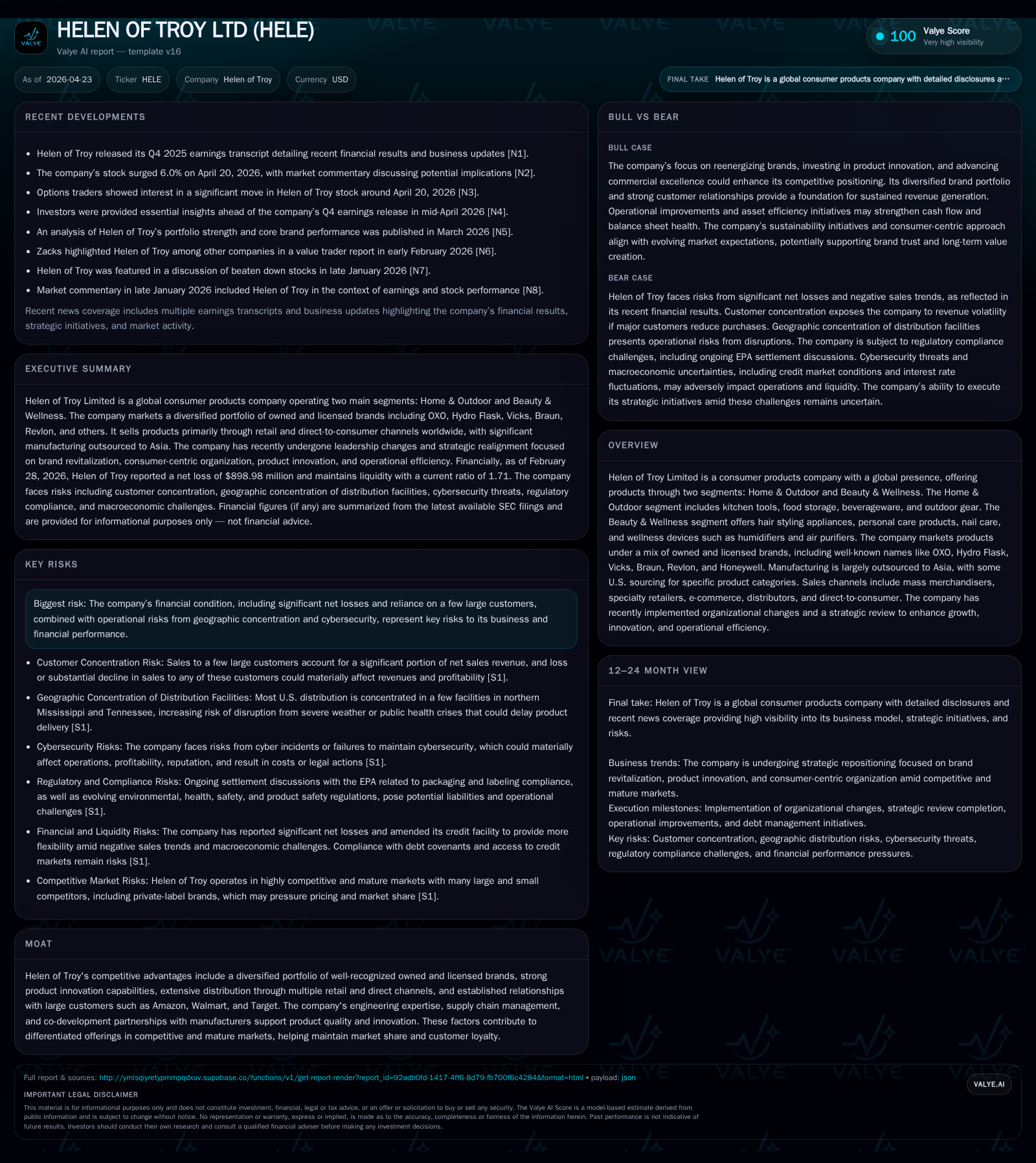
Helen of Troy Limited’s latest quarterly filing for Q3 fiscal 2026 highlights ongoing restructuring and strategic efforts under new leadership to stabilize revenue and profit growth after steep losses. The consumer products company operates across Home & Outdoor and Beauty & Wellness segments, relying on strong branded portfolios like OXO, Vicks, and Braun. However, the firm faces headwinds including concentrated manufacturing in Asia, exposure to large customers, regulatory risks, and recent operational disruptions. Its growth outlook rests on accelerating product innovation, sharpening brand focus, and improving supply chain resilience amid evolving retail dynamics. Financially, a significant operating loss marks FY2026 despite positive operating cash flow, underscoring both challenges and liquidity preservation.
Recent Operating Update
Helen of Troy's Q3 fiscal 2026 10-Q filing dated January 8, 2026, reveals an ongoing challenging environment with no material changes to risk factors since their last annual report [S2]. Following the close of FY2026 on February 28, the company reported a sharp operating income decline to -$782 million and net loss nearing -$899 million [F1], signaling significant operational pressures. However, the firm generated $171 million in operating cash flows with capex rising modestly to $39 million [F1], indicating an effort to preserve liquidity during losses.
On April 23, 2026, Helen of Troy also submitted an 8-K highlighting recent events including the appointment of a new CEO with a transformation mandate and ongoing strategic repositioning [S3]. This leadership change aims at accelerating growth through greater consumer centrism and portfolio rebalancing.
Business Model
Helen of Troy is a global consumer products player organized into two main segments: Home & Outdoor and Beauty & Wellness [S1][S25]. The Home & Outdoor segment includes kitchen tools (OXO), beverageware (Hydro Flask), food storage solutions, coolers, backpacks (Osprey), and outdoor gear. Beauty & Wellness offers hair styling appliances (Braun, Hot Tools), grooming tools, nail care (Olive & June), personal care liquids (Revlon license), humidifiers, thermometers (Vicks), air and water purifiers (Honeywell), heaters, and fans.
The company leverages a hybrid brand strategy combining owned brands with licensed names such as Revlon [S25]. Products reach consumers via multiple channels: mass merchandisers (Amazon represents ~20% of sales), specialty retailers like Sephora or Ulta in beauty categories, distributors, e-commerce platforms—including direct-to-consumer sites—and brick-and-mortar stores [S6][S9]. This omnichannel approach aims to capture diverse consumer segments but also requires robust coordination across supply chain and marketing functions.
Manufacturing is primarily outsourced to Asia—China (57% of finished goods in FY26) remains dominant despite diversification efforts toward Vietnam, Mexico, and other regions [S9][S11][S12]. The hair liquids category mainly sources from U.S. manufacturers reflecting quality or regulatory requirements. Such geographic sourcing reliance introduces supply chain risk amidst tariffs, labor cost inflation, trade restrictions, and political uncertainties.
Research and development focus on continuous product innovation is central to maintaining competitive advantage given shifting consumer preferences [S11]. The company also customizes certain product lines exclusively for large retailers to meet differentiated price points or packaging standards.
Industry Structure and Competitive Position
Helen of Troy competes in mature but fragmented home living and beauty/wellness markets characterized by intense competition from multinational conglomerates (e.g., Procter & Gamble for beauty) and private label brands from large retailers themselves .
The company’s moat derives primarily from its diversified portfolio of well-known owned and licensed brands combined with strong product innovation capabilities supported by engineering expertise. Its established relationships with top-tier customers—Amazon, Walmart (13% sales), Target (12%)—enable broad retail distribution but pose a concentration risk if these large buyers leverage bargaining power aggressively or switch suppliers [S6][S9][S15].
Operationally, the company faced setbacks such as automation issues at a Tennessee distribution center impacting order fulfillment in FY2025 that have since been remediated [S20]. However, geographic concentration of U.S. distribution centers remains a vulnerability exposing it to disruptions from severe weather or health crises [S16]. Cybersecurity threats also represent material risks given the growing digital footprint.
Regulatory compliance has become more complex especially after EPA discussions regarding labeling claims for air/water filtration products within its Beauty & Wellness segment led to repackaging costs and an accrued settlement liability of $4.4 million [S13][S19]. This underscores increasing scrutiny over product claims in wellness categories.
Growth Drivers and Constraints
The core growth drivers center on:
- Accelerating product innovation pipeline focusing on differentiated offerings aligned with evolving consumer trends such as health-consciousness or sustainability
- Modernizing go-to-market strategies to improve agility in responding to fragmented consumer attention via enhanced digital marketing analytics
- Strengthening brand loyalty through targeted campaigns leveraging omnichannel sales platforms
- Operational efficiency improvements including better inventory management and supplier diversification reducing Asia concentration risks
- Capital allocation focused on investing in high-return growth initiatives while monetizing non-core assets [S1][S27]
On the constraints side:
- Customer concentration amplifies risk if significant order reductions occur amid retail consolidation trends or macroeconomic slowdowns impacting discretionary spending
- Supply chain vulnerabilities linked to tariffs/legal tensions particularly involving China while managing rising labor costs remain critical constraints
- Regulatory environment tightening especially around environmental/safety certifications demands additional compliance investment which may delay launches or increase costs
- The structural maturity of both home living tools and beauty appliance markets requires constant innovation lest market share erodes to nimble competitors or private labels
- Geographic clustering of distribution infrastructure increases exposure to disruptive events impacting timely deliveries [S10][S15][S16]
What To Watch Next
Key milestones include:
- Progress updates on the new CEO-led strategic transformation concerning portfolio rationalization outcomes, innovation spending impact, and revenue/profit stabilization metrics.
- Quarterly revenue growth trends broken down by segment post-FY26 loss reporting, testing whether operational improvements translate into margin recovery.
- Further diversification in sourcing footprint outside China reducing geopolitical trade risk exposure.
- Resolution or developments around EPA settlement reflecting compliance risk management effectiveness.
- Customer order patterns from largest accounts signaling demand health amidst evolving retailer dynamics.
- Any adjustments in capital expenditure policy balancing growth investments versus liquidity preservation.
Financial Profile
Historical performance (annual)
| FY | Net ($mm) | CFO ($mm) | OpInc ($mm) | Capex ($mm) | Net YoY |
|---|---|---|---|---|---|
| 2026 | -899 | 171 | -782 | 39 | -826.4% |
| 2025 | 124 | 113 | 143 | 30 | -26.6% |
| 2024 | 169 | 306 | 261 | 37 | +17.7% |
| 2023 | 143 | 208 | 212 | 175 |
Source: SEC companyfacts cache [F1].
Capital returns and efficiency (annual)
| FY | Buybacks ($mm) | FCF ($mm) | ROE% |
|---|---|---|---|
| 2026 | 2 | 132 | -112.6 |
| 2025 | 103 | 83 | 7.4 |
| 2024 | 55 | 269 | 10.3 |
| 2023 | 18 | 33 | 9.6 |
Source: SEC companyfacts cache [F1].
The latest full fiscal year ending February 28, 2026 shows dramatically negative operating income of -$782 million compared to positive $143 million just two years earlier [F1], reflecting steep margin pressure possibly driven by impairments or restructuring charges disclosed around strategic transformation. Net loss also expanded massively to -$899 million from positive net incomes above $120 million during FY25. Despite these profits erosion signs, the firm maintained positive operating cash flow ($171 million) indicating working capital controls or non-cash charges contributing heavily to losses [F1]. Capex rose about 30% YoY reflecting reinvestment into operations or growth projects.
Liquidity appears stable with current ratio near 1.7x supporting near-term obligations comfortably. However equity dropped approximately half relative to prior year ($798 million vs $1.68 billion) pointing also toward asset impairments or cumulative losses consuming net assets during this turbulent period. Share repurchase activity was sharply curtailed indicating financial discipline priority shifting away from capital return at these low-profitability levels [F1].
This earnings profile underlines why ongoing strategy execution progress will be critical for Helen of Troy's turnaround prospects given competitive headwinds alongside macroeconomic uncertainty impacting consumer discretionary spending sectors.
This analysis is based on publicly available information contained within SEC filings as of April 2026 combined with sector knowledge. It does not constitute investment advice or recommendations.
Disclaimer: This is research-only, informational analysis and not investment advice. It may include AI-generated interpretation and general industry context. Always verify important details using primary sources.

Comments