
Capstone Holding Corp: Liquidity Challenges and Operational Pressures in Stone Products Manufacturing
Capstone's May 2026 quarterly report reveals critical liquidity strains, covenant waivers, and substantial equity dilution amid ongoing operational losses in a commoditized stone product market.
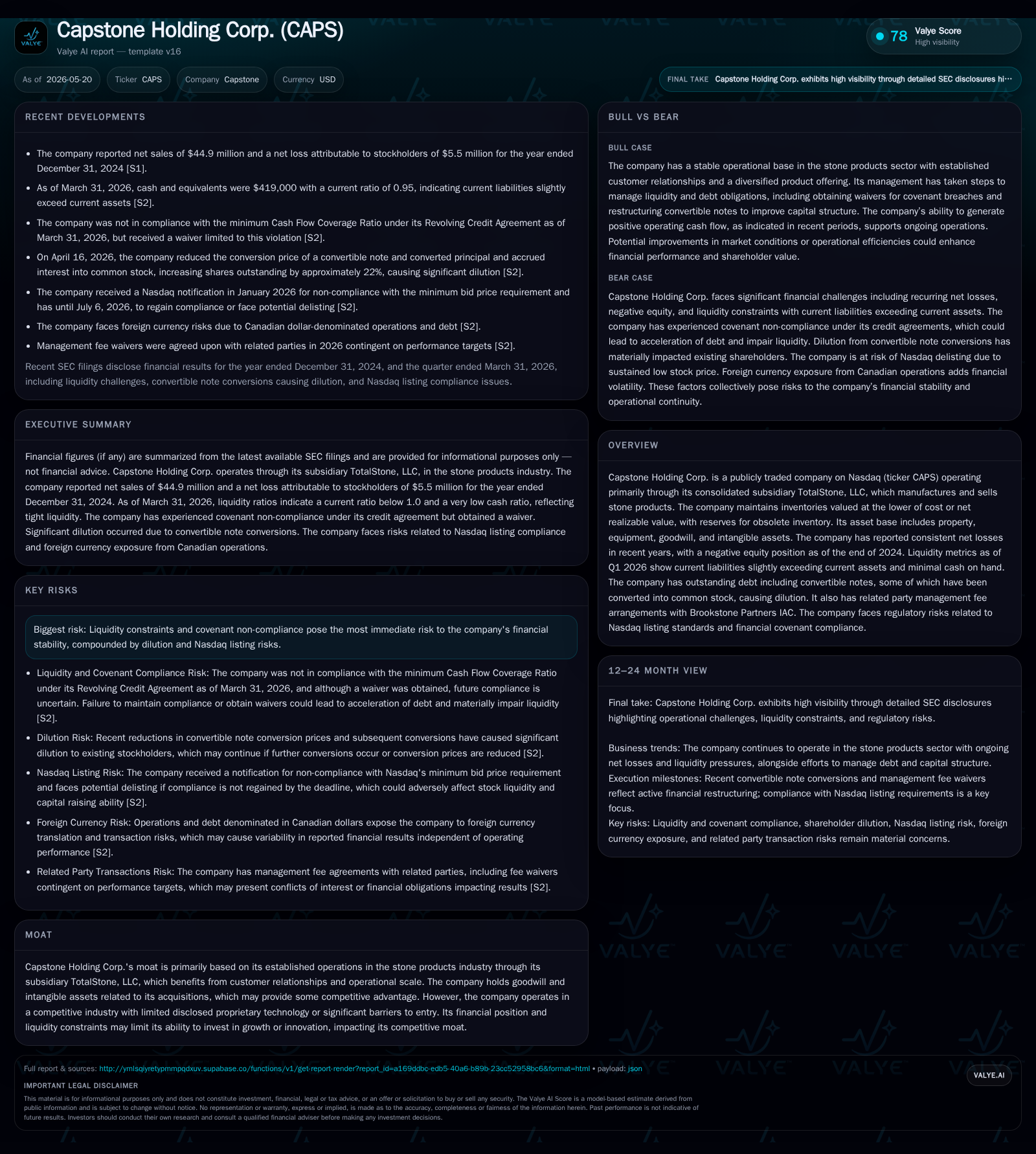
Capstone Holding Corp.'s latest 10-Q filing dated May 20, 2026 discloses a breach of the minimum Cash Flow Coverage Ratio under its revolving credit agreement as of March 31, 2026, leading to a limited waiver from its lender. Concurrently, conversion price reductions on convertible notes triggered significant equity dilution. Operating primarily through TotalStone LLC, Capstone faces persistent net losses in a highly competitive and commoditized stone products industry with limited product differentiation. The company’s liquidity position remains tight with a current ratio below one and modest cash reserves relative to debt. Key risks include potential debt acceleration on covenant breaches, further dilution from convertible notes, Nasdaq listing compliance pressures, and foreign exchange exposure from Canadian operations. Investors should monitor covenant compliance updates, refinancing efforts, and capital structure changes in upcoming disclosures.
Latest Quarterly Operational Update: Covenant Breach Highlights Liquidity Strain
Capstone Holding Corp.'s May 20, 2026 quarterly report [S2] reveals that as of March 31, 2026 the company was not in compliance with the minimum Cash Flow Coverage Ratio required under its Revolving Credit Agreement with Beacon Bank & Trust.
In parallel developments on April 16, 2026, Capstone reduced the conversion price applicable to $500,000 of principal under its October Note to $0.57 per share. This adjustment prompted conversion of approximately $1.73 million principal plus $120 thousand accrued interest into roughly 2.56 million common shares in one day—diluting existing shareholders by about 22% [S8]. This significant equity dilution impacts earnings per share and book value metrics negatively.
Cash and equivalents are limited to about $419 thousand while total debt stands around $15.7 million [F1], underscoring tight working capital conditions.
Business Model Overview: TotalStone LLC’s Stone Product Operations
Capstone primarily operates through its wholly owned subsidiary TotalStone LLC engaged in manufacturing and distributing natural stone products for construction and architectural use [S1]. Revenue arises from customer purchases of finished stone goods valued at the lower of cost or net realizable value with conservative inventory management practices including specific reserves for obsolescence.
The asset base includes property and equipment essential for production alongside goodwill and identifiable intangible assets related to acquisitions or customer relationships; however these intangible assets are modest relative to total assets indicating limited proprietary technology or brand differentiation.
Persistent net losses reported reflect ongoing margin pressures driven by input costs versus competitive pricing dynamics typical of this industry segment [F1]. The business model hinges on volume scale within a commodity market rather than specialized premium offerings.
Industry Dynamics: Competitive Pressures in Stone Product Supply
The stone product sector is highly competitive with many regional producers offering largely undifferentiated natural stone materials. Pricing is sensitive due to commoditization; demand closely tracks construction activity cycles rather than structural growth trends.
Barriers to entry remain low aside from standard environmental or mining regulatory requirements typical for industrial mineral processing operations. Customer switching costs are minimal, mostly related to supply reliability and quality consistency rather than brand loyalty or exclusive technologies.
While TotalStone’s scale provides some operational leverage, it does not insulate Capstone fully from pricing competition or margin erosion given the absence of significant technological moats [S1]. Regulatory compliance obligations such as Nasdaq listing standards impose administrative burdens but no strategic advantages.
Growth Prospects Limited by Financial Constraints
Potential growth avenues include expanding geographic reach through acquisitions like Canadian Stone Industries which broaden market access but introduce foreign exchange risk exposure [S21].
However, growth is fundamentally constrained by liquidity scarcity which limits capital available for upgrading production capabilities or broadening product lines [S2]. Recurring operating losses restrict reinvestment capacity while dependence on lender waivers curtails financial flexibility
Operational improvements or securing new contracts may provide incremental revenue gains but are unlikely to overcome systemic margin pressures without substantial strategic investment.
Key Risks: Liquidity Pressures, Covenant Dependence & Dilution Potential
Liquidity remains the primary risk factor given minimal cash reserves relative to approximately $15.7 million debt load [F1]. Convertible note terms that allow repricing reductions create ongoing dilution risks for shareholders which may depress stock valuations further [S8].
Nasdaq listing compliance concerns persist; sustained low trading prices risk delisting notifications potentially restricting access to public capital markets [S22]. Additionally, Canadian operations expose Capstone to currency volatility impacting reported results and dollarized debt servicing costs [S25].
Investor Watchpoints: Monitoring Covenant Compliance and Capital Structure Developments
Investors should closely monitor forthcoming quarterly filings for updates on covenant compliance post-waiver period alongside disclosures regarding refinancing strategies or working capital facility enhancements outlined in recent investor FAQs published May 6, 2026 [S3][S4]
Management’s actions toward stabilizing cash flows through cost controls or asset sales will be critical indicators of turnaround potential.
Market reactions to any proposed share structure adjustments such as reverse stock splits aimed at meeting Nasdaq bid price requirements also warrant attention due to their impact on shareholder value dynamics [S25].
Financial Snapshot: Current Liquidity and Leverage Profile
As of March 31, 2026, Capstone held current assets of approximately $25.98 million against current liabilities close to $27.43 million yielding a current ratio near 0.95 [F1]. Cash balances were limited at roughly $419 thousand compared with total debt near $15.7 million.
Net debt—total debt less cash—stands near $15.3 million reflecting elevated leverage pressures relative to liquid resources [F1]. These financial metrics corroborate the liquidity constraints highlighted by recent covenant breaches requiring lender waivers.
This analysis synthesizes publicly filed SEC documents up to May 2026 without projection or research view bias reflecting Capstone Holding Corp’s current operating and financial condition.
Disclaimer: This is research-only, informational analysis and not investment advice. It may include AI-generated interpretation and general industry context. Always verify important details using primary sources.

Comments