
Catalyst Acquisition Corp.: Blank-Check Structure, Media Focus, and the Strategic Uncertainty of Early-Stage SPACs
Catalyst Acquisition Corp. is a Cayman Islands-incorporated SPAC targeting acquisitions in traditional and digital media, including video games and publishing. Despite a substantial trust account and reported liquidity position, the company reported a significant net loss and has yet to announce a definitive business combination, leaving material uncertainty around future value creation.
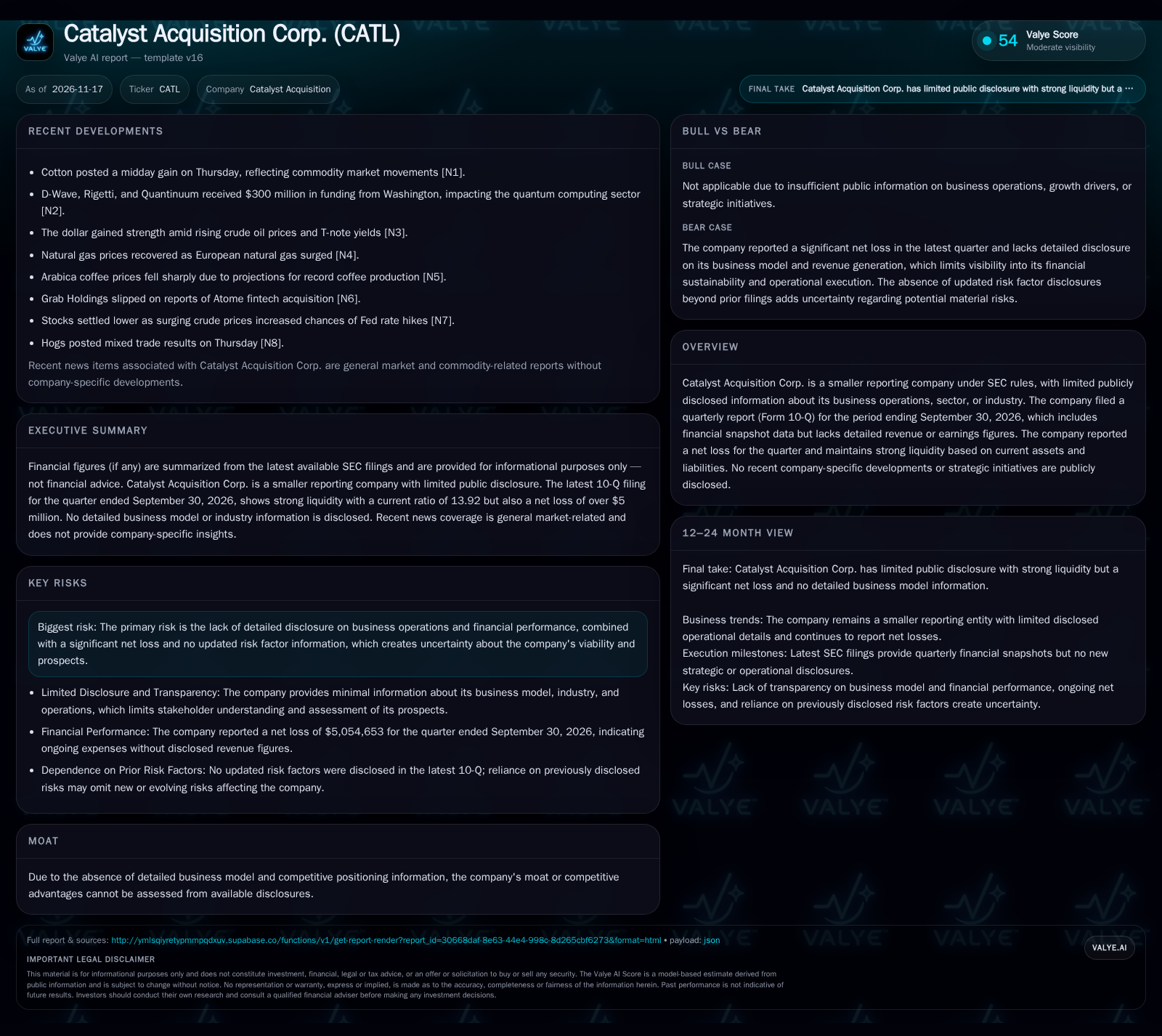
Catalyst Acquisition Corp. is a newly public SPAC with a $211.5 million trust account and a stated focus on media sector acquisitions. Ongoing costs and a narrowing deal window make milestone visibility and target clarity critical for assessing future prospects. [S1]
Catalyst Acquisition Corp. is a special purpose acquisition company (SPAC) that went public in July 2026, raising over $211 million to pursue a business combination in the media ecosystem, especially targeting video games and digital publishing. While its current liquidity is high due to unspent IPO proceeds, the company has yet to disclose a target or make material operational progress, and it reported a substantial net loss in its most recent quarter. As execution windows narrow and ongoing costs erode capital, Catalyst’s future depends on its ability to source, negotiate, and close a compelling acquisition in a competitive landscape where SPAC dealmaking faces increased scrutiny and redemption risk. [S1]
IPO Proceeds and Early-Stage Status Frame Immediate Outlook
Catalyst Acquisition Corp. completed its IPO on July 29, 2026, raising $200 million by selling 20 million units at $10 each, followed by a $2.7 million sponsor private placement and an $11.5 million partial over-allotment, resulting in $211.5 million placed in trust. As of September 30, 2026, the company reports current assets of $1,704,409 and current liabilities of $122,479, reflecting a current ratio of 13.92. However, the primary capital pool—over $211 million—remains segregated in the trust and is not included in operating current assets. The company also reported a net loss of $5,054,653 for the quarter, consistent with the typical cost structure of a pre-deal SPAC facing legal, advisory, and administrative expenses. No target or business combination has been announced, and no new risk factors or strategic updates have been disclosed since the IPO. [S1]
SPAC Economics: Trust Capital, Sponsor Incentives, and the Clock
By design, Catalyst Acquisition Corp. is structured to create value through the identification and acquisition of a private operating company, using the $211.5 million trust as acquisition currency. Until a deal is executed, the SPAC earns nominal interest on the trust (typically U.S. government securities), while incurring operating costs that result in predictable net losses. Sponsor economics are driven by founder shares that convert into a significant equity stake in the post-combination entity, provided a successful deal occurs. The fundamental economic challenge for Catalyst is to secure a target whose value and growth prospects can justify both the dilution from founder shares and the time value of capital for public holders. If a deal is not completed within the 36-month post-IPO window required by Nasdaq, the trust is liquidated and funds are returned to public shareholders—leaving the sponsor and early investors with sunk costs and no upside. This creates a strong incentive to pursue a transaction, but also the risk of suboptimal deal selection if high-quality targets are scarce or negotiating leverage shifts toward private sellers.
Media SPACs Face Crowded Field and Evolving Deal Dynamics
Catalyst’s stated focus on traditional and digital media—including video games, mobile gaming, and publishing—places it in a competitive arena where many SPACs and private equity funds are seeking similar assets. In recent years, the number of SPACs chasing media and gaming deals has surged, leading to increased competition for attractive targets and greater scrutiny of deal quality. Target companies with compelling growth or platform economics can often negotiate favorable terms or choose between multiple bidders. Meanwhile, the post-2021 SPAC environment has seen higher redemption rates, more rigorous SEC oversight, and market skepticism about deal valuations and long-term value creation. Without a disclosed target or unique sourcing edge, Catalyst is subject to these same competitive pressures. The actual strength of its negotiating position will depend on its ability to identify proprietary targets, structure attractive deal terms, and convince both PIPE investors and public shareholders of the merits of the eventual transaction.
A High-Quality Acquisition Could Unlock Premium Valuation
If Catalyst can identify and close on a high-growth, cash-generative media or gaming platform—especially one with strong network effects, recurring revenue, or intellectual property—public shareholders could see significant value creation. In this scenario, the merged company may attract PIPE (private investment in public equity) support at favorable terms, reduce redemption rates, and trade at a premium to the trust value. Confirmation would come from the announcement of a well-regarded target with clear sector fit, a robust pro forma business plan, and credible management continuity. Early indications might include a sharp reduction in redemption risk, positive analyst commentary, or the ability to raise additional capital alongside the merger. Falsification would occur if the deal is met with skepticism, high redemptions, or PIPE withdrawal, signaling market concerns about the target’s fundamentals or transaction structure.
Deal Uncertainty and Ongoing Costs Erode Optionality
The most plausible trajectory is that Catalyst continues incurring administrative and advisory costs while evaluating targets, with trust funds earning minimal interest. As time passes, the pressure to announce a deal mounts, especially as the 36-month deadline approaches. In this scenario, a deal is eventually announced, but with heightened redemption risk and possible need for additional capital to close. Confirmation would be the announcement of a letter of intent or definitive agreement, accompanied by investor communications and proxy filings. Falsification would occur if the company repeatedly extends its timeline, fails to secure a target, or encounters public shareholder resistance to proposed terms—resulting in trust liquidation and return of capital.
Failure to Secure a Compelling Target Triggers Liquidation
If Catalyst is unable to identify or agree terms with a suitable acquisition candidate, or if market conditions deteriorate further, the SPAC may be forced to liquidate at or before the 36-month deadline. In this scenario, public shareholders receive their pro rata share of the trust, but the sponsor forfeits its investment in founder shares and private placement units. Confirmation would include missed deal milestones, failed shareholder votes, or explicit announcements of trust liquidation. Falsification would require a credible target announcement and evidence that the deal can overcome redemption and regulatory hurdles.
Milestones and Events That Will Define Catalyst Acquisition’s Next Phase
Announcement of a letter of intent or definitive agreement for a business combination, including target identity, valuation, and deal terms.
Disclosure of PIPE (private investment in public equity) commitments or other external financing to support the transaction, if applicable.
Shareholder redemption rates at the time of deal vote—a lower redemption rate would indicate stronger market confidence in the transaction.
Regulatory or SEC feedback on deal structure, disclosures, or accounting treatment, especially if new rules affect SPAC merger mechanics.
Updates on extension votes, changes to the SPAC timeline, or amendments to trust or sponsor agreements.
Public communications from the sponsor or management team regarding target sourcing, sector focus, or proprietary deal flow (if disclosed).
Administrative expense trends and working capital burn, which would help assess the residual value for public shareholders if no deal is completed.
Disclaimer: This is research-only, informational analysis and not investment advice. It may include AI-generated interpretation and general industry context. Always verify important details using primary sources.

Comments