
Century Communities Balances Move-In-Ready Efficiency with Elevated Mortgage Headwinds
The July 2026 quarter underscores Century Communities’ operational resilience through geographic diversity and vertical financial services integration amid ongoing mortgage rate pressures.
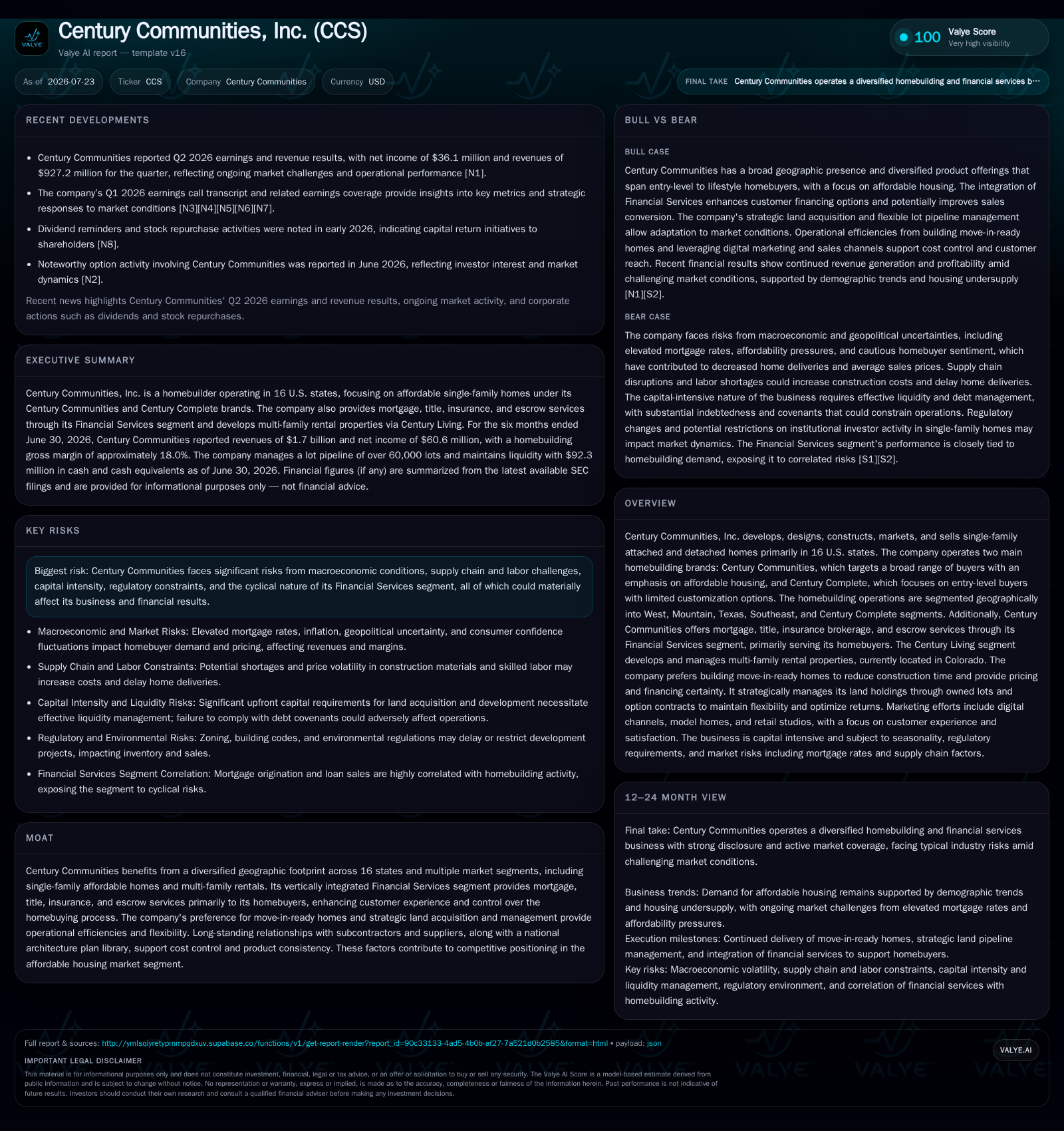
Century Communities’ latest quarterly report reveals a modest decline in homes delivered but a higher concentration of affordable, move-in-ready homes, reflecting cautious buyer behavior under elevated mortgage rates [S2][N1]. The company's dual-brand strategy targets entry-level and move-up buyers with differentiated customization options, supporting demand segmentation [S1][S2]. Operationally, Century's emphasis on move-in-ready homes drives faster build cycles and margins, differentiating it from peers reliant on build-to-order models. Geographic diversification across five segments buffers regional downturns, while the integrated Financial Services segment enhances customer financing and margin stability [S1]. Nevertheless, risks persist from macroeconomic volatility, housing affordability constraints, cancellation rates, and capital intensity [S1][S2]. Monitoring backlog trends and pricing power will be critical near-term demand indicators [S2][N1].
Second Quarter Operational Results Shift in Affordable Home Demand
In the second quarter of 2026, Century Communities delivered approximately 4,519 homes across its operations — a slight decrease from prior trends yet accompanied by an incremental rise in the proportion of homes priced below Federal Housing Administration-insured mortgage limits to roughly 96% [S2]. This affirms the company’s sustained emphasis on affordable housing even amid increasingly challenging macroeconomic conditions characterized by elevated mortgage interest rates and geopolitical uncertainty driving buyer caution [N1][S2]. Around 98% of delivered homes were built as move-in-ready units rather than custom-built orders. This shift towards inventory-style product combined with a high cancellation rate environment points to buyers seeking financing certainty and quicker delivery times in an affordability-constrained market.
Order backlog levels remain relatively stable despite softness in delivery volume; this divergence highlights ongoing consumer reticence around home purchases at prevailing rates but also reflects Century’s success in maintaining contractual commitments through its segmented brand appeal and efficient inventory management strategies. Cancellation metrics underscore this cautious buyer sentiment but have not escalated materially to disrupt revenue recognition trajectories yet.
Leveraging a Dual Brand Model: Targeting Affordability Through Product Segmentation
Century Communities operates under two principal brands catering to distinct market niches. The "Century Communities" brand provides homes primarily targeting affordable housing segments inclusive of entry-level up to lifestyle buyers. Here customers benefit from limited customization options allowing upgrades tailored to preferences without lengthy build cycles. Conversely, "Century Complete" zeroes in on true entry-level buyers typically purchasing via retail studios or centralized locations including digital platforms. These homes usually feature no upgrade choices, enhancing transaction efficiency and reducing construction variability [S1][S2].
This dual-brand strategy facilitates serving a broader base while optimizing sales velocity through distinct distribution channels that also help manage cancellation risk via differing customer deposit requirements. Early evidence suggests that digital-centric sales efforts at the Century Complete brand improve lead conversion efficiency by simplifying purchase decisions for first-time buyers navigating high mortgage hurdles.
Move-In-Ready Approach: Operational Leverage Against Construction and Labor Cost Pressures
More than 98% of newly delivered homes in Q2 were move-in-ready rather than built-to-order constructions—a strategic choice delivering operational benefits. This approach shortens build cycle times substantially relative to traditional custom builds seen among some peers like PulteGroup who maintain larger customization capabilities. The compressed construction timeline reduces exposure to volatile subcontractor labor costs and input-price inflation common within the supply chain currently affecting residential builders nationwide.
Additionally, cultivating strong subcontractor relationships combined with a national architecture plan library ensures consistent product quality while enabling advantageous pricing negotiations for volume-based work scheduling [S1]. These efficiencies underpin gross margin resilience amid rising cost pressures observed across homebuilding peers.
Mitigating Regional Volatility: Geographic Diversification as a Strategic Buffer
Century’s footprint spans 16 states segmented into five reporting areas: West (including California and Washington), Mountain (Arizona, Colorado, Nevada, Utah), Texas, Southeast (Florida through Tennessee), plus the Century Complete brand presence across multiple states mainly concentrated in southeastern and midwestern markets. Such geographic diversification disperses regulatory risk related to land entitlement delays or local zoning challenges while balancing varying regional economic growth rates influencing buyer demand [S1][S2].
For instance, strength in Texas and Mountain regions partially offsets softness experienced in California’s higher-cost West segment where affordability constraints are more acute. Supply chain disruptions have had differential impacts too—localized material shortages or labor availability strain certain zones less than others—allowing Century to flexibly reallocate capital across markets showing better return profiles.
Vertical Integration of Financial Services Enhancing Customer Conversion and Margin Stability
A significant competitive differentiator is Century's vertically integrated Financial Services segment encompassing Inspire Home Loans (mortgage origination), Parkway Title (title services), IHL Home Insurance Agency (insurance brokerage), and IHL Escrow (escrow services) primarily serving its own homebuyers. This full-service capability eases buyer financing complexity prevalent under elevated mortgage rate regimes by offering tailored loan solutions bundled within the purchase process [S1].
Vertical integration supports faster sales cycle completion due to streamlined underwriting workflows alongside capturing additional fee income that enhances overall margins compared to counterparts lacking such integrated infrastructure (e.g., Lennar Corporation’s model is often cited). It also affords greater insights into borrower profiles facilitating proactive risk management during credit tightening phases.
Growth Opportunities in Product Innovation and Multi-Family Rental Expansion
While new home deliveries compose Century's core revenue source, the company also pursues multi-family rental developments under its Century Living segment currently focused in Colorado [S1]. Although nascent relative to homebuilding volumes, this line introduces recurring income streams diversifying revenue away from solely transactional real estate sales
Moreover, product innovation around limited customization paired with affordability aims to tap unmet housing needs amid persistent supply shortages nationally. Government incentives targeting affordable housing could further catalyze growth signals if leveraged effectively alongside evolving construction technologies improving cost containment.
Risks Held in Check: Macroeconomic Factors, Cancellation Rates, and Capital Intensity
Key risks remain apparent including sustained pressure from high mortgage interest rates eroding buyer affordability despite low inventory backdrops creating structural demand tension. Elevated cancellation rates indicate consumer hesitancy exacerbated by economic uncertainty though currently manageable within booking pipelines [S2].
Supply chain inflation notably elevates raw material costs directly impacting construction expenses; maintaining subcontractor relationships becomes pivotal to controlling these inputs within budgeted ranges. Land acquisition remains capital intensive requiring sizable upfront investment affecting balance sheet leverage given Century reported net debt nearing $1.36 billion as per latest data points [F1]. Regulatory hurdles around entitlement processes add additional timing uncertainty particularly in California-heavy regions.
Near-Term Watchpoints: Order Book Development, Pricing Power, and Mortgage Market Dynamics
Investor focus should monitor sequential movements in order backlog levels as early signals of shifting demand confidence post Q2 lull. Renewed backlog growth would imply improved conversion momentum despite mortgage-cost headwinds. Pricing power sustainability amidst heavier discounting or incentives warrants assessment given affordability thresholds observed across segments.
Additionally, tracking financial services revenue penetration offers insights into incremental margin capture effectiveness amid tighter credit conditions influencing speculative buyer participation rates [N1][S2]. Macro factors such as Federal Reserve policy shifts impacting mortgage yields remain key overarching variables shaping the residential homebuilding outlook further into late-2026
Financial Profile Discussion: Leverage, Cash Position and Returns Analysis
As of June 30, 2026, Century Communities held approximately $92 million in cash and cash equivalents juxtaposed against total debt estimated near $1.45 billion resulting in net debt around $1.36 billion reflecting typical capital structure for sizeable public homebuilders balancing working capital needs for land acquisition and ongoing construction activity [F1]. This leverage level underscores exposure to refinancing risk especially if macroeconomic dynamics constrict access to credit markets or elevate funding costs materially.
Operating income metrics remain under pressure given elevated costs and reduced delivery volumes relative to peak years; thus return on invested capital is sensitive to cycle timing though partially mitigated by efficiency gains associated with move-in-ready builds.
This analysis reflects only publicly available information as of mid-2026 filings without investment research views or forecasts.
Disclaimer: This is research-only, informational analysis and not investment advice. It may include AI-generated interpretation and general industry context. Always verify important details using primary sources.

Comments