
Altisource Portfolio Solutions Strengthens Service-Tech Integration Despite Customer Concentration Risks
Q2 2026 results reveal resilience in Altisource’s integrated real estate and mortgage service platform, tempered by persistent customer concentration and vendor dependencies.
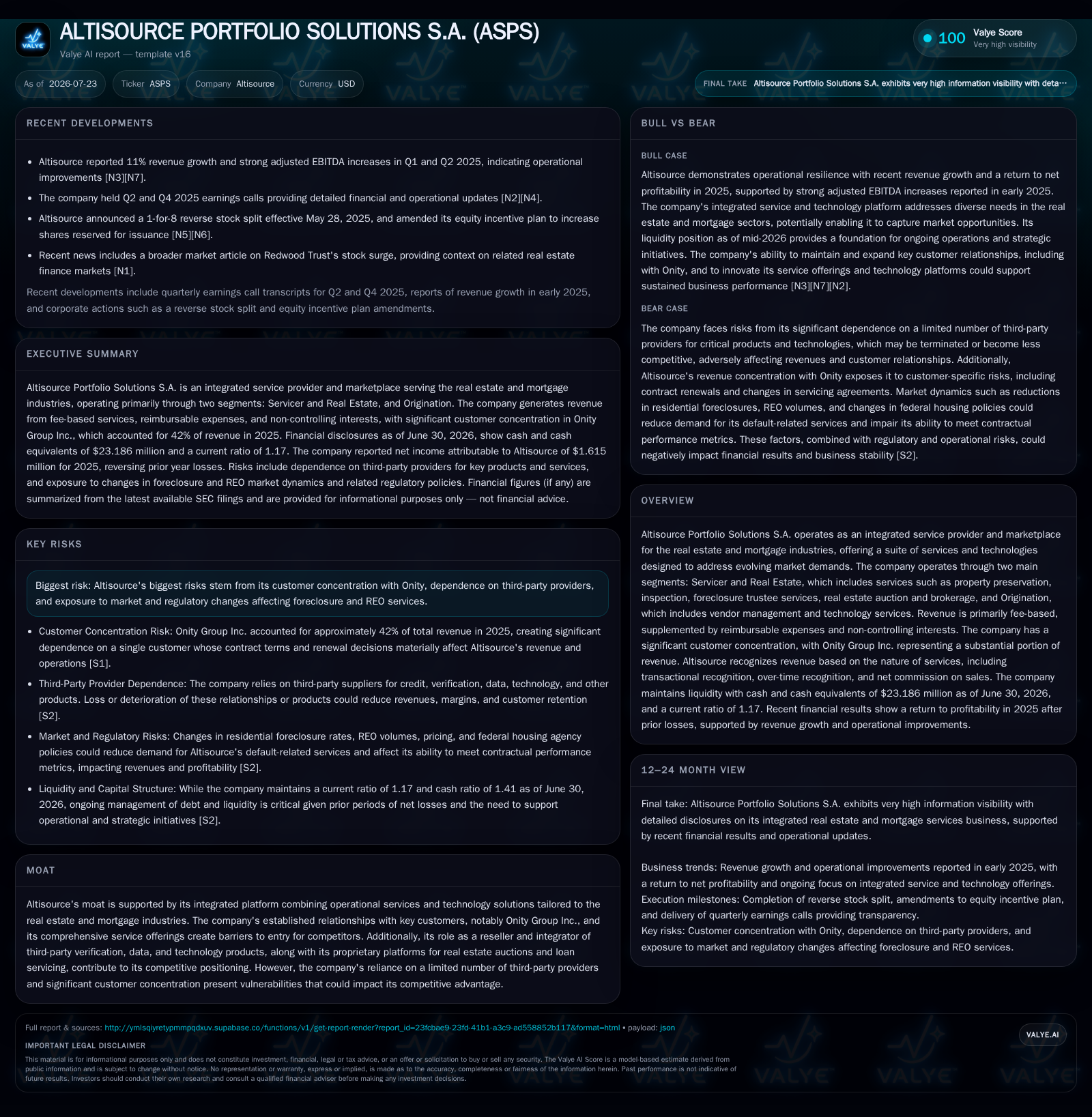
Altisource Portfolio Solutions’ latest quarterly filing highlights stable fee-based revenue streams across its servicer and real estate segments amid ongoing challenges stemming from significant customer concentration and dependence on third-party vendors. The company continues leveraging its proprietary technology platforms alongside operational services to differentiate in a cyclical real estate services industry. However, risks related to revenue concentration with Onity Group Inc. and restrictions from third-party providers underline potential volatility. Key growth drivers remain tied to mortgage market activity, foreclosure volumes, and technology adoption, with the near-term outlook focusing on contract renewals and compliance milestones. The balance sheet shows moderate leverage with a current ratio of 1.17 and working capital cushions supporting operational needs as of Q2-end.
Q2 2026 Operating Results Highlight Integrated Service-Tech Model Amid Concentration and Vendor Risks
Altisource Portfolio Solutions S.A. reported its Q2 2026 results on July 23, 2026, underscoring the continued execution of its hybrid business model that combines operational real estate services with proprietary and third-party technology platforms [S2]. The company’s Servicer segment remains focused on property preservation, foreclosure trustee services, and inspection activities, while the Real Estate segment encompasses brokerage, real estate auctions, and technology-enabled vendor management solutions. Transaction volumes in these segments continue to be influenced by mortgage market dynamics, including delinquency rates, foreclosure activity, and REO (Real Estate Owned) inventory levels, which drive demand for Altisource’s fee-based services [S2].
Despite operational stability, Altisource faces persistent risks related to its significant customer concentration, with Onity Group Inc. representing a substantial portion of revenue, and its dependence on a limited number of third-party providers for critical verification, data, and technology products. These dependencies expose the company to potential contract non-renewals, pricing pressures, or product discontinuations that could materially impact revenue streams and margins [S2], [S3]. The company’s integrated platform approach, which bundles operational services with technology solutions, differentiates it from peers that typically focus on either standalone service provision or technology platforms, fostering customer switching costs but also increasing vendor reliance [S1].
Business Model and Revenue Composition: Fee-Based Services with Technology Resale and Reimbursables
Altisource’s revenue primarily derives from fee-based transactional services across property preservation, foreclosure trustee services, real estate brokerage, and auction activities. These fees are closely tied to operational KPIs such as the number of properties managed, foreclosure and REO volumes, and transaction counts in auctions and brokerage [S1]. Additionally, reimbursable expenses—costs passed through for outsourced vendor work—contribute to revenue but typically carry lower margins, exerting pressure on overall profitability [S1].
The company also acts as a reseller and integrator of third-party verification tools, credit data products, and technology platforms, including proprietary auction marketplaces and vendor management software. This hybrid model positions Altisource between traditional service providers and pure technology firms, enabling it to offer end-to-end solutions that integrate data, operational workflows, and compliance services for mortgage servicers and real estate investors [S1]. However, this model entails risks related to third-party vendor contract terms and product availability, which are critical to maintaining competitive pricing and service quality [S2].
Competitive Landscape and Industry Positioning
Within the real estate and mortgage services sector, Altisource competes against a range of firms including mortgage servicing companies, property preservation providers, real estate brokerage firms, and technology platform vendors. Its integrated service and technology platform approach distinguishes it from peers such as ServiceLink Holdings, which primarily focus on operational services without the same level of technology integration. This full-stack positioning supports higher switching costs and deeper customer relationships but also concentrates risk exposure [S1], [S2].
Customer concentration remains a notable vulnerability, with Onity Group Inc. accounting for a significant share of revenues. This concentration risk contrasts with peers that maintain more diversified customer bases, potentially leading to greater revenue volatility for Altisource if contract renewals or customer demand fluctuate [S2]. Additionally, competition arises from vertically integrated mortgage servicers developing in-house capabilities and technology disruptors offering specialized solutions, underscoring the importance of ongoing platform innovation and customer retention efforts.
Growth Drivers: Mortgage Cycles, Foreclosure Trends, Regulatory Complexity, and Technology Adoption
Altisource’s revenue growth is closely linked to mortgage origination and refinancing cycles, which influence loan volume and servicing activity [S1]. Increased mortgage originations and refinances drive demand for vendor management and inspection services, while economic stress periods that elevate defaults and foreclosures increase the need for property preservation and REO asset disposition through auctions
Regulatory complexity in foreclosure and mortgage servicing processes favors specialized compliance services embedded within Altisource’s offerings, creating a baseline demand that can be less sensitive to market cycles but subject to regulatory changes [S1], [S2]. The company also benefits from a broader industry trend toward outsourcing non-core operational functions by mortgage servicers, accelerating adoption of integrated vendor management platforms that combine data integration with field services.
Technology platform adoption rates serve as a key leading indicator of incremental revenue growth beyond traditional fee-for-service models, reflecting Altisource’s ability to expand its footprint within client workflows and enhance operational efficiency.
Risk Factors: Customer Concentration, Vendor Dependencies, and Market Volatility
The company’s high customer concentration with Onity Group Inc. presents a material risk to revenue stability. Contract renewal outcomes with this major client are critical near-term milestones, with any loss or reduction in business potentially causing significant revenue disruption [S2], [S3].
Vendor dependency risk is also significant. Altisource relies on a limited number of third-party providers for essential verification, data, and technology products. Contract terminations, pricing increases, or product discontinuations by these suppliers could impair Altisource’s ability to offer competitive bundled solutions, compress margins, or force costly operational adjustments [S2]
Macroeconomic factors such as fluctuations in mortgage origination volumes, foreclosure rates, and REO inventory directly impact transaction volumes and fee income. Regulatory changes affecting foreclosure trustee services could increase compliance costs or restrict service offerings, adding uncertainty to future results [S1], [S2].
Key Upcoming Milestones and Monitoring Points
Critical near-term indicators include contract renewal negotiations with Onity Group Inc. and other major customers, which will provide insight into revenue continuity and customer retention. Similarly, developments in agreements with third-party technology and data providers warrant close attention due to their potential impact on service offerings and margins.
Regulatory developments affecting foreclosure processing and trustee services remain important catalysts, with changes potentially altering demand patterns or compliance requirements. Monitoring rulemaking timelines and related litigation outcomes will be essential to anticipate operational impacts.
Finally, tracking adoption rates and enhancements of Altisource’s proprietary technology platforms, including auction marketplaces and vendor management solutions, will offer evidence of successful market penetration and the sustainability of growth beyond legacy operational services.
Financial Position and Profitability Overview
As of June 30, 2026, Altisource’s balance sheet reflects total debt of approximately $169 million and cash and equivalents of about $23 million, resulting in net debt near $146 million [F1]. Current assets of roughly $57 million against current liabilities of approximately $48 million yield a current ratio of 1.17, indicating moderate short-term liquidity
Operating income remains modestly positive but constrained, reflecting a tight margin environment influenced by the mix of reimbursable expenses and fee-based revenues [F1]. The reimbursable component, while contributing to top-line growth, tends to dilute gross margins compared to pure fee revenues, a common characteristic in real estate services firms blending pass-through costs with transactional commissions
This capital structure and profitability profile suggest manageable leverage consistent with sector norms but highlight the importance of margin management and cost control, particularly given vendor cost risks and customer concentration exposures.
This analysis is based exclusively on Altisource Portfolio Solutions S.A. filings dated July 23, 2026, including the Q2 2026 10-Q [S2], the concurrent 8-K event filing [S3], the 2025 annual 10-K [S1], and the latest financial snapshot data [F1]. It provides a detailed business model and operating context review within the real estate and mortgage services industry, emphasizing key operating metrics, competitive positioning, risk factors, and financial condition without investment research views.
Financial snapshot summary
As of June 30, 2026, the company holds $23 million in cash and equivalents against $169 million in total debt, with net debt approximating $146 million [F1]. Current assets of $57 million and current liabilities of $48 million produce a current ratio of 1.17x, reflecting moderate liquidity to cover short-term obligations
Disclaimer: This is research-only, informational analysis and not investment advice. It may include AI-generated interpretation and general industry context. Always verify important details using primary sources.

Comments