
NovoCure’s Advancements in Tumor Treating Fields Reflect Strategic International Growth
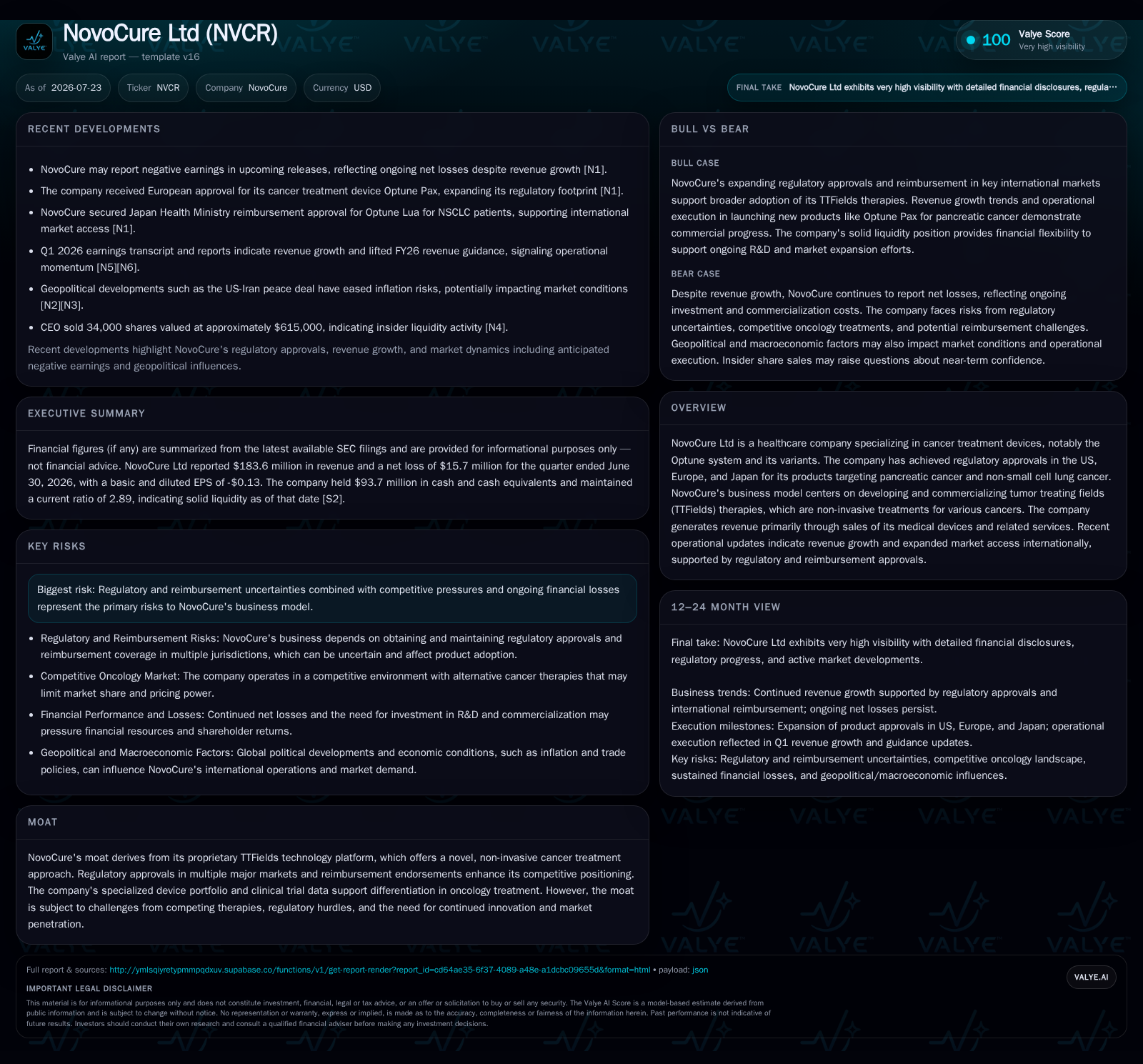
NovoCure reports sustained revenue growth driven by expanded regulatory approvals and reimbursement progress across major markets, bolstering its device commercialization despite ongoing operating losses.
In its Q2 2026 filing, NovoCure demonstrated solid operational momentum with growing patient treatments and rising revenue supported by new regulatory clearances for its TTFields devices in pancreatic and lung cancer indications. Expanded reimbursement coverage internationally aids broader adoption and market access. The business model capitalizes on device sales complemented by recurring consumables, while ongoing R&D and commercial expenses maintain operating losses. Sustained execution on regulatory milestones, patient uptake, and reimbursement remain crucial for scaling TTFields therapy adoption amid competitive oncology treatment alternatives.
NovoCure’s Q2 2026 Operational Momentum Reflects Strategic Expansion of TTFields Therapy
NovoCure’s Q2 2026 results underscore continued commercial progress with a notable increase in the number of patients treated using its Tumor Treating Fields (TTFields) platform, driving revenue growth despite persistent operating losses typical of oncology device innovators investing in scale and market development [S2]. The company’s revenue expansion correlates with broader clinical adoption across multiple cancer indications, supported by recent regulatory approvals and reimbursement advancements. Elevated research and development (R&D) and selling, general and administrative (SG&A) expenses reflect ongoing investments in label expansions and geographic market penetration, which are critical to sustaining patient volume growth and device commercialization [S2]. NovoCure’s ability to convert regulatory milestones into tangible increases in patient treatments serves as a key near-term operating indicator.
Expanding Market Access Through Regulatory Approvals and Reimbursement Stability
In the first half of 2026, NovoCure achieved significant regulatory progress, including CE Mark approval in Europe for Optune Pax® targeting locally advanced pancreatic cancer and expanded U.S. Food and Drug Administration (FDA) clearances for non-small cell lung cancer (NSCLC) indications [S1],[N6]. These approvals materially broaden the company’s addressable patient population beyond its initial glioblastoma multiforme (GBM) focus, enabling entry into high-incidence solid tumors with substantial unmet needs. Concurrently, NovoCure resolved Medicare billing privilege revocation issues, which were administrative rather than compliance-related, restoring stable reimbursement pathways critical for predictable revenue recognition and patient access in the U.S. market [S29].
This dual advancement in regulatory clearance and reimbursement coverage enhances market access by reducing payer-related uncertainties and facilitating oncology providers’ confidence in prescribing TTFields devices. Given the high cost and novel nature of TTFields therapy, securing durable reimbursement coverage in major Western markets is foundational to scaling patient adoption. NovoCure’s commercial strategy emphasizes simultaneous expansion of treatment indications and insurance coverage to overcome traditional payor skepticism toward innovative medical technologies.
TTFields Technology: Differentiation and Competitive Positioning in Oncology
NovoCure’s TTFields technology represents a non-invasive therapeutic modality that delivers alternating electric fields to disrupt mitotic processes in cancer cells, distinguishing it from conventional chemotherapy, radiotherapy, and emerging immunotherapies [S1],[N7]. Unlike systemic treatments, TTFields offers a localized mechanism with a favorable safety profile characterized by minimal systemic toxicity, which can be advantageous in combination regimens.
However, clinical adoption hinges on demonstrating consistent efficacy through robust trial endpoints such as overall survival and progression-free survival, as well as ensuring patient compliance with wearable device usage. Recent Phase 3 data from the TRIDENT trial indicated no statistically significant survival benefit when TTFields was initiated concurrently with chemoradiation compared to sequential initiation, though safety and tolerability were confirmed [S26]. This outcome highlights the challenge of achieving breakthrough efficacy in a competitive oncology landscape dominated by well-established modalities.
NovoCure’s clinical trial designs align with industry standards set by leading biotech oncology firms like Amgen and Exelixis, emphasizing rigorous endpoint validation and integration into multidisciplinary treatment protocols [N9]. Nonetheless, the requirement for patient adherence to a wearable device introduces operational complexity not typically encountered with pharmaceutical therapies.
Business Model: Device Sales Augmented by Consumables and Clinical Support Services
NovoCure’s revenue model is anchored in upfront sales of TTFields medical devices classified as durable medical equipment, supplemented by recurring revenue streams from consumable transducer arrays that require periodic replacement, and clinical support services that facilitate patient adherence and optimize treatment outcomes [S1]. This hybrid model enhances gross margin stability by coupling one-time device sales with predictable consumable replenishment and service contracts, creating switching costs that support customer retention.
The scalability of this model depends on expanding the number of patients treated across approved indications and geographies. Each new regulatory approval increases the prescriber base and potential device unit sales, while geographic expansion into markets with favorable reimbursement policies amplifies revenue growth potential. Clinical support services also play a strategic role in improving patient compliance, a critical factor influencing real-world effectiveness and payer confidence.
Growth Drivers: Label Expansion, Geographic Penetration, and Clinical Awareness
NovoCure’s growth trajectory is propelled by multiple structural factors. Label expansions into pancreatic and NSCLC indications, validated through clinical trials and regulatory approvals, open new high-incidence patient populations [S2],[N6]. Geographic expansion efforts include regulatory clearances in Europe and Japan, broadening market reach and diversifying revenue sources.
Increased physician and patient awareness, driven by targeted marketing and education initiatives, fosters clinical adoption by highlighting TTFields’ safety profile and potential benefits as a complementary therapy. Epidemiological trends showing rising incidence rates of pancreatic and lung cancers provide a growing demand base that supports durable revenue growth independent of economic cycles.
Ongoing R&D investments focus on evaluating TTFields in combination with immunotherapies and novel agents, aiming to unlock additional indications and enhance clinical efficacy over the medium to long term.
Risks and Operational Challenges
NovoCure faces several risks that could impact its growth and operating results. Regulatory approval timelines remain uncertain, particularly in markets outside the U.S. and Europe where local standards and processes vary [S4]. Reimbursement coverage outside primary markets is not guaranteed and may be restrictive, potentially limiting patient access and revenue generation. Competition from emerging targeted molecular therapies and immuno-oncology agents challenges TTFields’ positioning within the oncology treatment paradigm.
Patient adherence to the wearable TTFields device is a critical operational risk; suboptimal compliance can reduce therapeutic effectiveness and negatively influence payer reimbursement decisions [S25]. Clinical trial outcomes that fail to demonstrate clear survival benefits could delay label expansions or restrict indication sizes. Intellectual property disputes, while not currently material, remain a potential threat to exclusivity.
Addressing these risks requires NovoCure to maintain proactive payer engagement, invest in device usability improvements, and continue generating robust clinical evidence.
Key Metrics and Upcoming Catalysts to Monitor
Important near-term indicators include quarterly patient treatment volumes, which serve as direct proxies for clinical adoption and revenue growth [S2]. Regulatory milestones such as additional FDA or PMDA approvals and label expansions will materially affect addressable markets. Reimbursement coverage developments, especially in new geographies, will influence market penetration and billing consistency.
Clinical data presentations at major oncology conferences, including ASTRO 2026, will impact physician acceptance and payer perceptions. Management’s commentary on operating expense trends and financial discipline during upcoming earnings calls will provide insight into the balance between growth investments and cost control [S3]. Monitoring these variables will clarify the sustainability and scalability of NovoCure’s TTFields commercialization strategy.
Financial Position Supports Ongoing Investment Amid Operating Losses
As of June 30, 2026, NovoCure held approximately $93.7 million in cash and cash equivalents, with current assets totaling $638.5 million against current liabilities of $220.7 million, yielding a strong current ratio of 2.89x [F1]. The company reported operating losses near $154 million for the prior fiscal year, reflecting substantial R&D and SG&A expenditures necessary to support clinical development and global commercialization efforts [F1].
NovoCure’s balance sheet strength, characterized by zero debt and ample liquidity, provides a runway to sustain investments in regulatory approvals, reimbursement expansion, and market development. The company’s financial strategy appears focused on balancing growth initiatives with prudent expense management to support long-term TTFields adoption.
Disclaimer: This analysis is informational and based on publicly available filings and industry context. It does not constitute investment advice or research views.
Disclaimer: This is research-only, informational analysis and not investment advice. It may include AI-generated interpretation and general industry context. Always verify important details using primary sources.

Comments