
Texas Capital Bancshares Strengthens Capital Management and Navigates Credit Sensitivity in Q2 2026
Q2 2026 results highlight Texas Capital’s cautious credit loss provisioning amid growth, underpinned by enhanced capital returns and Federal Reserve oversight.
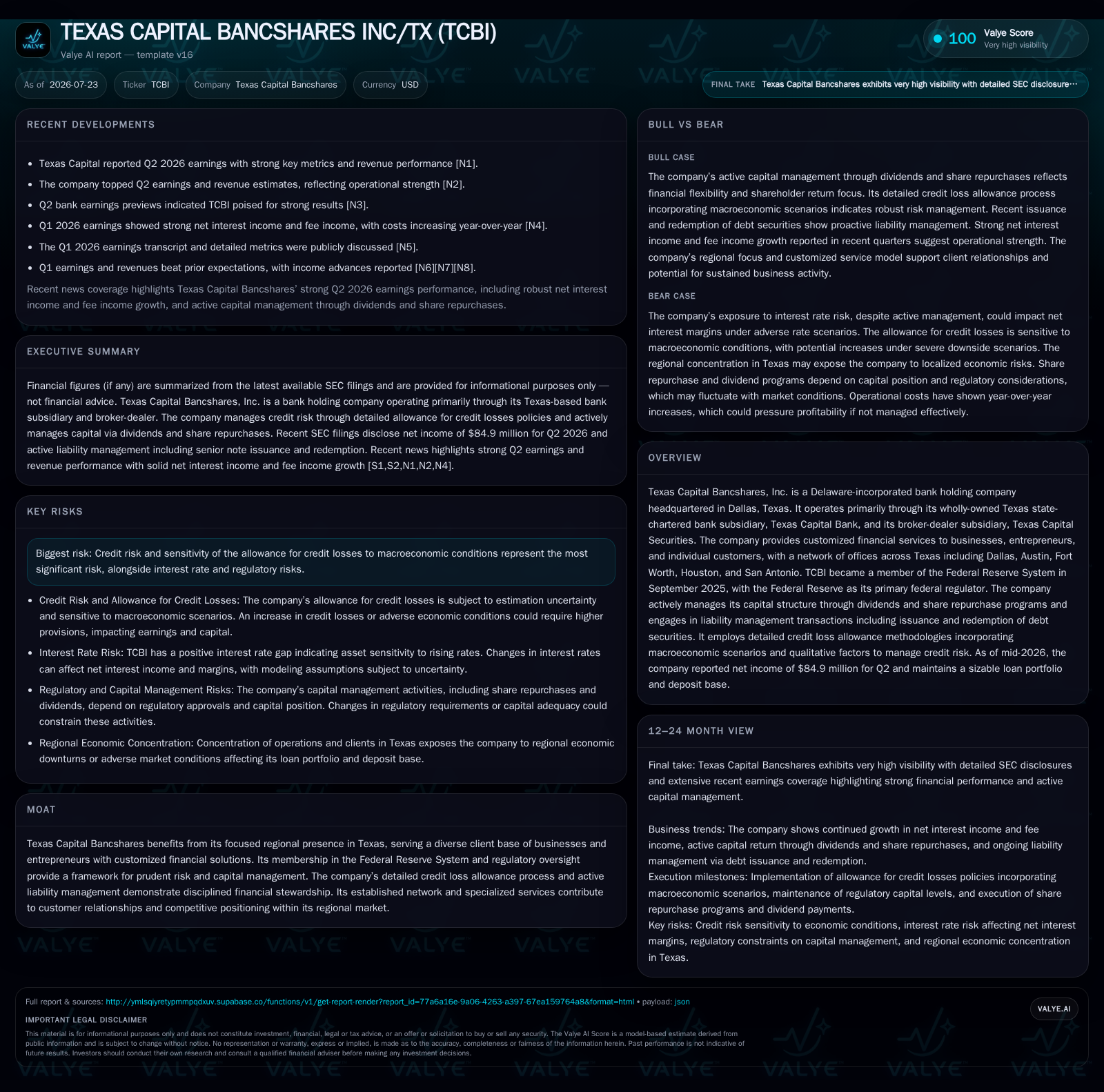
Texas Capital Bancshares’ Q2 2026 operating update reveals disciplined adjustment of allowance for credit losses in response to macroeconomic sensitivities while sustaining loan growth across Texas markets. The company initiated common stock dividends and maintained an active share repurchase program authorized through 2026, signaling confidence in capital adequacy following its recent Federal Reserve membership. Its targeted regional lending and specialized brokerage subsidiary complement revenue streams, positioned amidst evolving funding cost dynamics typical of regional banks.
Q2 Operating Dynamics Reflecting Evolving Credit Risk Sensitivities
Texas Capital Bancshares’ second quarter filing dated July 23, 2026, illustrates an increased allowance for credit losses driven by careful macroeconomic scenario modeling that captures downside risks affecting its commercial borrower base [S2][S27]. This allowance is established through provisions charged against current earnings, representing management’s best estimate of expected credit losses over the loan portfolio’s life. The firm employs a granular loan segmentation approach combined with quantitative historical loss rates augmented by qualitative overlays — named Portfolio Level Qualitative Factor (PLQF) and Segment Level Qualitative Factor (SLQF) — to capture nuanced risk deviations not reflected purely in historical data [S27]. The provision increase reflects heightened caution rather than immediate material deterioration in loan performance. This dynamic is vital as it implies Texas Capital’s reserve build is proactive, cushioning against potential macroeconomic headwinds without signaling outright asset quality impairment.
This reserve management directly affects net interest margins (NIM) through provisioning expense influences on reported earnings but does not necessarily impair core lending economics where interest income accrues on performing loans. As such, maintaining balance between adequate credit loss coverage and preserving earnings stability is central to TCBI’s risk management.
Regional Loan Growth and Income Drivers within the Texan Market Ecosystem
The annual filing dated February 10, 2026, provides foundational context that Texas Capital's primary revenue driver is net interest income derived from commercial lending to businesses and entrepreneurs concentrated within major Texas metropolitan areas including Dallas, Austin, Fort Worth, Houston, and San Antonio [S1]. This localized footprint benefits from regional economic expansion trends while exposing the company to concentration risk linked to Texas’s economic cycles.
Quarterly commentary and market reports align with this targeted approach indicating continued organic loan growth driven by demand among middle-market enterprises seeking customized credit solutions [N1]. The company's model capitalizes on leveraging proximity to clients with tailored offerings rather than scale alone.
In parallel, deposit betas—reflecting how deposit rates adjust relative to broader market rates—have influenced funding costs during recent interest rate cycles. This dynamic impacts NIM by shaping the cost of interest-bearing deposits relative to yields earned on loans. Texas Capital exhibits typical regional bank sensitivity whereby deposit re-pricing lags rate hikes partially pressuring margins but also benefiting from sticky core deposits that stabilize funding costs over time [N1]
Strategic Liability Management Amplified by Federal Reserve Membership Status
A transformational milestone occurred with Texas Capital Bank’s admission to the Federal Reserve System in September 2025 [S1]. This shift places the company under enhanced regulatory scrutiny for capital adequacy, liquidity coverage ratios, stress testing, and other supervisory requirements beyond previous state banking commission oversight.
The new regulatory environment has fortified Texas Capital’s liability management toolkit—allowing more nimble issuance and redemption of subordinated notes and other unsecured borrowings—which supports optimizing debt maturity profiles and managing interest expense efficiently [S1][S2]. Notably, the redemption of $375 million subordinated notes due in 2031 earlier in the year was facilitated by proceeds from a new $400 million senior note issuance at a fixed-to-floating rate structure priced at slightly above prevailing treasuries plus spread, reflecting prudent cost control [S21][S26].
Such transactions exemplify liability management strategies deployed under Federal Reserve governance that balance funding diversification against cost efficiency.
Operational Efficiency Positioning Relative to Regional Bank Cohorts
While specific efficiency ratio disclosures are limited in the quarterly filings, qualitative commentary emphasizes ongoing expense discipline balancing growth initiatives with consolidated revenue streams including fee income from its broker-dealer subsidiary Texas Capital Securities [S1][N2]
Compared with peers such as Comerica Inc. or Zions Bancorporation within similar regional geographies, TCBI operates with efficiency metrics tracking closer to community banks emphasizing lean operations yet scaling selectively where client needs demand more complex services. This positioning allows flexibility amid fluctuating loan demand or deposit cost environments while maintaining competitive service delivery.
Capital Return Policies: Initiation of Dividends alongside Share Repurchase Utilization
A notable strategic evolution unfolded in H1 2026 whereby Texas Capital declared and commenced paying quarterly common stock dividends — $0.20 per share during the first half year — marking a shift toward returning capital to shareholders following years without dividend issuance [S4][S5]. Concurrently, an authorized $200 million share repurchase program remains active, having executed just over one million shares repurchased at average prices near $97 per share through June 30, indicating management's commitment to balanced shareholder value enhancement amid capital buildup post-Fed membership.
This dual policy reflects calibrated confidence in regulatory capital buffers while accommodating investor appetite for income alongside potential upside from stock buybacks.
Macroeconomic Sensitivities Shaping Credit Loss Allowance Methodologies
Management’s allowance estimation explicitly models various macroeconomic scenarios encompassing baseline and severe downside paths. As of March 31, 2026, modeled allowance sensitivity indicates roughly $90 million incremental provisions could be required should worst-case economic conditions fully materialize; however qualitative adjustments and portfolio shifts could modify this figure dynamically going forward [S22]
This framework affirms credit risk remains a principal vulnerability given Texas Capital’s concentration in commercial real estate finance and entrepreneurial lending — sectors exposed to cyclical economic impulses within Texas.
Outlook on Execution Milestones: Market Signals, Regulatory Compliance, and Funding Stability
Looking ahead to forthcoming quarters will test Texas Capital’s ability to maintain loan performance stability amid evolving economic conditions affecting borrowers while continuing disciplined capital return programs aligned with Federal Reserve expectations [S3][N3]. Monitoring provisioning trends vis-à-vis actual charge-offs or non-performing loans will be critical to assessing credit risk trajectory along with deposit behaviors impacting funding costs.
Furthermore, regulatory reporting under Fed oversight will increasingly influence operational license sustainability advocating prudent capitalization mechanics tied closely to business strategy execution.
Financial Profile Discussion: Strengthened Capital Ratios and Liquidity Context
Robust tangible book values combined with healthy regulatory capital ratios signal strong capacity for absorbing credit losses or funding growth without jeopardizing balance sheet integrity. These factors lend credence to management's ability to execute liability management transactions tactically while progressing shareholder returns.
This analysis integrates the most recent SEC filings alongside news-based interpretations without offering investment advice or speculative projections. It highlights how Texas Capital Bancshares maintains prudent credit risk controls amid macroeconomic uncertainty while advancing strategic capital return policies pursuant to enhanced Federal Reserve supervision—all within its distinctive regional Texan banking niche.
Disclaimer: This is research-only, informational analysis and not investment advice. It may include AI-generated interpretation and general industry context. Always verify important details using primary sources.

Comments