
Dover Corp’s Q2 Surge Highlights Strength in Aftermarket and Digital Integration
Dover’s Q2 2026 results underscore resilient organic growth, margin expansion, and digital transformation progress amid industrial market dynamics.
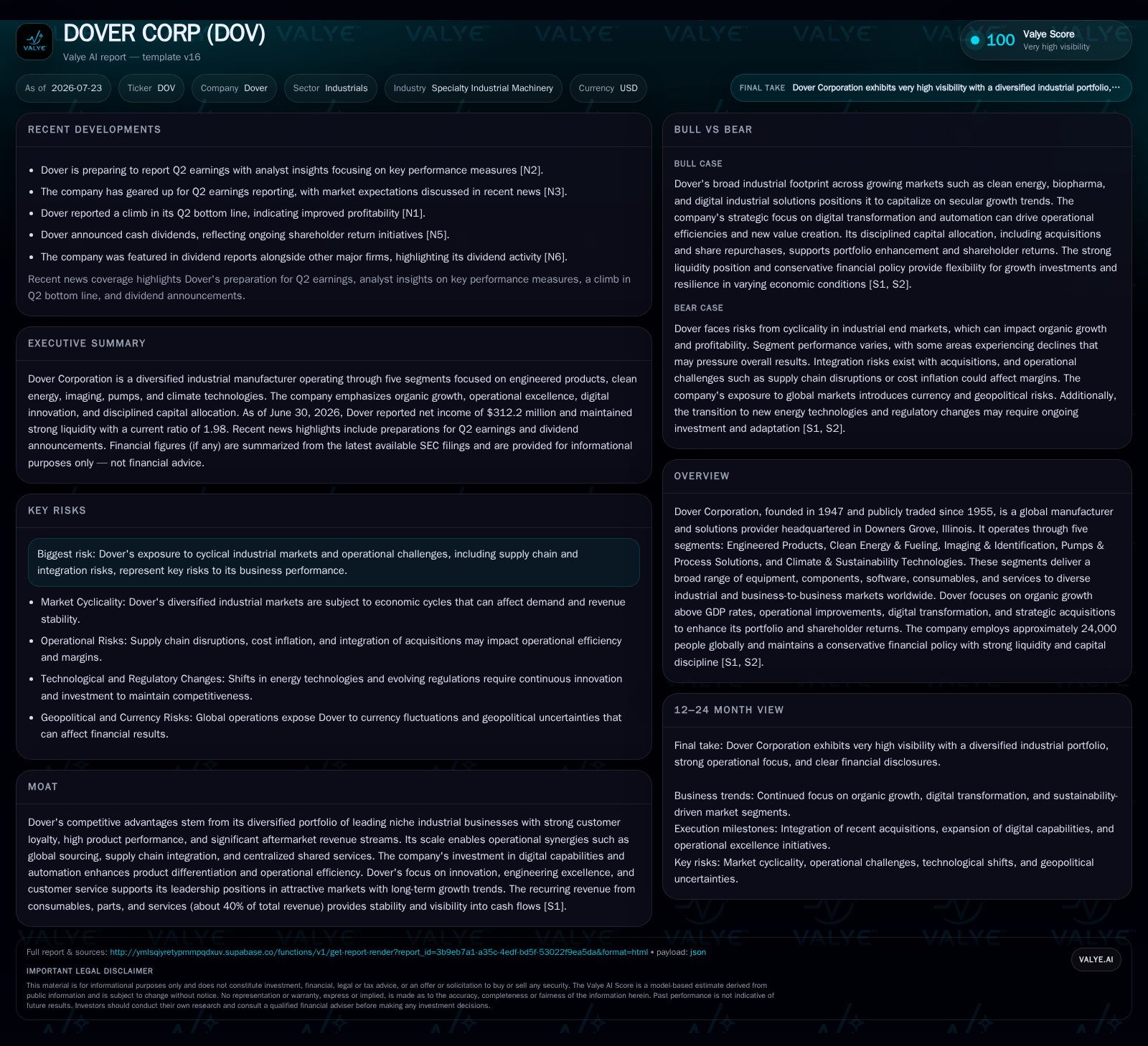
In its latest quarterly filing, Dover Corporation demonstrated improved organic revenue growth and operating margin expansion, driven by strong demand stability across its diversified specialty industrial machinery segments. The company’s sizeable recurring aftermarket parts and consumables business (~40% of revenue) provides crucial cash flow visibility amid cyclical capital equipment fluctuations. Dover’s ongoing investments in digital transformation and automation are materially enhancing product lifecycle management and customer retention. Capital discipline combined with a globally integrated supply chain supports sustained operational efficiency relative to peers. While cyclical end-market exposure and supply chain challenges persist, Dover is strategically positioned to benefit from rising industrial automation and sustainability demand over the medium term.
Q2 Operating Momentum: Organic Growth and Margin Gains Highlight Portfolio Resilience
Dover's second-quarter 2026 results reveal notable improvements in organic revenue growth rates accompanied by meaningful operating margin expansion [S2]. These advances signal stable demand across the company’s diversified portfolio amid ongoing industrial market cyclicality. Specifically, Dover’s ability to exceed prior quarterly growth benchmarks suggests that underlying end-market activity—in sectors such as energy fueling infrastructure, precision industrial machinery, and climate tech equipment—remains robust enough to offset broader macroeconomic challenges. The operating leverage implied by margin gains indicates success in driving operational efficiencies via centralized manufacturing footprint optimization and disciplined cost management initiatives. This combination bolsters confidence in the durability of current performance trends beyond transient cyclical effects.
Aftermarket Revenue: A Stable Pillar Supporting Cash Flow Visibility Amid Cyclicality
A critical pillar enabling Dover's resilient financial profile is its substantial aftermarket parts and consumables business, which contributes approximately 40% of total revenue [S1]. This recurring revenue stream cushions the company against the inherent volatility typical of capital equipment sales tied to irregular industrial capex cycles. Customers purchasing consumables—ranging from precision marking inks to specialized pump components—create stable demand patterns grounded in machinery lifecycle needs rather than discretionary capital investments. Additionally, this segment benefits from strong customer retention fostered through integrated digital platforms offering remote diagnostics and replacement part forecasting capabilities. In comparison with industry peers such as Graco Inc., which also emphasize aftermarket stability, Dover's scale and segment breadth provide further diversification advantages.
Digital Transformation Accelerates Product Innovation and Customer Retention
Dover’s ongoing investment in digital capabilities materially enhances both its product offerings and internal operational efficiency [S1]. Through the establishment of Dover Digital Labs—a cross-functional team composed of software developers, AI engineers, automation experts, and product security specialists—the company integrates embedded intelligence into machinery for connected monitoring-as-a-service models. This enables remote configurability and predictive maintenance services that extend customer lifetime value while reducing downtime risks. Moreover, digital adoption expedites streamlined sales processes via common e-commerce platforms that reduce complexity in product discovery and purchasing. These technological advancements reinforce Dover’s engineering excellence reputation within niche OEM markets while contributing quantitatively through improved pricing discipline and working capital management.
Segmented Excellence: Differentiated Offerings Across Clean Energy, Pumps, Imaging, Engineered Products, and Climate Technologies
Dover operates through five specialized segments targeting distinct industrial end-markets characterized by differentiated business models and go-to-market strategies [S1]. The Engineered Products segment focuses on vehicle aftermarket solutions, defense components, and precision fluid dispensing systems tailored for high-reliability applications. Clean Energy & Fueling addresses growing demand for safe storage and transport equipment across traditional fuels alongside hydrogen and EV charging infrastructure—an area benefiting from accelerating sustainability mandates. Imaging & Identification delivers precision coding equipment with integrated consumables serving packaged goods traceability requirements crucial for regulatory compliance. Pumps & Process Solutions provides critical flow control instrumentation servicing biopharmaceutical production to chemical processing industries with escalating quality demands. Lastly, Climate & Sustainability Technologies offers energy-efficient refrigeration and thermal management products aligned with evolving environmental standards.
Each segment emphasizes engineering-led innovation supported by global supply chain integration efforts that reduce lead times while leveraging centralized shared services for standardized manufacturing excellence. This segmentation strategy not only diversifies exposure but fosters deeper expertise allowing Dover to capture niche profitability dynamics.
Industry Context: Competitive Benchmarks Reflect Scale Benefits and Strategic Capital Discipline
Benchmarking Dover against comparable diversified industrial manufacturers such as Illinois Tool Works (ITW), Parker-Hannifin (industrial automation focus), and Graco Inc. reveals distinctive competitive positioning rooted in portfolio diversification coupled with disciplined capital allocation,[N1]. Dover channels roughly 2% of revenues into targeted capital expenditures aimed at capacity expansion and productivity gains while sustaining selective acquisitions to augment strategic niches [S1],[S13],[S15]. Its considerable scale facilitates effective global sourcing arrangements reducing input cost pressures relative to smaller peers. Operational synergies arise from centralized functions like Dover Business Services enhancing procurement leverage.
Digital transformation efforts at peer firms are increasingly pivotal; here Dover’s integrated approach—with its dedicated digital labs complementing automation investments—provides a comparative edge by embedding advanced analytics directly within products for aftermarket monetization opportunities. Such structural advantages bolster margins while preserving flexibility to navigate cyclical end-market fluctuations.
Growth Catalysts: Automation Adoption and Sustainable Equipment Demand as Expansion Drivers
The specialty machinery sector benefits broadly from escalating industrial automation trends driving capital equipment upgrades worldwide [S1]. Increased digitization fosters demand for connected devices capable of seamless integration within smart factory ecosystems—precisely aligning with Dover's digitally enabled product pipeline enhancements. Demand for sustainable solutions further expands addressable markets as customers seek energy-efficient alternatives compliant with tightening regulations governing emissions and safety standards.
Emerging economies continue industrializing rapidly; here Dover’s geographically diversified footprint positions it well to capitalize on rising middle-class consumption requiring advanced manufactured goods that rely on precise machinery inputs served by its Pumps & Process Solutions or Engineered Products segments. Concurrently, replacement cycles triggered by aging installed bases fuel consistent aftermarket parts growth supporting long-term cash flow predictability.
Risks Persist: Cyclical End-Market Exposure and Supply Chain Challenges Require Vigilance
Despite multiple strengths, Dover remains subject to inherent risks characteristic of capital goods manufacturing including sensitivity to macroeconomic downturns impacting capital spending decisions across key customer sectors [S4],[S5]. Prolonged recessions or deteriorating trade conditions could constrain order intake resulting in inventory adjustments or restructuring expenses.
Supply chain disruptions—due to raw material cost volatility or logistics bottlenecks—pose tangible threats potentially increasing production costs or delaying deliveries compromising customer relationships. Labor market tightness in key manufacturing hubs raises wage inflation concerns which may pressure margins absent offsetting productivity improvements.
Integration execution risks persist when assimilating acquired businesses necessitating stringent project management to realize anticipated synergies without diluting operational focus.
"Looking Ahead": Key Operational Milestones and Order Book Developments to Monitor
Stakeholders should monitor upcoming disclosure on order backlog trajectories indicating forward demand visibility alongside updates on the scaling of digital service offerings enriching the aftermarket ecosystem [S3]. Progress milestones related to capacity expansions or e-commerce platform enhancements will offer early signals on how well Dover sustains recent momentum amidst evolving industry technology frameworks.
Further indicators include pricing environment shifts within each segment reflecting competitive dynamics plus refinement of margin contribution from newly introduced products embodying advanced digital features.
Financial Profile Discussion: Balance Sheet Strength Enables Continued Strategic Investment
As of the most recent quarter end June 30, 2026, Dover maintained a healthy liquidity position highlighted by current assets totaling approximately $4.95 billion versus $2.50 billion in current liabilities resulting in a strong current ratio near 1.98x [F1]. Net debt stands around $2.3 billion after accounting for cash equivalents balancing sufficient financial flexibility to support ongoing organic investment programs (circa 2% of revenues) alongside opportunistic acquisitions aligned with portfolio priorities [F1],[S2]. Operating income trends underpin free cash flow generation capacity fueling shareholder returns without compromising balance sheet conservatism.
In sum, this fiscal snapshot demonstrates robust capital structure foundations empowering sustained strategic deployment into automation technologies, supply chain optimizations, digital capabilities enhancement—and prudent risk management needed given persistent industrial cycle challenges.
Disclaimer: This is research-only, informational analysis and not investment advice. It may include AI-generated interpretation and general industry context. Always verify important details using primary sources.

Comments