
King Resources’ Transition to Blockchain-Enabled Art Trading Faces Liquidity and Concentration Risks
King Resources operates through Heavenly Grace Limited to blend physical collectibles trading with blockchain-based ownership tokens, but profitability remains elusive amid operational dependencies and capital constraints.
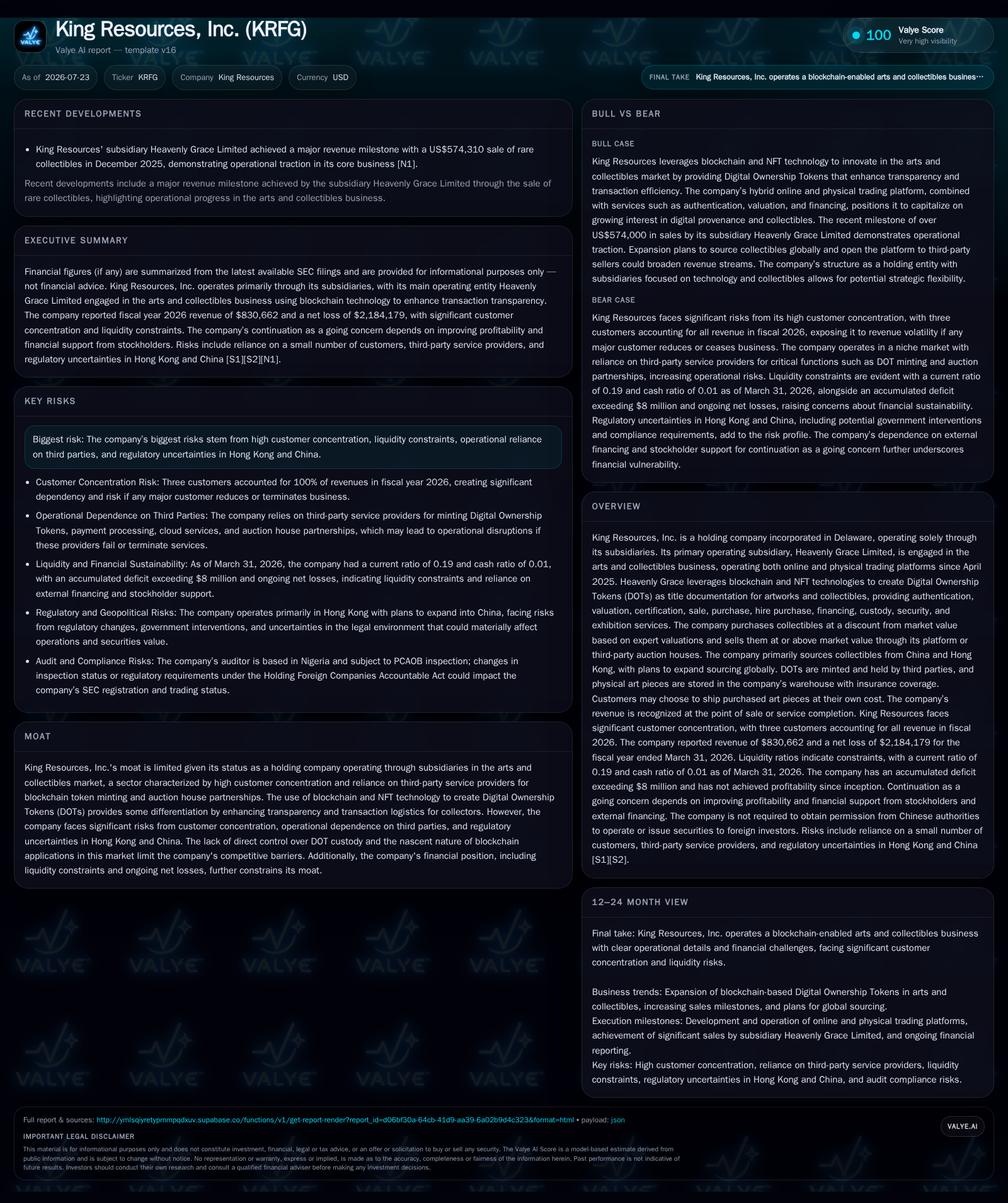
King Resources, Inc. has shifted its business focus from power technology to arts and collectibles trading via its subsidiary Heavenly Grace Limited, launched in 2025 with a hybrid physical-digital model employing blockchain-based Digital Ownership Tokens (DOTs). While this positions them uniquely at the intersection of traditional art markets and NFT platforms, they have yet to achieve profitability, facing heavy reliance on a small customer base and third-party service providers for token minting and auction execution. The company’s limited liquidity, substantial debt load, and plans for expansion hinge critically on additional shareholder funding over the next 12 to 18 months.
Recent Operating Update: Early-Stage Collectibles Transition Remains Loss-Making
expanded investments in technology development and marketing as they scale platform operations [S1]. Cash balances are critically low at $8,789 as of quarter-end versus current liabilities exceeding $1.46 million resulting in a fragile liquidity position that necessitates further capital injections from shareholders within the next 12–18 months [F1][S2].
Business Model: Hybrid Collectibles Trading Amplified by Blockchain Title Documentation
King Resources operates solely through subsidiaries with Heavenly Grace Limited now its primary operating segment. Heavenly Grace buys physical artworks and collectibles at discounts determined via recognized expert valuations—a standard valuation practice designed to create margin opportunities upon resale [S1]. These items are then retailed either via its own online platform or through third-party auction houses at or above prevailing market prices. Revenue is primarily derived from sales margins on these transactions supplemented by ancillary fees associated with authentication, valuation and certification (AVC), hire purchase financing options for buyers, custody and security services, and exhibition offerings (collectively CSE) enhancing collector experience [S1].
A key differentiator is the use of blockchain technology to create Digital Ownership Tokens (DOTs), which serve as immutable title documents representing ownership rights transparently recorded on an NFT framework [S1]. These DOTs improve provenance verification—a critical factor in high-value art markets—and facilitate secondary transactions via peer-to-peer trading platforms planned for later rollout. Currently however, King Resources relies entirely on third parties for minting DOTs as well as custody services given regulatory complexity [S1][S2].
This operational dependency underscores a business model that straddles traditional art dealing practices while embedding emerging decentralized digital asset mechanisms. The company aims eventually to transition its platform into a marketplace enabling collectors to transact directly for platform transaction fees without King Resources handling inventory logistics [S1]. This evolution could diversify revenue streams beyond linear collectibles sales into more scalable platform economics.
Industry Structure and Competitive Position
The arts and collectibles industry traditionally relies on robust expert valuations and trusted provenance establishment managed via established auction houses like Sotheby’s or Christie’s; meanwhile newer entrants like OpenSea or Rarible provide blockchain-native NFT marketplaces primarily focused on digital-only assets. King Resources occupies an intersecting niche combining physical asset dealing with digital tokenization primarily centered in Greater China [S1]. This space remains nascent with significant regulatory uncertainty regarding tokenized securities classification especially within Hong Kong and mainland China jurisdictions [S1].
The company faces pronounced challenges from notable customer concentration identified in filings: three customers represented all revenues during fiscal year 2026 highlighting demand volatility risk should these relationships falter or terms deteriorate [S2]. Additionally operational risk emanates from reliance on third-party vendors across critical nodes—blockchain minting providers, cloud infrastructure operators hosting their platform, payment processors handling transactions, plus auction houses executing sales events [S2]. Failure or disruption among any of these partners could meaningfully interrupt revenue flows or degrade user trust.
While using DOTs incorporates transparency benefits reflecting industry trends toward digitization of ownership records and provenance verification seen at players like Artory or Verisart—King Resource’s limited direct control over custody mechanisms weakens defensibility against competitors able to vertically integrate or build more secure ecosystems.
Growth Drivers: Blockchain Adoption Meets Global Sourcing Expansion Potential
Key drivers supporting King Resources’ growth trajectory include increasing demand globally for authenticated collectibles paired with growing acceptance of blockchain technologies underpinning provenance transparency. As collector affinity moves toward verified digital ownership certificates coupled with physical custody services offered via CSE bundles, King Resources’ hybrid business model aligns with evolving buyer preferences.
Management signals strategic intent to broaden collectible sourcing beyond China and Hong Kong to international markets presenting enlarged addressable opportunity pools while mitigating geographic concentration risks [S1]. Concurrently efforts are underway to enhance ecommerce capabilities serving not only direct sales but a future phase digital marketplace wherein third-party sellers can transact DOT-linked assets reducing operational workload yet unlocking new fee-based revenue potential [S1].
Investment in technology development appears targeted at scaling platform robustness combined with community-building initiatives which evidence recognition that user experience depth matters critically in differentiated marketplaces competing with both legacy auction houses and digitally native NFT platforms.
Risks / Watchpoints / Growth Constraints
ities interpretations particularly across Hong Kong/China may impede geographic expansion or enforce costly compliance regimes limiting scalability [S1].
- Unproven Profitability Path: Continued net losses highlight challenges in balancing elevated technology development costs with still nascent revenue streams requiring effective commercialization strategies execution.
What To Watch Next
Important near-term demand markers include tracking new client wins beyond concentrated customer base alongside volume growth metrics capturing sourced versus sold collectibles consistent with revenues rising organically rather than lumpy one-off sales. Uptake rates for ancillary financing/hire purchase options will indicate platform stickiness while monitoring DOT minting volumes offers proxy for digital adoption momentum. Operational KPIs tied to third-party partner uptime reliability will reveal robustness of the hybrid delivery architecture.
From a corporate finance perspective securing stated additional shareholder investment commitments notably the proposed multi-million-dollar injection from Williamsburg Venture Holdings LLC constitutes a key liquidity milestone essential for sustaining technology ramp-up plans during expected ongoing net loss phases [S1]. Upcoming quarterly disclosures will illuminate cost control effectiveness against growing scale requirements impacting gross margin trajectories.
Expanding collectible sources internationally beyond Asia-Pacific will mark strategic globalization progress charting move toward diversified supply chains reducing concentration risk inherent today.
Financial Profile Discussion
In summary King Resources embodies an intriguing convergence play marrying traditional art dealing practices with cutting-edge blockchain-facilitated digital ownership tokens aiming at expanded global reach through ecommerce innovation. Yet it confronts formidable hurdles around generating stable diversified demand streams amidst concentrated customer exposure coupled with thin liquidity buffers reliant on committed shareholder financing support plus operational dependencies subject to partner continuity risks all unfolding within an uncertain regulatory landscape that tempers growth aspirations today.
Disclaimer: This is research-only, informational analysis and not investment advice. It may include AI-generated interpretation and general industry context. Always verify important details using primary sources.

Comments