
Visteon Advances Digital Cockpit Leadership Amid OEM Production Pressures
Visteon's latest quarter highlights resilience through innovation and balanced capital allocation despite customer volume headwinds.
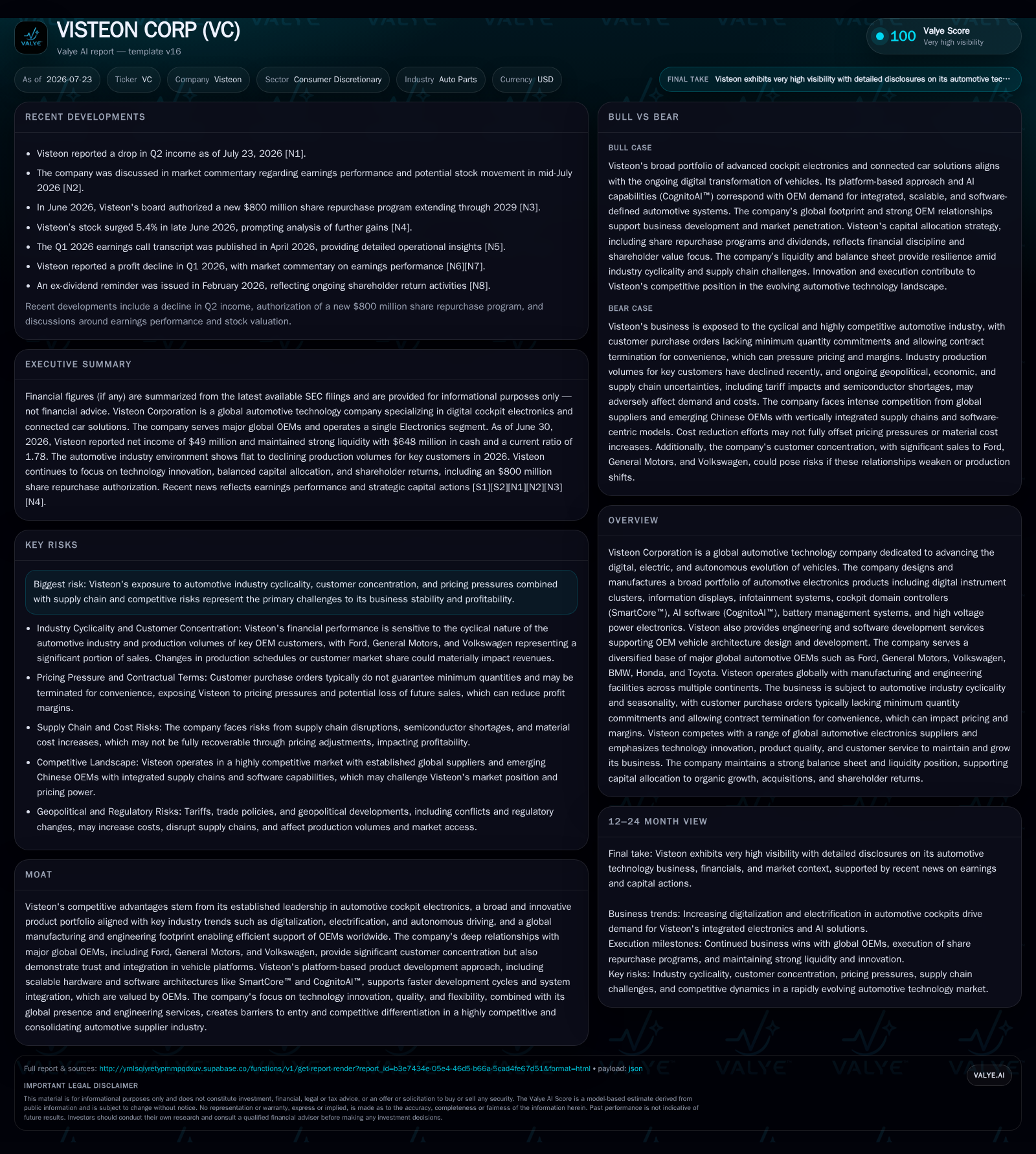
In Q2 2026, Visteon Corporation managed a complex operating environment marked by stable global automotive production but declining volumes among its key OEM customers. The company continues to leverage its scalable cockpit electronics platforms and AI software to capture growing electronic content per vehicle, aligning with ongoing trends of electrification and autonomous driving. Though supply chain risks and OEM concentration persist, Visteon's diversified global footprint and strategic share repurchase program support financial flexibility. Monitoring new business wins, production volumes at major customers, and margin trends will be critical to assessing the durability of its growth trajectory.
Recent Operating Update
tween macro market conditions and concentrated customer exposure forms the immediate backdrop affecting Visteon’s revenue stability.
In response to these dynamics, Visteon executed a $200 million fixed-dollar accelerated share repurchase (ASR) transaction as part of an $800 million repurchase authorization extending through 2029 [S3]. This move reflects management’s confidence in cash-flow generation capability amidst volatile volume trends and signals strong shareholder value discipline. The timing of this transaction amidst soft production volumes likely indicates an opportunistic capital allocation stance leveraging internal liquidity reserves [S3], supported by reported cash & equivalents of $648 million against net debt position of negative $328 million as of June 30, 2026 [F1].
Business Model Analysis
Visteon operates as a Tier 1 automotive electronics supplier specializing in the cockpit domain—offering critical digital instrument clusters, infotainment interfaces, cockpit domain controllers branded SmartCore™, AI-driven solutions under CognitoAI™, battery management systems, and high voltage power electronics [S1]. These advanced hardware/software modules are integral components embedded within global OEM vehicle platforms operated by companies such as Ford (26% of sales), General Motors (12%), and Volkswagen (10%) [S20]. The monetization approach is primarily via supply contracts governed by purchase orders correlating closely with OEM vehicle build plans rather than guaranteed minimum volumes [S20]. Pricing is periodically renegotiated over platform life cycles with adjustments reflecting cost efficiencies but pressured by competitive tendering.
Drivers underpinning revenue include changes in vehicle production volumes from these key customers; increasing electronic content per vehicle stemming from digitalization of cockpits; technological upgrades aligned to rising electrification; and contract wins expanding footprint into additional segments or geographies. Margins hinge on successful cost containment initiatives that offset price concessions highly typical in automotive Tier 1 supplier relationships [S20]. Notable is Visteon’s platform standardization strategy leveraging scalable hardware architectures reducing development cycle times—a critical advantage during accelerated OEM digital cockpit refresh programs [S1]. Additionally, engineering services augment product sales through embedded software development expertise tightly coupled with customers’ architectural design efforts.
Industry Structure & Competitive Position
The automotive technology industry is intensely cyclical with revenue streams closely tied to vehicle production rates which fluctuate with economic cycles. Competition revolves around technical innovation pace, product quality/reliability, price competitiveness, timeliness of delivery, and the ability to economically support global platform architectures through geographically diverse manufacturing footprints [S20]. Visteon faces challenges from other Tier 1 suppliers who also push integrated cockpit solutions combining hardware/software synergies.
Vendors like Aptiv or Denso share comparable footprints but differ in product emphasis or scale. Moreover, semiconductor suppliers upstream are critical given the persistent chip shortage fragilities highlighted in recent years impacting capacity utilization and cost dynamics across automotive electronics providers [S1]. Visteon's established relationships with blue-chip OEMs confer some customer stickiness but also concentrate risk—Ford alone constitutes over one-quarter of net sales—exposing revenue streams to shifts in Ford’s program directions or platform refresh timelines [S20].
Meanwhile, government regulations increasingly demand cleaner vehicle technologies accelerating electric powertrain adoption where battery management systems form a strategic product line for Visteon catering to evolving electrification requirements [S1]. The company’s advance into AI-enabled cockpit interfaces positions it advantageously for autonomous driving features gaining traction industry-wide.
Growth Drivers
Several structural drivers underpin medium-to-long-term growth prospects for Visteon:
- Electronic Content Expansion: Consumer expectations for rich connected experiences amplify demand for multi-display digital cockpits and responsive infotainment systems embedding AI features like CognitoAI™, fueling per-unit selling price increases.
- Electrification Accelerators: Growing penetration of hybrid & battery electric vehicles necessitates sophisticated battery management systems and high voltage power electronics—areas where Visteon has developed competencies.
- OEM Platform Standardization: As OEMs consolidate model variants onto fewer platforms globally or regionally, scalable hardware/software solutions reduce development costs for both customers and suppliers—an enabler for faster new program wins.
- Software & Engineering Services: Integration services supporting system architecture design improve long-term customer retention through closer platform embedment.
- Emerging Market Expansion: Presence across multiple continents including Eastern Europe and Asia aligns with rising regional vehicle assembly activity supportive of incremental sales volumes.
The company’s ability to continue translating business wins into backlog growth and higher unit shipments will confirm execution effectiveness on these fronts.
Risks & Watchpoints
Primary risks revolve around:
- Automotive Cyclicality & Customer Concentration: Significant dependency on several large OEMs means downturns or program delays negatively impact sales disproportionately compared to broader industry trends [S2][S20].
- Supply Chain Vulnerabilities: Semiconductor availability remains fragile; disruptions can cause delivery delays triggering penalty costs or lost business [S1].
- Pricing Pressure: With negotiated prices often linked to volume forecasts that can decrease abruptly due to cancellations or lower recurring orders, margin volatility is a constant concern.
- Technological Change Pace: Failure to keep pace with innovations particularly around AI-enabled interfaces or electrification systems risks losing market share.
- Regulatory Changes: Shifting compliance landscapes can impose redesigns that burden costs or delay program launches.
- Geopolitical & Currency Exposure: Global operations expose the company to political risks affecting supply continuity alongside currency translation swings impacting reported results.
What To Watch Next
Key milestones include monitoring:
- Quarterly updates on segment-specific order backlogs especially related to electrification products.
- Share repurchase progress against the $800 million authorization as an indicator of confidence in free cash flow generation.
- Announcements around new business wins or contractual awards reflecting successful penetration of next-gen cockpit electronics designs.
- Supply chain developments notably any easing or exacerbation of semiconductor shortages impacting deliveries.
- Gross margin trends signaling efficacy in cost control versus pricing erosion pressure.
- R&D spend levels relative to sales in support of continued technology leadership.
- Vehicle production estimates from major OEM customers aligned with updated Mobility Global forecasts impacting near-term volume assumptions [S2]
Financial Profile Discussion
Visteon maintains a robust balance sheet characterized by a strong liquidity position—with $648 million cash & equivalents exceeding total debt of approximately $320 million at mid-year 2026—resulting in a net cash position near $328 million [F1]. Its current ratio stands at a solid 1.78 indicative of healthy working capital coverage [F1]. The company’s strategic capital allocation balances reinvestment into organic growth initiatives like R&D or manufacturing capacity alongside inorganic acquisitions evidenced by recent user experience engineering firm purchase and sustained shareholder returns via share buybacks and dividends [S2][S3][S21].
Profitability metrics reflect modest operating income margins consistent with typical automotive technology supplier profiles exposed to volume variability; ongoing cost efficiencies remain essential for margin expansion given competitive pricing pressures. Free cash flow generation suffices to support funding requirements including dividends while preserving ample optionality for further strategic investments or balance sheet fortification during downturn phases.
Disclaimer: This is research-only, informational analysis and not investment advice. It may include AI-generated interpretation and general industry context. Always verify important details using primary sources.

Comments