
West Bancorporation’s Efficiency Gains and Asset Quality Sustain Regional Banking Strength
WTBA reports improved profitability and robust asset quality in H1 2026, maintaining strong regional community bank fundamentals amid deposit pressures.
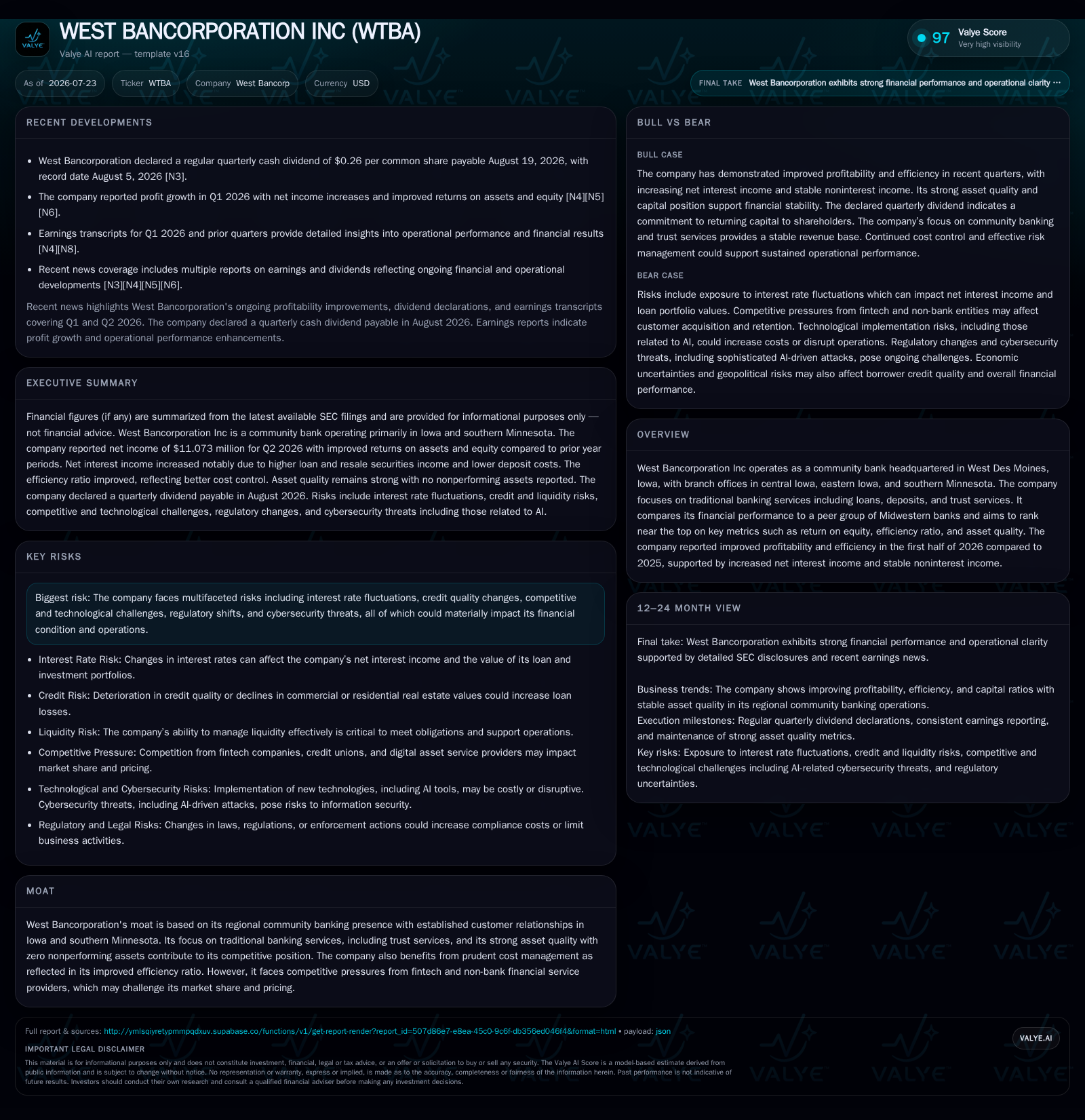
West Bancorporation Inc., a Midwestern community bank anchored in Iowa and southern Minnesota, reported its second quarter results for 2026 showing a resilient business model characterized by solid asset quality and improved operating efficiency. Total assets declined modestly year-to-date, driven by a contraction in loans and deposits, yet capital levels have strengthened. The company’s loan portfolio mix shifted with growth in commercial real estate and residential mortgages offsetting declines in construction and commercial loans. Asset quality remains pristine, with zero nonperforming loans reported as of mid-2026, underscoring prudent credit risk management. Deposit attrition, including reduced brokered deposits, reflects competitive and rate environment challenges typical for regional banks. Liquidity is fortified by Federal Home Loan Bank advances hedged with swaps to lock in fixed funding costs. Ongoing efficiency improvements and trust service offerings support WTBA’s positioning near the top of Midwestern peers on key metrics like return on equity and efficiency ratio.
Recent Operating Update Highlights Robust Fundamentals Amid Adjusting Balance Sheet
West Bancorporation Inc (WTBA), headquartered in West Des Moines, disclosed in its Q2 2026 filing that total assets decreased modestly from roughly $4.14 billion at the end of 2025 to $4.03 billion mid-year [S2]. This contraction primarily stems from a retreat in loans outstanding (down about $52 million) and deposits (down about $123 million since year-end), partially offset by increased holdings in securities purchased under agreements to resell—a form of short-term secured investments rising to $142 million as of June 30, 2026 [S2]. The balance sheet movements indicate active liquidity management adapting to prevailing market and competitive conditions.
Loan portfolio changes reflect strategic repositioning: significant declines occurred within construction, land development (-$93 million) and commercial loans (-$42 million), while commercial real estate loans saw an increase of approximately $48 million complemented by a $38 million rise in one- to four-family residential first mortgage loans [S7]. The move toward more permanent financing rather than construction aligns with regulatory prudence around concentration risk—particularly given the elevated levels of commercial real estate relative to regulatory capital thresholds—and reduces exposure volatility.
Asset quality remains exceptional with zero nonaccrual loans or past due loans over 90 days as of both June 30, 2026 and December 31, 2025; no other real estate owned is reported either [S7]. This signals strong underwriting discipline and effective portfolio monitoring despite sector risks tied to CRE exposures.
Deposits declined by around 3.6% year-to-date to approximately $3.3 billion mainly driven by normal cash flow fluctuations among core depositors alongside a decrease in brokered deposits from roughly $154 million at year-end to $110 million mid-year—the latter typically used as a supplementary wholesale funding source for balance sheet flexibility [S14]. Brokered deposits maturity profiles extend into late-2027 while uninsured deposits excluding brokered funds stand near 27%—a level consistent with enhanced FDIC insurance coverage via reciprocal networks that mitigate concentration risks inherent in larger regional banks [S2], [S14].
Business Model: Traditional Regional Community Banking With Focus on Relationship Lending
WTBA operates principally as a community bank focused on traditional banking services including attracting core deposit funding from retail, commercial clients, and public entities along with extending diverse loan products such as commercial real estate finance, construction loans transitioning into permanent financing, consumer residential mortgages and business lines of credit complemented by fiduciary trust services [S1]. The company’s revenue primarily derives from net interest income earned on its loan portfolio funded mainly through core deposits supplemented periodically with brokered deposits and Federal Home Loan Bank advances hedged via interest rate swaps locking low fixed costs over several years despite rolling short-term borrowings active as a liquidity tool [S2], [S14].
Noninterest income stems notably from trust services—a strategy supporting fee diversification leveraged through long-standing relationships in the Iowa and southern Minnesota footprint—offering some insulation from loan margin cyclicality common across regional banking peers [S1]. Cost management is a priority as reflected in improvements to the efficiency ratio noted for H1 2026 relative to prior periods underpinned by lean operations consonant with WTBA’s position near the top-tier of Midwestern community banks along key financial ratios including return on equity (ROE) and asset quality benchmarks.
Industry Structure And Competitive Positioning Within Midwestern Regional Banks
The regional community banking sector within Midwest states like Iowa embodies localized financial intermediation characterized by strong customer intimacy driven relationship lending serving agriculture-related businesses, small-medium enterprises (SMEs), residential borrowers, and public sector clients. WTBA fits this archetype leveraging local market knowledge advantage versus national mega-banks whose scale benefits are counterbalanced by less personalized service appeal.
However, emerging competitive forces challenge this dynamic: fintech lenders are gaining traction for loan origination especially through digital channels offering fast underwriting albeit typically smaller average ticket sizes; non-bank providers compete aggressively for deposits using innovative platforms and pricing models creating pressure on community banks’ deposit bases particularly those exposed heavily to uninsured or brokered deposit concentrations. Against these trends WTBA’s participation in reciprocal deposit networks helps extend FDIC insurance safety ceilings thereby mitigating depositor flight risks.
Regulatory oversight remains stringent especially concerning capital adequacy requirements (Tier 1 capital ratios) critical for growth capacity management while heightened scrutiny applies on commercial real estate concentrations requiring robust risk monitoring protocols which WTBA has codified through internal policies keeping exposures within acceptable limits despite naturally higher CRE weighting given its geographic markets.[S1], [S7]
Key Growth Drivers Supporting Sustainable Profitability
Local economic vitality across Iowa and southern Minnesota with diverse industry presence underpins steady demand for varied loan types—commercial real estate remains attractive given ongoing business expansions coupled with residential mortgages supported by favorable demographic trends within target locales encouraging home ownership.
Deposit growth initiatives rely heavily on deepening core customer engagement alongside reciprocal networks that allow scalability beyond federally insured limits enhancing balance sheet stability amidst competitive rate environments.[S2]
Operational efficiencies continue improving WTBA’s cost structure complementing net interest margin gains derived through effective asset-liability management practices including the use of interest rate collars mitigating rate volatility impacts on deposit costs.[N3] Enhanced trust service offerings present incremental fee revenue opportunities reinforcing brand loyalty.
Risks And Watchpoints: Interest Rates, Credit Quality & Competitive Pressures
WTBA faces multi-dimensional risks typical for regional community banks: fluctuations in interest rates can compress net interest margins if deposit repricing outpaces loan yield adjustments; credit risk may evolve if economic downturns stress borrowers particularly within CRE segments despite current asset quality strength.[S26]
Competitive pressures not just from traditional banks but increasingly fintech platforms warrant vigilant customer retention efforts especially among younger demographics migrating toward digital-first banking experiences necessitating continued investments balancing cost control [S1]
Furthermore cybersecurity threats intensify with expanded digital service adoption presenting operational vulnerabilities; regulatory changes could impose additional capital compliance burdens or restrict certain growth avenues impacting profit generation.[S26]
What To Watch Next: Execution On Loan Mix Optimization And Deposit Stability Initiatives
Monitoring Q3 updates will illuminate whether the strategic shift away from volatile construction lending toward permanent CRE financing sustains asset quality advantages or signals emerging credit stress due to macroeconomic shifts.
Deposit trends warrant close observation given recent declines; stabilizing or reversing core deposit erosion amid competitive rate environment will be vital alongside managing brokered deposit balances prudently without excessive dependence.
Efficiency ratio trajectories and noninterest income performance (notably trust service fees) will serve as barometers for operational leverage realization supporting ROE targets.
Management commentary addressing technology adoption progress vis-à-vis fintech competition will also be important signals regarding future-readiness within a rapidly digitizing banking landscape.
Financial Profile Discussion
As of June 30, 2026, WTBA's total stockholders’ equity increased modestly to approximately $281 million from $266 million at year-end reflecting retained earnings accumulation amid operating profitability sustained over the first half of the year [S2]. Borrowings remain steady at $270 thousand via Federal Home Loan Bank advances fully hedged with interest rate swaps spanning until mid-2029 fixing borrowing costs between ~1.86%–4.32%, an approach aligning funding cost certainty beneficial amid interest rate volatility [S2].
The decline in both loans and deposits reflects temporary adjustments influenced by secondary market refinancing activity impacting payoffs; however, the enhanced capital buffer combined with stable asset quality supports resilience against credit losses while preserving capacity for measured growth when market conditions normalize [S2], [S7].
In summary, West Bancorporation’s second quarter demonstrates disciplined execution maintaining solid profitability metrics grounded on strong asset quality controls alongside operational efficiency improvements amidst localized economic conditions shaping loan demand and deposit dynamics characteristic of Midwestern regional banks.
Disclaimer: This is research-only, informational analysis and not investment advice. It may include AI-generated interpretation and general industry context. Always verify important details using primary sources.

Comments