
Goosehead Insurance Expands Agent Base and Franchise Network Leveraging Proprietary Tech Platform
Goosehead Insurance's latest quarter underscores growth in commissions, franchise royalties, and a strategic share repurchase enhancing shareholder value.
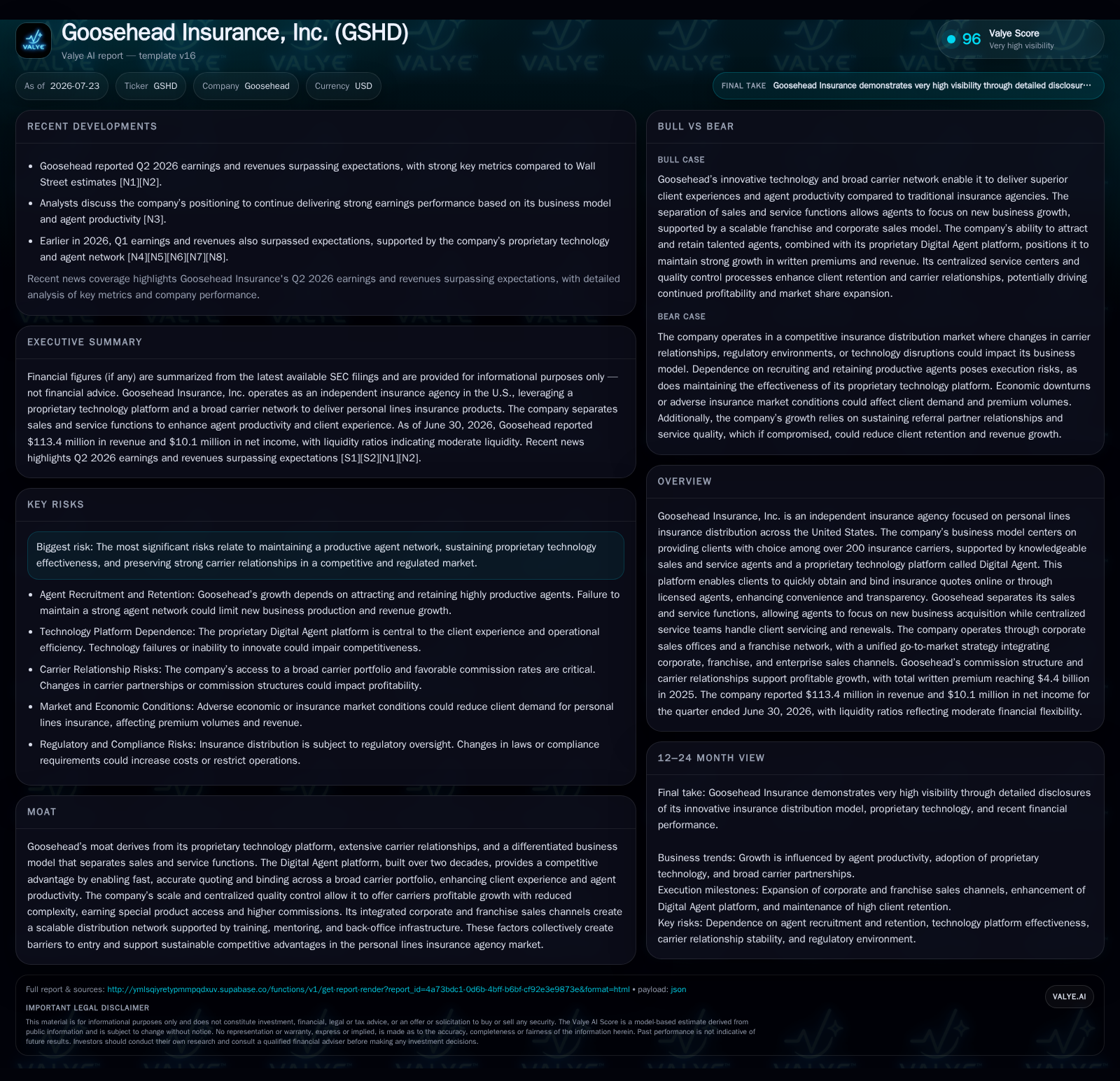
In the most recent quarterly filing, Goosehead Insurance reinforced its growth trajectory through agent recruitment and franchise penetration, supported by its proprietary Digital Agent platform. The company’s business model hinges on commission revenues from personal lines insurance products distributed via corporate and franchise sales channels. Its competitive edge derives from technology-enabled quoting services and a clear separation of sales and service functions. Growth drivers include national franchise expansion, agent productivity gains, and rising premium rates, while risks focus on carrier relationships and regulatory compliance. Financially, the company maintains a solid liquidity position with ongoing authorized share repurchases underlining capital return focus.
Recent Operating Update: Strategic Growth Confirmed in Q2 2026
Goosehead Insurance’s latest quarterly report filed July 23, 2026 reveals continued momentum in expanding its core insurance agency business leveraging both commission-based revenues and franchise royalties. The company reiterated its commitment to growing the number of active sales agents within both corporate offices and its franchise base — key drivers for new business commissions and renewal royalty fees respectively [S2],[S3]. The firm also disclosed an increased share repurchase authorization program now permitting up to $198.3 million in buybacks through May 2027, signaling confidence in cash flow generation and commitment to shareholder returns within capital allocation priorities [S2],[S8]. No material changes to risk factors or accounting policies were announced during this period, indicating operational stability [S19],[S18].
Business Model: Dual Sales Channel with Technology-Enabled Efficiency
Goosehead operates as an independent personal lines insurance agency providing access to over 200 insurance carriers nationwide through a combination of company-owned corporate sales offices and franchised independent agencies. Its revenue is primarily generated from commissions on policies sold or renewed — comprising new business commissions, renewal commissions, contingent commissions from carriers incentivized by volume or profitability thresholds — alongside recurring franchise royalty fees anchored in policy retention from franchised operations [S1],[S16].
A distinctive element is its proprietary Digital Agent platform which integrates data inputs to enable customers either to self-quote online or engage licensed agents seamlessly for personalized advice. This platform facilitates rapid quote-to-bind cycles improving conversion rates while preserving the need for knowledgeable human agents who provide consultative insurance coverage guidance tailored to complex personal needs. By clearly separating sales functions (focused on hunter agents acquiring new business) from service functions (dedicated teams managing client renewals and servicing), Goosehead boosts agent productivity and client retention simultaneously — reinforcing both top-line growth and renewable revenue streams [S1],[S16].
The company’s unified go-to-market strategy aligns corporate sales momentum with scalable franchise expansion supported by technology training hubs and quality control infrastructure — a synergy that underpins efficient national footprint scaling without diluting brand or service quality [S16]. Franchisees benefit from local market knowledge combined with Goosehead’s centralized operational resources including back-office support, marketing blueprints emphasizing referral partnerships, and ongoing technology enhancements.
Industry Structure and Competitive Position
Within the broader insurance agency distribution industry — positioned intermediarily between insurance carriers and individual buyers — Goosehead's model contrasts traditional captive agencies (e.g., State Farm) that limit consumer choice by tying clients exclusively to one carrier product suite. Instead, Goosehead's extensive carrier portfolio allows personalized coverage selections reflecting diverse consumer risk profiles while leveraging competitive pricing enabled by transparent digital quoting systems.
Peers such as Brown & Brown represent large-scale independent agencies with broad carrier relationships but often lower integration of proprietary technology compared to Goosehead’s Digital Agent platform. Franchise-based agencies like Brightway Insurance offer localized service but may lack unified technology infrastructure that Goosehead has developed over two decades. Technology-enabled brokers like SelectQuote compete on digital convenience but frequently focus more on direct-to-consumer lead generation than fully integrated agent-driven consultative models.
This combination of proprietary digital tools with differentiated agent specialization provides Goosehead a moat evidencing strong net promoter scores (reported at 77), client satisfaction multiples higher than industry averages, and compelling carrier incentives resulting in preferential product access and enhanced commission yield mechanics [S1]. The firm’s ability to recruit agents effectively—leveraging targeted university recruiting programs and internet campaigns—also sustains a robust talent pipeline critical in this commission-driven environment where agent productivity is paramount [S24],[S16].
Growth Drivers
The primary growth levers for Goosehead are:
- Agent Headcount Expansion: Increasing the number of licensed producers equips Goosehead to scale new business commission revenues directly; year-over-year growth seen in corporate agent count translates into higher policy counts with associated commissions [S1],[N1].
- Franchise Network Penetration: Deploying franchises across new geographies extends local market access; as these mature beyond the initial ramp-up period (noting ~9% recently established franchises), royalty fee income grows steadily given elevated renewal rates associated with longer tenure franchises [S1],[S24].
- Technology Adoption: Continued investments in Digital Agent capabilities facilitate higher customer engagement levels—improving quote-to-bind conversion rates—which directly impacts commission volumes while reducing administrative friction in servicing policies remotely.
- Rising Premium Rates: Market-wide premium inflation supports total written premium growth—a key base upon which most commission calculations rely—thereby bolstering overall revenue potential especially when client retention holds steady near historical levels (~85%) [S1],[N2].
- Carrier Relationships & Contingent Commissions: Deepening carrier partnerships unlocks contingent commission tiers which reward profitable growth patterns; this amplifies revenue beyond fixed commission percentages for policy placements alone.
Risks and Watchpoints
Key risks that could constrain growth or compress margins include:
- Agent Recruitment & Retention: Maintaining productive agent networks requires ongoing investment in competitive compensation packages, training programs, and support infrastructure; failure here would limit new business inflows.
- Technology Platform Sustainability: As an essential differentiation factor, the proprietary Digital Agent platform must continue evolving against digital disruptors and insurtech entrants offering alternative distribution modes.
- Carrier Dependency & Commission Structures: The firm’s economics heavily rely on sustaining favorable contracts with carriers; regulatory or market pressure could alter commission schemes or product availability detrimentally.
- Regulatory Compliance: Operating across multiple states entails compliance complexity affecting licensing for agents/franchises as well as data privacy/security standards tied to client information handled digitally.
- Economic Cyclicality: Insurance purchase activity can be influenced by macroeconomic conditions such as housing market dynamics or consumer spending power – fluctuations here affect overall policy volume trends.
Close monitoring of these variables alongside metrics such as policy retention rates, average premium per policy trends, technology usage statistics (quote-to-bind ratios), agent onboarding success metrics, and contingent commission qualification milestones will provide meaningful indications of execution strength or emerging challenges.
What To Watch Next
Upcoming milestones crucial for operational progress assessment include:
- Sequential agent headcount disclosures highlighting recruitment pace versus attrition.
- Franchise growth cadence reflecting geographic expansion progress along with maturation curves impacting royalty fee escalation.
- Digital Agent platform enhancements rollout schedules coupled with user engagement KPIs influencing conversion ratios.
- Quarterly policy retention reporting which underpins renewal commission stability.
- Adjustments in carrier contract terms influencing revenue mix shifts between core commissions versus contingent incentives.
- Updates on any regulatory developments affecting licensing costs or data governance impacting cost structures.
- Execution outcomes around capital allocation including pace of share repurchases within authorized limits serving as signal of free cash flow health [N2],[S2],[S8].
Financial Profile Discussion
As of June 30, 2026, Goosehead held cash and equivalents of approximately $23.7 million against current liabilities of about $55.3 million, resulting in a current ratio near 1.54, which provides an adequate buffer for near-term obligations without reliance on additional external financing [F1]. Total debt was approximately $323 million with net debt around $299 million, reflecting leverage levels consistent with the company’s operating cash flow generation capacity [F1].
Disclaimer: This analysis is based solely on publicly available information including recent SEC filings dated up to July 23, 2026. It aims to provide an informed perspective on Goosehead Insurance's business model, industry context, operational updates, risks, growth drivers, and financial standing without constituting investment advice.
Disclaimer: This is research-only, informational analysis and not investment advice. It may include AI-generated interpretation and general industry context. Always verify important details using primary sources.

Comments