
Eureka Acquisition Advances Merger with Marine Thinking Amid Heightened Execution Risks
Eureka Acquisition Corp’s recent filings reveal critical developments in its de-SPAC process, including new debt obligations and sponsor involvement, underscoring the narrowing window to close its business combination.
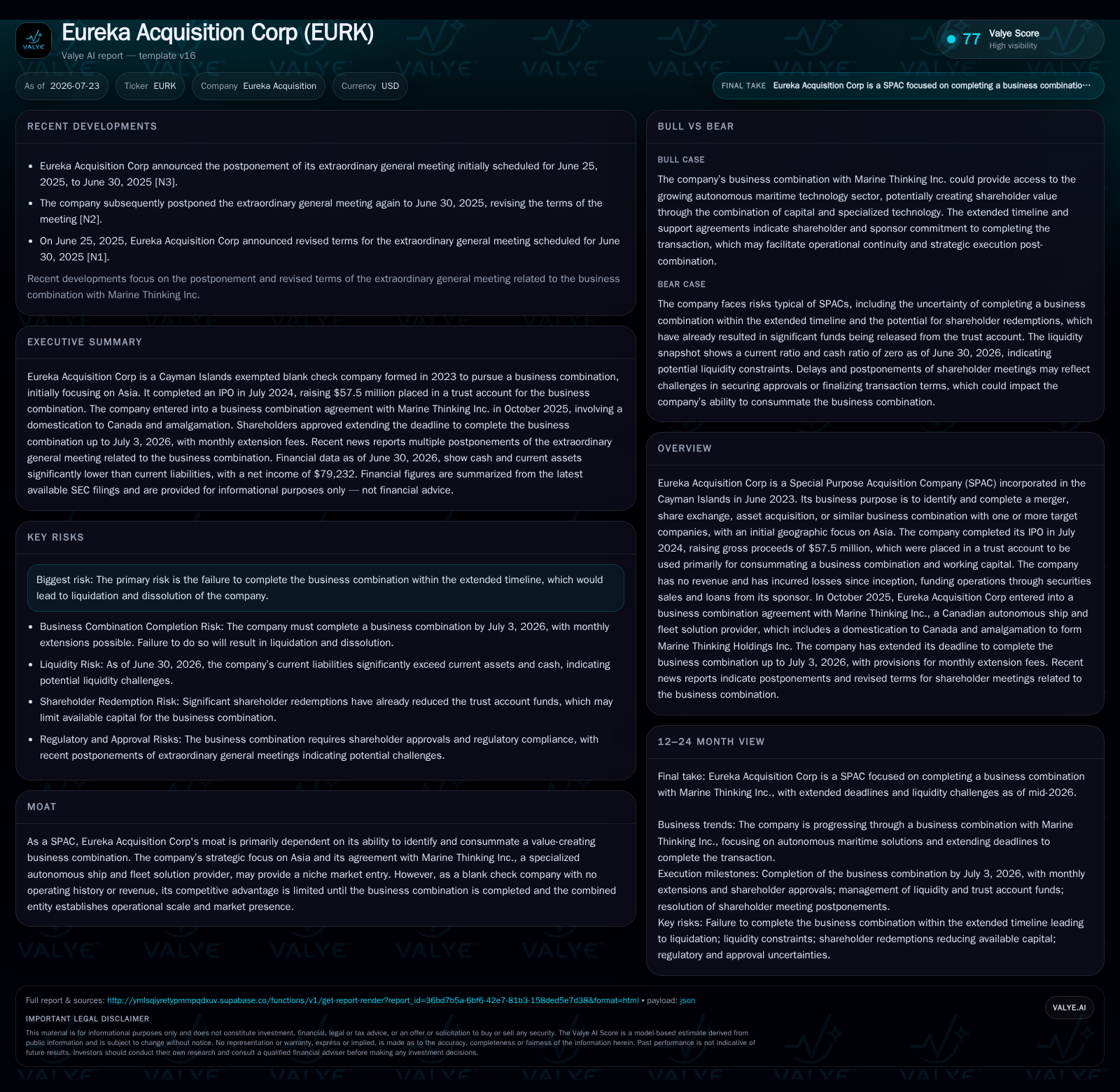
Eureka Acquisition Corp is progressing toward a business combination with Marine Thinking Inc., following a $57.5 million IPO and private placements. The company’s latest quarterly and event filings disclose an interest-free Extension Note tied to merger timing, with default risks that emphasize execution pressure. Despite substantial trust account funds earmarked for the transaction, current liabilities significantly exceed liquid assets outside the trust. Sponsor Hercules Capital Management holds a significant stake and has supported operations through loans. The SPAC’s success hinges on completing the deal within regulatory deadlines, managing shareholder redemptions, and navigating legal complexities related to the Canadian amalgamation.
Latest Quarterly Update: Extension Note Highlights Execution Pressure Ahead of Business Combination
In its most recent quarterly filing dated July 23, 2026, Eureka Acquisition Corp disclosed key developments in its ongoing de-SPAC process with Marine Thinking Inc., an autonomous maritime technology company headquartered in Canada [S2]. A material update is the issuance of an interest-free Extension Note due either upon consummation of the business combination or at the expiration of the SPAC’s term. This note contains stringent default clauses triggered by nonpayment or bankruptcy events, thereby amplifying financial covenant risk as the merger deadline approaches [S3].
This development underscores the critical timing pressures inherent in SPAC structures, where failure to complete a qualifying transaction within the allowed timeframe typically results in liquidation. While reported current assets stand at roughly $97,898 against $33.2 million in current liabilities as of June 30, 2026, these figures exclude approximately $57.5 million held securely in a trust account earmarked exclusively for funding the merger or refunding investors if the deal fails [F1]. Operational expenses remain funded largely through sponsor loans rather than operating cash flows—a standard approach for pre-combination SPACs.
Business Model Foundations: IPO Structure and Sponsor Dynamics Frame Value Creation Pathways
Eureka’s capital-raising adhered closely to established SPAC norms: On July 3, 2024, it completed an IPO issuing five million units priced at $10 each plus an over-allotment of 750,000 units shortly thereafter—generating total gross proceeds near $57.5 million including private placements to its sponsor Hercules Capital Management Corp [S1]. Each unit comprises one Class A ordinary share plus one right convertible into one-fifth of a Class A share following successful business combination completion.
Proceeds were placed into a segregated trust account managed by Continental Stock Transfer & Trust Company to safeguard public investors’ capital until deal closing or liquidation. This structure imposes disciplined capital preservation while allowing management discretion over net proceeds primarily for merger-related expenses and working capital.
Sponsor Hercules Capital holds approximately 33.89% ownership via private units granting significant pre-merger voting power but exposing public shareholders to dilution risk from accompanying warrants and rights issued during units offering. Public shareholders retain redemption rights before merger consummation—a critical variable affecting available cash for deal funding since elevated redemptions can strain transaction economics or necessitate alternative financing such as PIPEs.
These operational metrics—trust account size versus redemption rates; time remaining to close; sponsor equity stake relative to public float—are key indicators shaping post-merger equity value sustainability.
Competitive Positioning Within SPAC Peer Landscape: Niche Target Presents Unique Challenges
While Eureka operates within the broader SPAC ecosystem alongside notable peers like Pershing Square Tontine Holdings (PSTH) and Virgin Galactic (SPCE), it distinguishes itself by targeting Marine Thinking Inc., which specializes in autonomous maritime technologies—a sector less traversed by mainstream consumer-focused SPAC deals.
This niche confers potential upside from early exposure to emerging shipping automation trends but also introduces integration complexities given cross-border domestication requirements under Canadian law—a factor that may extend timelines compared to purely domestic mergers. Such complexities contrast with high-profile deals like Virgin Galactic's retail-driven de-SPAC or Canoo's electric vehicle launch challenges.
Post-2022 regulatory reforms have intensified scrutiny on SPAC transactions broadly, mandating enhanced transparency and tighter deadlines that Eureka must navigate carefully to avoid costly delays or compliance issues.
Key Growth Drivers: Market Appetite for Alternative Public Listings Fuels Deal Potential
SPACs remain attractive pathways for private companies seeking expedited public market access without traditional IPO delays. Eureka’s geographic focus on Asia initially combined with Marine Thinking’s innovative maritime tech platform reflects strategic alignment with sectors benefiting from digitization and sustainability imperatives.
Sponsor Hercules Capital’s network likely enhances deal sourcing capabilities essential for identifying compelling targets commanding premium valuations when successfully listed.
PIPE financing will be crucial post-announcement to bolster liquidity beyond trust funds—especially if investor redemptions reduce available cash—ensuring adequate capitalization post-merger.
Maintaining operating capital until revenue generation begins post-combination remains vital given typical pre-merger losses among blank-check companies heightening urgency around closing timelines.
Risks and Watchpoints: Time Constraints and Financial Obligations Demand Close Monitoring
Eureka explicitly acknowledges risks associated with failing to consummate its business combination within prescribed deadlines; such failure triggers liquidation returning only pro-rata trust assets net of fees—resulting in significant shareholder value erosion [S2]
Dilution risks are material due to sponsor shares plus outstanding warrants/rights layered atop public units creating competing claims on future earnings.
Market volatility impacts share price performance influencing shareholder redemption behavior—a direct driver of available merger funding.
The newly introduced Extension Note adds creditor rights complexity absent from earlier filings; failure to repay on schedule could compound financial strain through default events including bankruptcy or enforcement proceedings [S3].
Regulatory changes tightening SPAC rules increase compliance burdens adding uncertainty.
Limited operating history pre-merger restricts external visibility on management efficacy beyond sponsor reputation elevating governance risks until scale is achieved.
What Investors Should Monitor Next: Critical Milestones Shaping Post-Merger Outcomes
Investors should track forthcoming SEC filings updating business combination progress including any deadline extensions or transaction amendments vital given Extension Note maturity terms [S2,S3].
Shareholder vote scheduling and outcomes represent pivotal liquidity inflection points impacting stock trading profiles once Marine Thinking shares begin public trading.
PIPE financing announcements will signal institutional confidence levels underpinning balance sheet solidity after closing mitigating dilution concerns.
Disclosures concerning litigation or regulatory reviews offer insights into latent risks potentially affecting valuation ahead of listing.
Trading volume patterns and warrant exercises provide indirect sentiment gauges regarding market reception of Eureka’s de-SPAC prospects.
Financial Profile Discussion: Trust Account Integrity Underpins Investor Principal Preservation Amid Operational Funding Constraints
As of June 30, 2026, Eureka reported cash equivalents near $57.9K (excluding trust assets) with total current assets around $97.9K contrasted against substantial current liabilities exceeding $33.2 million—highlighting acute short-term liquidity limitations if trust funds were disregarded [F1]
However, trust account funds totaling approximately $57.5 million remain segregated exclusively for business combination funding or investor redemptions ensuring principal protection distinct from operational cash flows.
Operational expenses continue to rely on sponsor loans common among SPACs prior to deal closure supporting ongoing corporate overhead needs [S1,S3].
The interest-free Extension Note introduced recently matures concurrently with merger deadlines embodying contingent financing that amplifies default risk exposure should execution delays occur [S3].
Sponsor ownership near one-third aligns interests between backers and minority shareholders but predicates meaningful dilution contingent on redemption rates during de-SPAC voting phases requiring vigilant monitoring ahead of share conversion post-combination.
Overall financial health assessment centers on trust account security rather than classical liquidity ratios given unique blank-check entity structure differing fundamentally from operating companies.
This analysis synthesizes publicly available SEC filings through July 2026 reflecting Eureka Acquisition Corp’s position as a blank check company progressing towards its targeted business combination.
Disclaimer: This is research-only, informational analysis and not investment advice. It may include AI-generated interpretation and general industry context. Always verify important details using primary sources.

Comments