
PG&E Corp Advances Wildfire Mitigation and Operational Efficiency Amid Regulatory Challenges
Strong Q2 results highlight PG&E’s focus on safety, capital investment, and a balanced triple bottom line under heavy regulatory oversight.
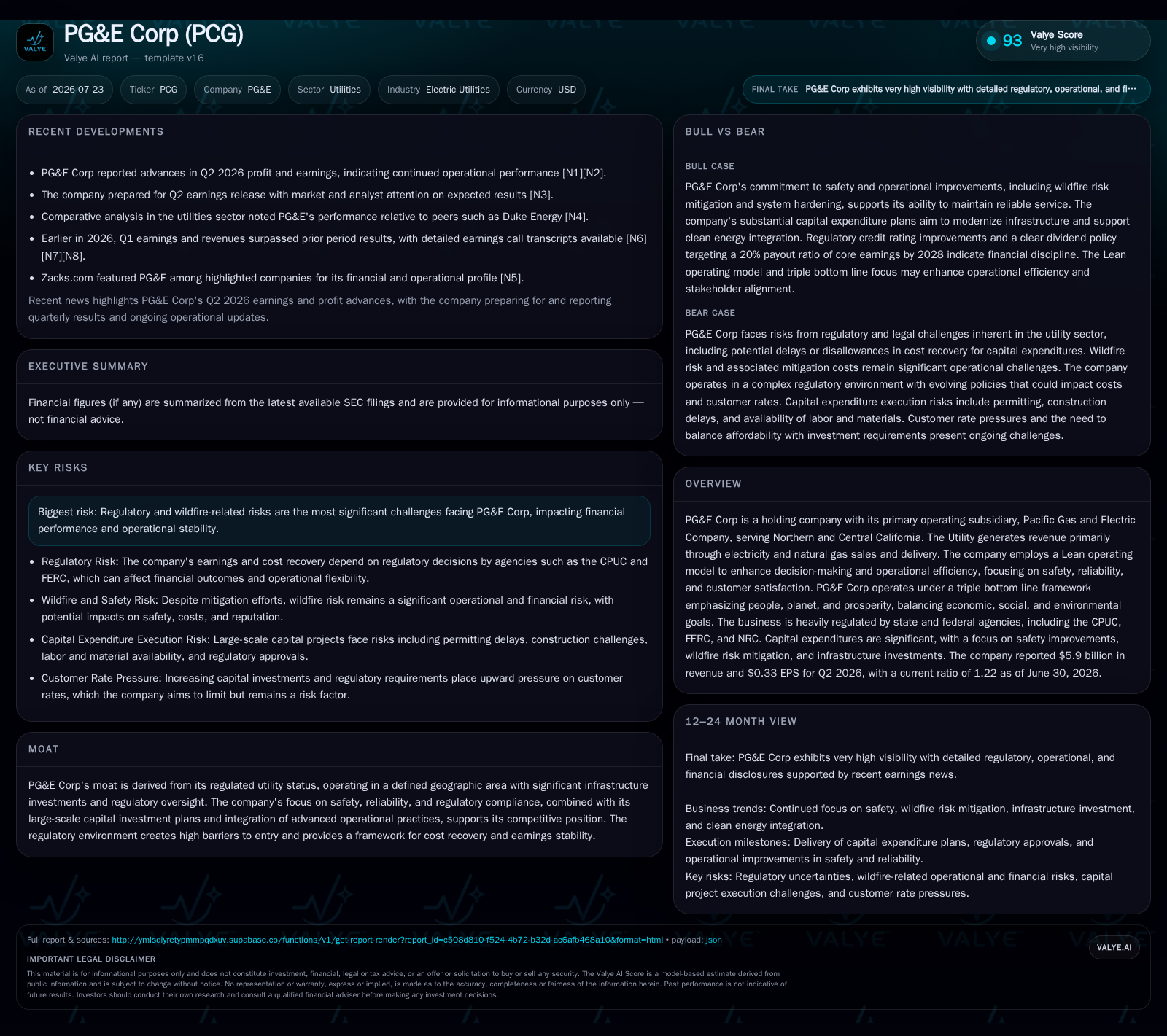
PG&E Corp reported a $5.9 billion revenue and $0.33 EPS in Q2 2026, reflecting steady execution on its regulated utility business model focused on electricity and natural gas delivery in Northern and Central California [S2], [N1]. The company’s Lean operations model supports improved decision-making and operational efficiency while addressing wildfire risk via significant capital expenditures and compliance with stringent state safety certifications [S1]. PG&E operates within a tightly regulated environment, balancing cost recovery through approved rates with ongoing challenges from wildfire liabilities and regulatory scrutiny. Key growth drivers include infrastructure modernization, load growth, and regulatory incentives to integrate renewables. Close monitoring of wildfire-related liabilities, regulatory rulings, and credit metrics remains essential for assessing long-term stability [S1], [S2].
Recent Operating Update: Q2 2026 Results Reflect Stability amid Strategic Capital Deployment
PG&E Corp reported second quarter 2026 revenues of approximately $5.9 billion and earnings per share (EPS) of $0.33 for the period ended June 30, 2026, demonstrating steady financial performance within its regulated electric and natural gas utility operations serving Northern and Central California [S2], [N1]. This outcome reflects consistent execution of its regulated-rate business model despite ongoing heavy capital expenditures focused on wildfire mitigation and infrastructure modernization mandated by California regulators. PG&E’s Lean operating system continues to enhance operational efficiency and decision-making responsiveness, supporting cost management while advancing safety and reliability objectives [S1], [S3].
Business Model: Regulated Utility with Safety-Driven Capital Investment
PG&E operates primarily through its principal subsidiary, Pacific Gas and Electric Company, which owns and manages electricity transmission and distribution networks alongside natural gas delivery infrastructure. The company’s revenues are predominantly generated through regulated rates approved by the California Public Utilities Commission (CPUC), which are designed to recover the utility’s prudently incurred costs—including capital expenditures (CapEx), operating and maintenance (O&M) expenses—and provide an allowed return on equity (ROE) [S1]. This cost-of-service ratemaking framework underpins PG&E’s financial stability and aligns incentives for infrastructure investment.
A critical element of PG&E’s business model is compliance with California wildfire safety legislation, notably AB 1054 and SB 254, which require the utility to maintain an approved Wildfire Mitigation Plan (WMP) and safety certification issued by the Office of Energy Infrastructure Safety (OEIS). These certifications are essential for PG&E to benefit from liability protections such as the Continuation Account fund and the reformed prudent manager standard, which cap the utility’s wildfire-related financial exposure. Failure to maintain safety certification or evidence of gross negligence could expose PG&E to uncapped wildfire liabilities, significantly impacting financial results and credit metrics [S1]
PG&E’s Lean operating model integrates continuous improvement practices to streamline workflows, reduce inefficiencies, and enhance safety culture. This approach supports the company’s triple bottom line philosophy—balancing economic performance with social responsibility and environmental stewardship—by fostering a workforce and operational environment focused on safety, reliability, and customer satisfaction [S1].
Industry Structure and Competitive Context: Monopoly with Regulatory Oversight
PG&E operates as a regulated monopoly within its defined service territories in Northern and Central California, serving a diverse customer base including residential, commercial, and industrial end-users. The utility’s operations are subject to comprehensive oversight by multiple regulatory bodies: the CPUC governs retail rate setting and safety compliance; the Federal Energy Regulatory Commission (FERC) oversees interstate natural gas transmission and wholesale electricity markets; and the Nuclear Regulatory Commission (NRC) regulates its nuclear generation assets [S1]
This regulatory environment imposes constraints and opportunities, as PG&E must balance infrastructure investment and operational cost recovery with customer affordability and regulatory scrutiny. The company’s regulated rate base—the net value of capital assets used to provide service—is a key driver of allowed revenues and earnings potential. Regulatory lag, the delay between capital investment and rate recovery approval, remains a significant operational and financial consideration.
PG&E’s scale and geographic concentration differentiate it from multi-state peers such as Southern Company and Duke Energy, which face broader regulatory and operational complexities. However, these peers provide benchmarks for capital intensity, operational efficiency, and regulatory engagement within the capital-intensive regulated utility sector.
Growth Drivers: Infrastructure Modernization and Electrification Trends
PG&E’s growth prospects are anchored in expanding its regulated rate base through sustained capital investments targeting wildfire mitigation, grid hardening, and modernization initiatives. These include equipment upgrades, enhanced vegetation management programs, undergrounding of vulnerable power lines where feasible, and deployment of advanced monitoring and forecasting technologies to improve system resilience and safety [S1]. Regulatory approvals for these investments typically follow detailed CPUC review, with cost recovery and ROE adjustments contingent on demonstrated prudency and compliance.
Load growth driven by population and economic expansion in PG&E’s service territory contributes to incremental electricity and natural gas demand. Electrification trends, including increased adoption of electric vehicles (EVs) and electrification of heating, further support volumetric growth in electricity delivery measured in megawatt-hours (MWh). While energy efficiency programs moderate natural gas consumption growth, they complement the utility’s broader decarbonization and sustainability objectives.
Regulatory incentives aimed at integrating renewable energy sources and supporting clean energy transitions provide additional growth avenues. Although PG&E primarily operates as a distribution utility, it engages in procurement and partnership arrangements to facilitate renewable generation integration, aligning with California’s ambitious environmental policies.
Risks and Operational Watchpoints: Wildfire Liability and Regulatory Dynamics
PG&E’s foremost risk remains wildfire-related liability exposure despite legislative protections. Maintaining valid safety certification and demonstrating adherence to the prudent manager standard are essential to preserving liability caps and mitigating financial risk. Wildfire-related safety incident rates and compliance with the Wildfire Mitigation Plan constitute critical operational KPIs.
Regulatory lag in rate case proceedings can delay cost recovery, impacting cash flow and earnings stability. Additionally, elevated O&M expenses associated with safety programs, cybersecurity defenses against threats to grid infrastructure, and environmental compliance—including remediation of incidents such as the 2023 Butte Canal breach—add complexity and cost pressures.
Public and stakeholder perceptions continue to influence PG&E’s social license to operate, particularly in light of historical wildfire events. Effective community engagement and transparent communication remain vital components of risk management.
Monitoring Points: Regulatory Filings and Operational Execution
Upcoming CPUC decisions on rate cases and Wildfire Mitigation Plan updates will be pivotal in defining allowed returns on capital investments and shaping PG&E’s financial trajectory. Monitoring developments in wildfire claims settlements and litigation is important due to their potential impact on financial provisions and contingent liabilities.
Operationally, tracking capital project milestones and improvements in reliability metrics such as the System Average Interruption Duration Index (SAIDI) and System Average Interruption Frequency Index (SAIFI) will provide insight into execution effectiveness and service quality.
Management’s commentary on O&M spending trends, strategic priorities, and regulatory engagement during quarterly earnings calls will offer additional context on near-term operational and financial outlooks. Credit rating agency assessments amid evolving risk profiles also warrant attention given implications for borrowing costs.
Financial Profile: Liquidity and Capital Structure
As of June 30, 2026, PG&E reported cash and cash equivalents of approximately $972 million against current liabilities of about $12.67 billion, resulting in a current ratio of approximately 1.22, consistent with capital-intensive utilities managing substantial short-term obligations related to ongoing projects and payables [F1]. Total debt figures are less current but prior disclosures indicate multibillion-dollar fixed obligations, reflecting leverage levels typical within the regulated utility sector.
Disclaimer: This analysis is for informational purposes only and does not constitute investment advice. It incorporates company-reported data and general industry context without projections or research views.
Disclaimer: This is research-only, informational analysis and not investment advice. It may include AI-generated interpretation and general industry context. Always verify important details using primary sources.

Comments