
Waste Connections’ Q2 2026 Results Spotlight Vertical Integration and Market Consolidation Benefits
Waste Connections sustained operating margins and revenue growth in Q2 2026, leveraging exclusive contracts and vertically integrated waste management assets amidst ongoing industry consolidation.
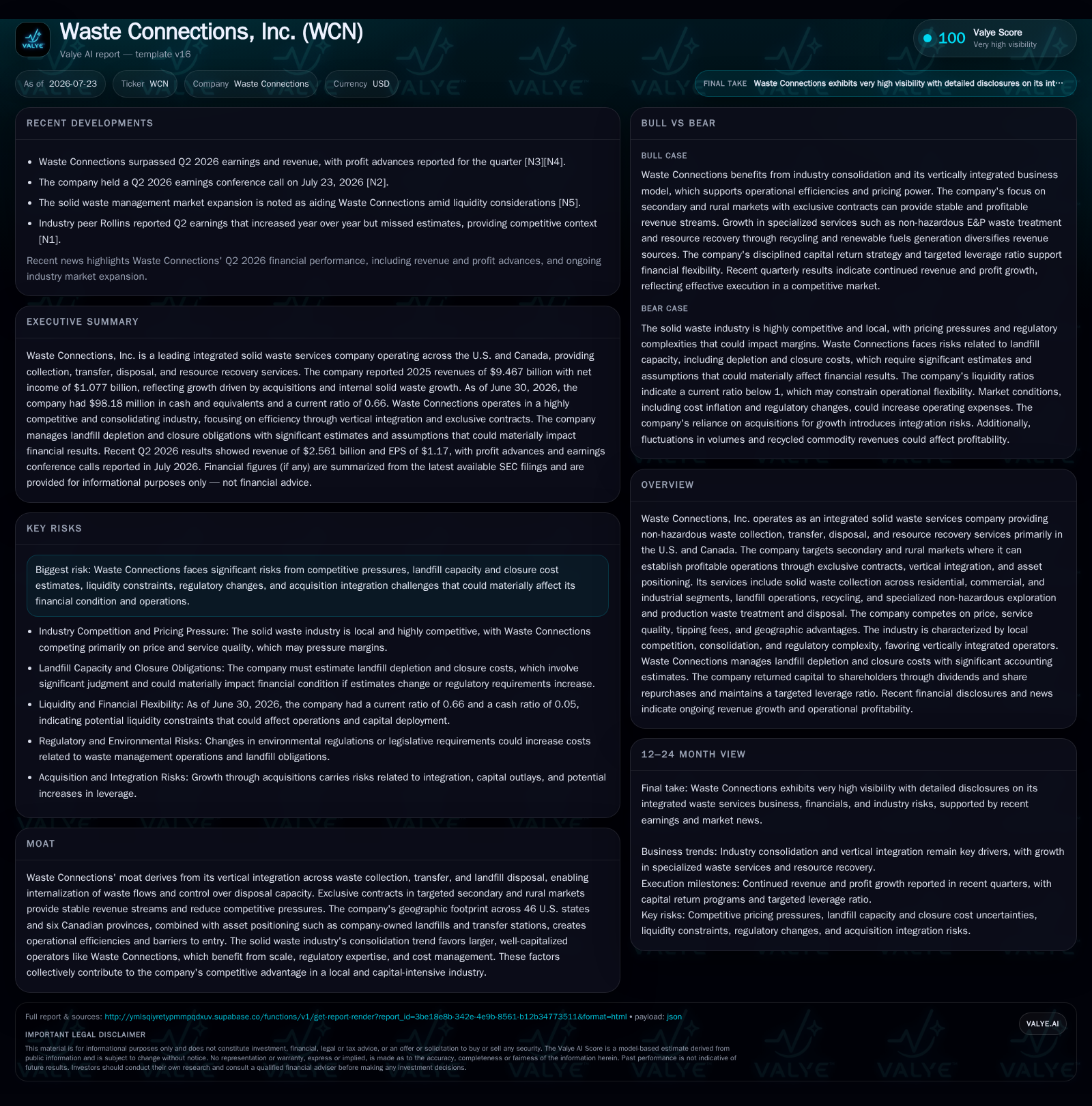
In its latest quarterly filing, Waste Connections demonstrated continued operational stability powered by its integrated business model, combining non-hazardous waste collection, transfer, and landfill disposal primarily in secondary and rural markets. Exclusive long-term contracts underpin consistent volumes while company-owned landfills and transfer stations enable margin capture through tipping fees and internalized flows. The broader solid waste industry’s consolidation trend reinforces Waste Connections’ pricing power and geographic scale advantage. Key growth avenues include development in niche waste streams such as exploration and production (E&P) waste, although landfill capacity constraints and regulatory changes remain watchpoints.
Q2 Earnings Reveal Stable Margin Capture Through Vertical Scale
The accounting change related to government grants adoption had no material impact on reported results, indicating fundamental performance strength remains anchored in operations rather than mere accounting shifts [S2]. With intrinsic operating efficiency stabilized by asset control, Waste Connections maintains a margin profile less susceptible to external volume swings or price compression seen by less integrated peers.
Exclusive Collection Contracts Underpin Local Market Resilience
A core pillar of Waste Connections' business model is securing exclusive long-term non-hazardous solid waste collection contracts primarily in secondary and rural markets across 46 U.S. states plus six Canadian provinces [S1]. These exclusive agreements limit direct collection competition locally and provide predictable volumes of municipal solid waste (MSW), commercial refuse, and industrial waste flows.
The local nature of contracts reveals a strategic focus: targeting less-contested markets where the company can establish strong regional presence coupled with geographic asset positioning. Stable customer retention arising from these arrangements supports predictable recurring revenue streams—critical given the capital-intensive nature of the industry's value chain where upfront investments in collection fleets and landfills require steady throughput to sustain returns.
Contrast this with urban hubs where numerous competitors vie for market share; Waste Connections' emphasis on secondary areas affords an operational moat bolstered by contract exclusivity that mitigates pricing pressure.
Strategic Use of Asset Positioning Drives Operational Efficiency
Asset ownership distinguishes Waste Connections from pure-hauling players. The company operates numerous landfills it owns outright along with strategically placed transfer stations that aggregate collected waste efficiently before final disposal [S1][S2]. This setup enables substantial cost savings by reducing gate fees paid to third parties and limiting transportation overhead.
Capital expenditure priorities reflect managing landfill life expectancy — extending active capacity while addressing regulatory-driven closure cost requirements. Q2 expenditures included significant investment both in property improvements and undeveloped land acquisitions for future site development [S10]. This forward-looking capex strategy supports sustainable landfill utilization rates critical to maintaining the platform's margin integrity.
Vertical integration also facilitates charging of tipping fees not only on internally sourced wastes but from third-party haulers accessing transfer stations or landfill sites. Such diversified fee capture improves operating leverage relative to competitors reliant solely on either collection or disposal margins.
Industry Consolidation Reinforces Pricing Power and Barrier to Entry
The broader integrated solid waste management sector is undergoing continued consolidation driven by escalating operational complexity, regulatory pressures, and capital demands for permitted disposal sites [S1]. Smaller operators struggle with these challenges due to limited scale or access to capital markets.
Waste Connections aligns with peers like Waste Management (WM) and Republic Services (RSG), leveraging scale advantages enabling disciplined pricing through tipping fees that incorporate environmental compliance costs yet remain competitive due to efficient asset utilization.
Consolidation creates higher entry barriers as acquiring complementary landfills paired with exclusive collection routes becomes increasingly costly. This dynamic supports Waste Connections’ ability to renew contracts with less risk of price erosion—a notable advantage compared to less integrated regional operators who must secure external disposal capacity under fluctuating market rates.
Opportunities in Niche Waste Streams Complement Core Operations
Beyond municipal solid waste services, Waste Connections expands selectively into specialized non-hazardous exploration & production (E&P) waste treatment markets across key basins in North America [S1][S2]. These niche segments exhibit growth potential tied to energy sector activity levels while commanding differentiated pricing structures due to specialized handling requirements.
Additionally, resource recovery initiatives including recycling operations contribute incremental revenues aligned with rising regulatory focus on diversion from landfills. Technological advances in processing allow more effective capture of recyclable materials or renewable fuels generation—creating ancillary profit centers that complement traditional hauling/landfill margins.
Incremental scale in these targeted segments could enhance overall portfolio margin resilience even amid cyclicality affecting core MSW volumes.
Risks from Landfill Capacity Limits and Regulatory Changes Monitor Closely
Despite strengths, notable risks persist related to landfill capacity exhaustion timelines which impose capital expenditure commitments for new site development or expansions [S1]. Uncertainties around closure cost estimates can impact long-term liabilities recorded on the balance sheet as well as ongoing post-closure care expenses potentially pressuring free cash flow.
Environmental regulations periodically evolve — tightening emission controls or imposing stricter landfill operation standards — increasing compliance costs that must be factored into pricing models. Competition remains a concern especially if municipalities alter policies favoring curbside recycling or alternative waste treatment technologies reducing volumes directed toward traditional landfills.
Labor availability for fleet operation or regulatory personnel expenses constitute additional cost pressures alongside macroeconomic factors influencing commercial/industrial waste generation.
What to Watch Next: Contract Renewals, Capex Trends, and Margin Sustainability
Upcoming quarterly reports will be important for assessing the trajectory of contract renewal pricing terms across the sprawling proprietary customer base — key indicators for revenue durability amid inflationary cost environments [S2][S3]
Capital spending patterns will reveal whether investments keep pace with anticipated landfill depletion schedules or technology upgrades necessary for regulatory compliance without excessive cash burn that could strain liquidity.
Further earnings commentary may clarify expectations around inbound volume trends particularly within niche E&P markets that offer diversification from municipal solid waste cycles.
Monitoring changes in average tipping fees per ton alongside operating margin developments will signal if vertical integration benefits continue offsetting inflationary headwinds characteristic of this capital-intensive segment.
Financial Profile Discussion: Balance Sheet Leverage Supports Growth but Requires Vigilance
Waste Connections exhibits a finance profile typical for large integrated solid waste companies requiring substantial capital assets. The June 30, 2026 balance sheet shows approximately $9.28 billion total debt offset by $98 million cash/equivalents resulting in net debt near $9.19 billion [F1][S2]. Current assets of $1.40 billion and current liabilities of $2.13 billion imply a current ratio near 0.66x as of June 30, 2026 [F1].
Robust free cash flow generation from stable fee-based revenue streams is crucial to meet interest obligations given prevailing debt levels [S10]. Capital expenditures are substantial ($650 million+ annually) reflecting ongoing site expansions alongside equipment upkeep required under stringent environmental rules.
This blend of leverage-driven growth emphasizes maintaining disciplined financial management while balancing investment needs against liquidity risks inherent in the industry’s long asset life cycles.
This analysis integrates Waste Connections’ recent quarterly disclosures with established industry knowledge emphasizing how vertical integration combined with contract exclusivity builds a defensible competitive position amid continuing sector consolidation. While regulated landfill capacity limits represent a structural constraint requiring careful capex planning, ongoing expansion into niche services offers a potential buffer enhancing the resilient cash flow framework supporting elevated leverage typical within integrated solid waste operators.
Disclosure: This report is for informational purposes only and does not constitute investment advice or research views.
Disclaimer: This is research-only, informational analysis and not investment advice. It may include AI-generated interpretation and general industry context. Always verify important details using primary sources.

Comments