
Molina Healthcare's Operating Pressures and Capital Resilience in Q2 2026
Q2 results show margin pressure from rising medical costs and membership shifts, balanced by regulatory capital strength.
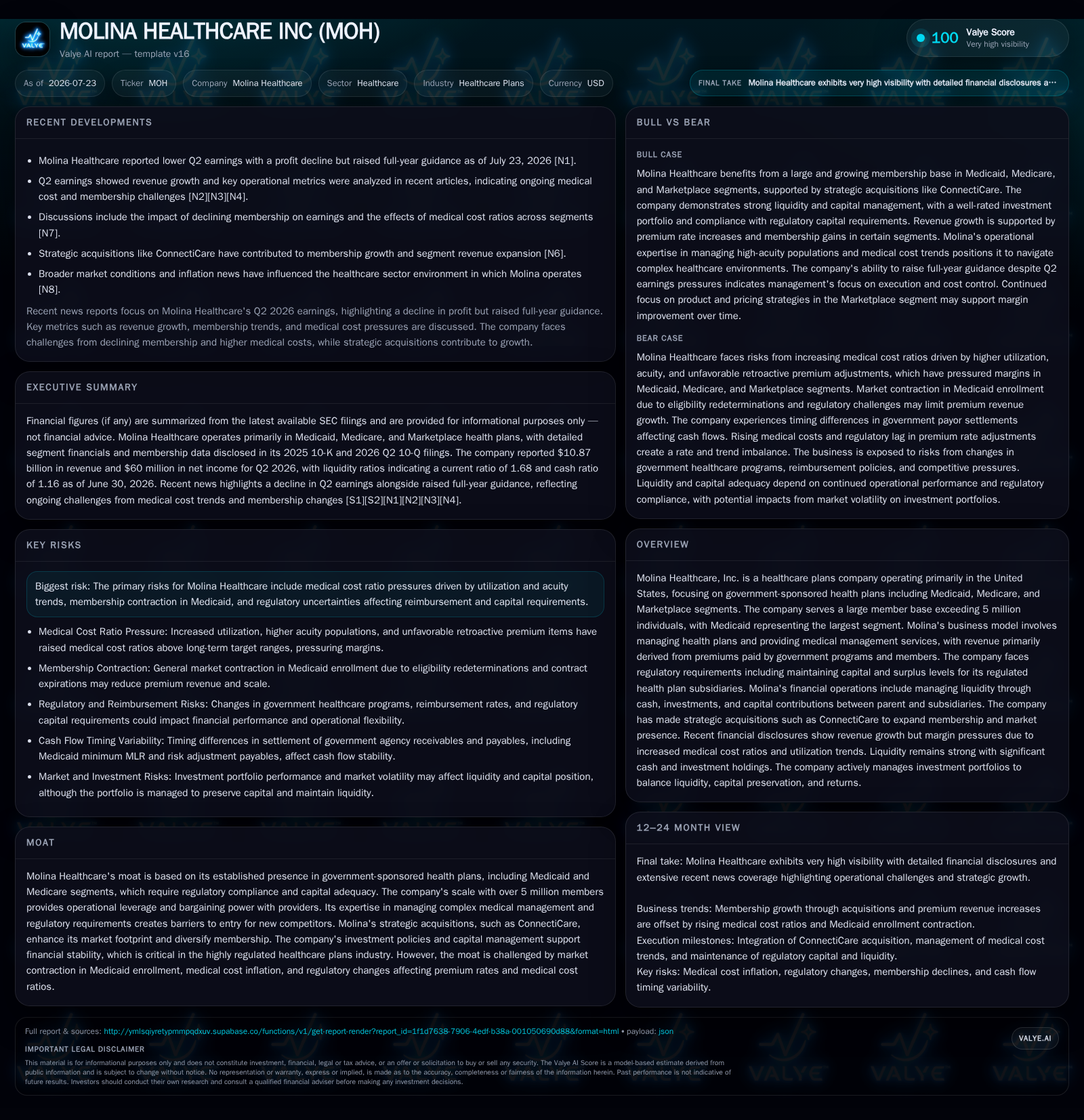
In Q2 2026, Molina Healthcare experienced upward pressure on medical cost ratios, especially driven by Medicare utilization trends and elevated pharmacy and long-term services costs. Medicaid membership contraction persisted due to eligibility redeterminations, creating premium revenue headwinds despite incremental gains from acquisitions like ConnectiCare. Regulatory capital requirements continue to constrain dividend flexibility but the company maintains a solid liquidity position with nearly $5 billion in cash and undrawn credit facilities. These dynamics underscore the ongoing tension between rising healthcare expenses, payment rate lags, and operational scale advantages in government-sponsored managed care.
Q2 Operating Pressures: Medical Cost Trends Outpacing Premium Growth
Molina Healthcare’s Q2 2026 update detailed significant upward pressure on its Medical Cost Ratio (MCR), particularly within the Medicare segment. The increase is largely attributed to higher-than-expected utilization among high-acuity dual-eligible members, notably for long-term services and supports (LTSS) as well as expensive specialty pharmacy drugs [S2], [S1]. This trend follows the 2025 pattern where Medicare MCR rose from 89.1% to 92.4%, compressing margins despite pricing adjustments and market exits [S1]. Such rising costs indicate persistent challenges in aligning capitated premiums with rapidly increasing utilization intensity.
Meanwhile, Medicaid experienced membership contraction aligned with broader market dynamics driven by eligibility redeterminations [S2], [S1]. Although premium revenues increased slightly due to rate hikes and contractual gains including from the ConnectiCare acquisition [S3], the net effect of shrinking membership dampened top-line momentum. The marketplace segment remains actuarially volatile as premiums adjust based on member health acuity, complicating rate-setting processes given consumer price sensitivity and annually shifting risk profiles [S1], [S2].
The company recorded a $78 million liability related to estimated amounts owed to CMS under Part D settlement provisions at quarter-end, reflecting ongoing financial exposure tied to federal reconciliation mechanisms that impact earnings quality [S2]. This estimate rose modestly from $66 million at year-end 2025, underscoring continuing regulatory cost uncertainties.
Underlying Business Model Dynamics Within Government-Sponsored Plans
Molina’s business model centers on fixed capitation payments primarily from Medicaid programs, Medicare Advantage (MAPD), and healthcare marketplaces administered through states under federal guidelines [S1], [S2]. Revenue depends heavily on accurate actuarial assumptions balancing member risk scores against expected medical utilization. As premiums are generally set annually in contracts with government payors, rapid increases in medical costs or utilization can create lagging reimbursement that erodes medical margins.
Medicaid forms the largest segment by membership—over 4.5 million as of late 2025—with moderate rate increases partially offsetting contraction in covered lives caused by ongoing eligibility verifications at the state level [S1]. In contrast, Medicare’s smaller but higher-cost dual-eligible population presents distinct pricing pressures with utilization concentrated in expensive LTSS benefits and specialized therapies that have outpaced annual premium adjustments.
The strategic exit from certain MAPD markets aligns Molina toward concentrating on dual-eligible members where risk adjustment mechanisms more accurately reflect acuity-driven medical spending patterns, though execution risks remain as contract rights assets were impaired by $93 million in early 2026 [S2], [S16]. Operationally, profitability depends critically on effective utilization management strategies including provider network negotiation and care coordination to contain claims expense within capitated revenues.
Competitive Positioning: Peer Comparisons and Regulatory Constraints
Molina Healthcare operates alongside peers such as Centene Corporation and WellCare Health Plans within the managed Medicaid and Medicare landscape where scalability and regulatory compliance drive competitive advantage. Its membership base exceeding 5 million individuals provides bargaining power with providers while enabling fixed-cost leverage across administrative functions [S1]. However, margins face similar downward pressure observed industry-wide due to rising claims cost inflation outpacing regulatory premium adjustments.
Regulatory capital requirements impose a crucial constraint on Molina’s operational flexibility. At quarter-end, regulated subsidiaries held capital levels exceeding minimum thresholds required by state authorities, allowing some room for dividends to the parent company—estimated at around $170 million as of December 31, 2025—but this capacity is expected to shrink amid diminished net income performance [S1], [S2]. Dividend distributions are closely monitored given their impact on consolidated liquidity and debt covenants.
Growth Drivers: Membership Mix Evolution and Market Expansion via Acquisitions
Despite headwinds from Medicaid enrollment decline attributable to eligibility redetermination cycles extending into mid-2026, Molina expanded its footprint through strategic acquisitions such as ConnectiCare completed February 2025 [S3]. This deal contributes incremental premium revenue while diversifying geographic exposure into commercially insured segments that complement government plan offerings.
Longer term growth potential lies in demographic shifts favoring Medicare Advantage uptake due to an aging US population requiring complex chronic care management supported by Molina’s dual-eligible expertise. Moreover, improvements in risk adjustment analytics allow better capture of acuity-related reimbursement enhancing medical margin sustainability when effectively deployed.
State-level incentives encouraging managed care adoption for Medicaid populations also offer structural tailwinds supporting enrollment growth where Molina can compete on care quality metrics integrated with community-based service models.
Key Risks: Regulatory Shifts, Margin Compression, Membership Volatility
Primary risks include volatility in state-set Medicaid capitation rates which may fail to keep pace with escalating medical claims driven by inpatient utilization surges, behavioral health demand increases, pharmacy cost inflation, and LTSS expansion—all documented pressures translating into elevated MCRs exceeding target ranges [S1], [S4]. Retroactive premium rate adjustments or recoupments remain a latent concern potentially impacting reported results adversely.
Membership volatility persists as states conduct ongoing revalidations reducing eligible populations temporarily or permanently, directly impacting premium revenue streams and risk pool composition amidst competition from alternative insurance products or direct government coverage options. Marketplace plan participation continues exhibiting unpredictable enrollment patterns influenced by subsidy levels and consumer behavior changes challenging precise forecasting [S1], [S2].
Litigation risk exists in the form of securities class actions filed related to prior earnings guidance disclosures as well as routine provider contract disputes; while accruals have been recognized where likely losses exist, these factors add external uncertainty affecting operational focus under regulatory scrutiny [S4]
What to Watch: Milestones Around Reimbursement Adjustments and Enrollment Metrics
Enrollment data following state eligibility redetermination cycles will provide key signals for Medicaid population trajectory impacting premium revenue visibility. Integration progress of acquired platforms like ConnectiCare will be telling regarding margin contribution sustainability over coming quarters.
Finally, monitoring peer responses to marketplace volatility including pricing strategies employed by Centene or UnitedHealth Group offers comparative insight into strategic adaptations necessary under evolving regulatory frameworks.
Financial Profile Discussion: Balance Sheet Strength Amid Rising Expense Trends
As of June 30, 2026, Molina Healthcare maintains a robust liquidity position highlighted by approximately $5.0 billion in cash and cash equivalents against current liabilities near $7.7 billion resulting in a healthy current ratio around 1.68—indicative of sufficient short-term coverage capacity [F1], [S2]. Total outstanding senior notes aggregate roughly $3.77 billion spread across maturities through early 2033 carrying coupon rates between 3.875% and 6.5% [S2]. The combination of steady debt load and strong cash balance supports balance sheet resilience amid adverse margin trends.
Dividend distributions remain constrained by capital adequacy regulations yet some flexibility endures allowing measured cash flow upstreaming when earnings permit.
This financial posture offers Molina resilience against cyclical operating fluctuations while supporting ongoing strategic investments including technology enhancements aimed at improved utilization management capabilities critical for margin recovery prospects.
Disclaimer: This analysis is intended solely for informational purposes synthesizing publicly filed data without providing investment advice or research views.
Disclaimer: This is research-only, informational analysis and not investment advice. It may include AI-generated interpretation and general industry context. Always verify important details using primary sources.

Comments