
Vita Coco Expands Premium Reach While Managing Integration and Supply Chain Inflation Risks
Latest quarter shows growth supported by acquisition and pricing amid supply chain and tariff pressures.
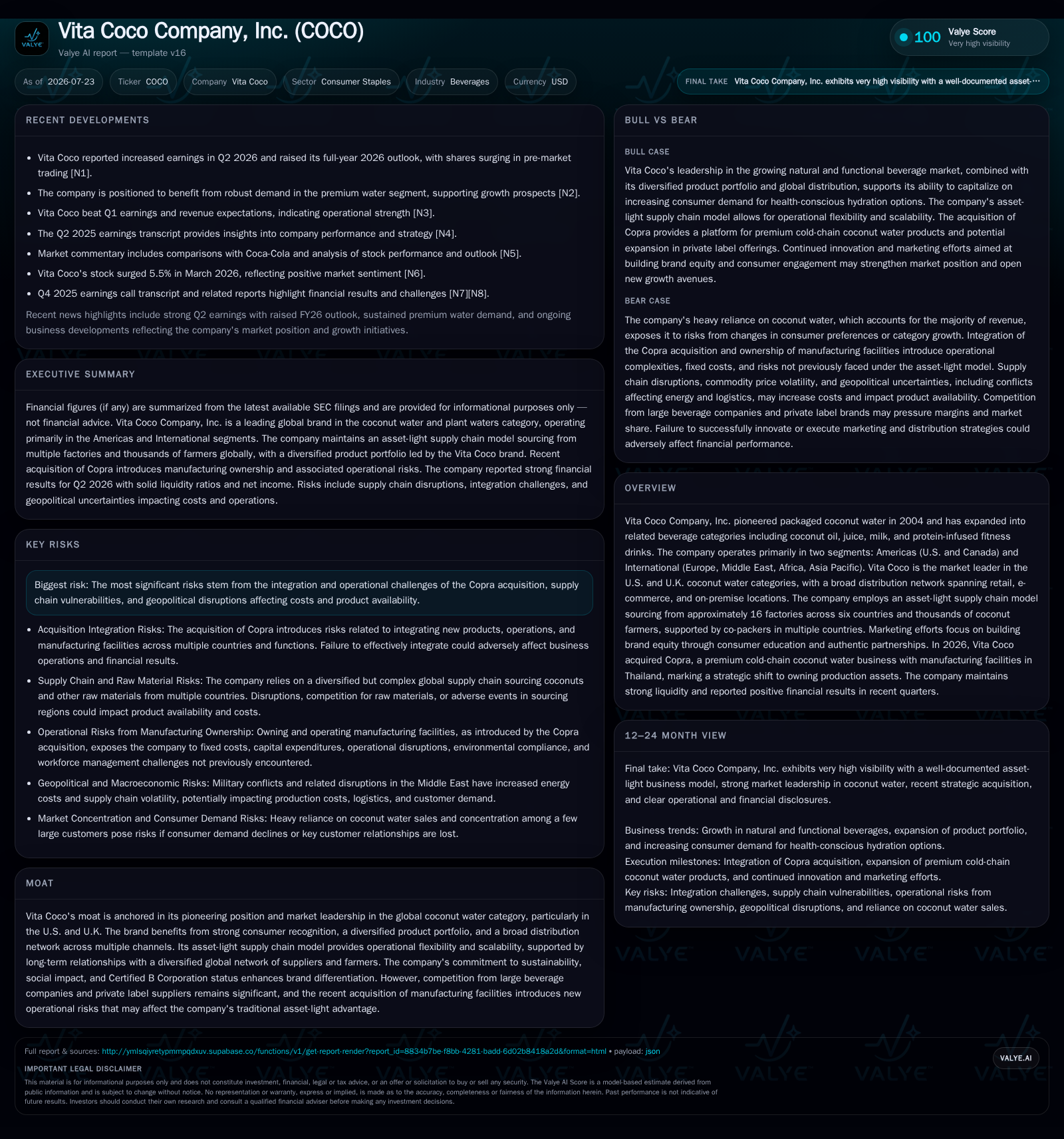
Vita Coco Company, Inc. reported a solid Q2 2026 operating performance driven by volume growth and net pricing improvements in its core coconut water products. The company is integrating its recent acquisition of Copra, a premium cold-chain coconut water producer, which introduces new operational complexity and asset ownership contrasting with its traditional asset-light model. While maintaining leadership in the U.S. and U.K. coconut water categories, Vita Coco faces margin compression due to tariffs, freight inflation, and rising packaging costs. Growth drivers include expanding distribution channels, product innovation, and sustainability commitments; however, integration risks and international supply chain vulnerabilities require close monitoring.
Recent Operating Update
In the second quarter ending June 30, 2026, Vita Coco continued to expand its core business despite ongoing challenges from tariffs and shipping cost inflation. Volume growth was underpinned primarily by increased sales of branded Vita Coco Coconut Water alongside pricing improvements that helped offset inflationary pressures on product costs. Importantly, the company completed the acquisition of Copra in July 2026—a premium cold-chain coconut water business with manufacturing facilities in Thailand—marking a strategic addition aimed at tapping into higher-quality segments and private label opportunities that demand specialized production capabilities [S2][S3]. While details remain limited on the financial impact of this deal, management has highlighted integration efforts spanning operations, supply chain, finance, human resources across multiple countries as key near-term priorities [S2].
Business Model Analysis
Vita Coco operates primarily as a branded beverage marketer specializing in coconut water alongside related plant-based beverages like coconut oil, milk products, and PWR LIFT protein-infused fitness drinks. The company’s historical competitive advantage stems from pioneering packaged coconut water starting in 2004 and establishing itself as the market leader in the U.S.—holding roughly a 40% share—and the U.K., with an estimated 80% market share in these categories [S1]. Revenue recognition depends on the segment: branded product sales are recognized upon customer receipt; private label revenues—which include both coconut water and oil produced under retailer brands—are recognized over production time since these arrangements represent distinct performance obligations with no alternative use for produced inventory [S15].
A defining feature of Vita Coco’s operating model is its asset-light supply chain strategy whereby it sources raw materials from approximately 16 factories spanning six countries across Asia Pacific, EMEA, and Americas regions without owning these factories directly. This approach leverages long-term supplier partnerships combined with co-packing arrangements—especially for local packaging—to remain flexible amid shifting consumer preferences or tariff environments while mitigating capital intensity [S1]. However, the recent Copra acquisition introduces owned manufacturing assets into this previously outsourced model introducing new fixed costs and operational complexity that could challenge its nimble SCM advantage if not integrated effectively.
Distribution is broad based across retail formats including club stores (e.g., Costco), grocery store chains, convenience outlets, drug stores, mass merchandisers as well as e-commerce platforms and expanding on-premise channels such as fitness centers, airports, corporate offices, and educational institutions [S1]. This multi-channel approach addresses diverse consumer purchasing behaviors enhancing product accessibility though it also subjects the company to variable margin structures depending on channel economics.
Industry Structure & Competitive Position
The functional and plant-based beverage industry is characterized by increasing consumer demand for natural hydration solutions with clean-label ingredients aligning with health-conscious trends favoring low sugar content and sustainably sourced ingredients. Within this environment, Vita Coco’s longstanding brand equity anchors its leadership position in global coconut waters but faces growing competition both from large beverage conglomerates such as Coca-Cola or PepsiCo expanding into functional waters as well as private label suppliers selling similar products at lower price points particularly in Europe and North America.
Vita Coco’s global sourcing scale is a critical barrier to entry since establishing dependable relationships with thousands of farmers across multiple countries buffers against localized disruptions seen elsewhere in agricultural commodity markets. Nonetheless, its significant exposure to tariff fluctuations—particularly U.S.-imposed reciprocal tariffs averaging ~23% during 2025—pressure margins more than some diversified peers who may have greater local manufacturing integration or less reliance on imports [S1][S11]. Packaging material concentration risk also looms given dependence on single suppliers like Tetra Pak for cartons which impacts costs should alternative supply prove unavailable or less competitive over short periods [S16].
The company's Private Label business supplements revenues but introduces margin variability since contracts are frequently rebid or regionally adjusted by major retailers impacting volume consistency; this heightens customer concentration risk particularly where large retail chains control significant shelf space allocation decisions [S12]
Growth Drivers
Several structural trends underpin growth prospects for Vita Coco:
- Consumer Hydration & Wellness Trends: Rising demand for natural beverages free from artificial additives supports ongoing category expansion globally.
- Product Innovation: New flavors, formats (such as enhanced isotonic drinks like PWR LIFT), and fortified nutrition blends cater to evolving consumer preferences seeking functional benefits beyond hydration.
- Channel Expansion: Growth potential lies in further penetration of e-commerce platforms globally plus scaling presence in on-premise venues where consumers seek convenient hydration options.
- Geographic Reach: Despite mature markets in North America & Europe representing bulk revenue (~83% Americas segment contribution), expansion into Asia Pacific and emerging regions presents upside potential as health awareness rises.
- Sustainability Focus: Certified B Corporation status highlights commitment to social responsibility strengthening brand differentiation among environmentally conscious consumers.
- Strategic Acquisitions: Targeted deals like Copra provide premium product extensions via cold-chain infrastructure necessary for higher-end beverage quality standards demanded by certain private label customers.
- Marketing Investment: Ongoing emphasis on brand education through authentic partnerships aims to deepen consumer engagement sustaining loyalty amid increasing category competition.
Risks & Watchpoints
Key risks plausibly shaping Vita Coco’s trajectory revolve around:
- Integration Complexity: The recent Copra acquisition adds owned plant assets which contrast with asset-light legacy operations; failure to integrate efficiently risks operational disruptions or dilution of organizational focus impacting core execution capabilities [S2].
- Supply Chain Inflation & Geopolitical Issues: Reliance on international sourcing exposes costs to ocean freight fluctuations exacerbated by geopolitical conflicts affecting tariff imposition/removal timing impacting landed costs unpredictably [S1][S8].
- Tariff & Trade Policy Volatility: Tariff rates have varied widely—from baseline 10% to effective up to 50% regionally—with relief announcements only partially mitigating cost impacts; renewed trade tensions could reintroduce elevated costs affecting gross margins similarly across industry competitors reliant on imports [S1].
- Margin Pressure: Increasing product input costs (raw materials plus packaging), distribution expenses including domestic logistics inflation reduce gross margin percentages despite pricing efforts; inability to fully pass these through risks earnings compression overall [S21].
- Customer Concentration & Private Label Uncertainty: Large retailer customers wield significant negotiating power able to adjust vendor terms or switch providers swiftly reducing revenue predictability especially for private label segments where contracts rotate periodically [S12][S19].
- Regulatory & Labeling Scrutiny: Increasing regulatory pressures related to ingredient claims or advertising may necessitate costly compliance adjustments or injunctions harming brand image if not met properly [S19][S20].
- Raw Material Sourcing Quality & Availability: Fluctuations in farming outputs due to economic shifts among suppliers or adverse climate conditions may limit uniform supply threatening production continuity [S16].
What To Watch Next
Investors and observers should monitor:
- Progress reports on Copra integration addressing synergies realization timelines alongside impact on supply chain flexibility.
- Quarterly gross margin trends reflecting tariff pass-through effectiveness versus input cost trajectories.
- Volume developments across branded versus private label portfolios indicating underlying demand robustness or contract renewals.
- Distribution expansions particularly within emerging geographies or new retail/on-premise accounts signaling penetration gains.
- Marketing ROI metrics connected to new product launches validating innovation success rates.
- Any indications of regulatory challenges related to labeling standards or ingredient certifications altering operational compliance needs.
- Changes in raw material procurement costs or availability influenced by global agricultural conditions or political events.
Financial Profile Discussion
Vita Coco's balance sheet remains robust entering the second half of 2026, highlighted by substantial liquidity with cash and equivalents totaling approximately $279 million as of June 30, 2026—a level offering ample cushion for existing operations plus funding for organic investments or acquisitions like Copra without near-term leverage concerns [F1]. Total debt is negligible at around $3 thousand as last reported year-end positioning the company conservatively from a credit perspective. The current ratio stands healthy at approximately 3.36 indicating strong short-term asset coverage relative to liabilities ensuring ongoing operational resilience [F1].
While gross profit increased year over year driven by higher net sales ($610 million in FY25 vs. prior year) growing by about 18%, gross margin contracted slightly (down ~2 percentage points) reflecting cost headwinds principally linked to tariffs and logistics inflation partially offset by product mix improvement favoring branded Vita Coco offerings [S21][F1]. SG&A expenses rose moderately attributed mainly to personnel-related costs (+$11 million) supporting marketing initiatives (+$3 million) alongside administrative overhead increases including lease transitions—factors typical during scaling phases especially amid acquisition activity [S21].
Operating income improved by nearly $9 million (+11%) showing incremental leverage despite inflationary pressures whereas higher marketing spend signals management's intent on sustaining brand momentum notwithstanding forex fluctuations causing modest losses recently reported [S21][F1]. Continued prudent capital allocation balanced against investing in growth platforms will be crucial going forward given emerging complexity post-acquisition integration.
Disclaimer: This analysis is based solely on publicly available information from company filings and reliable news sources as of July 23, 2026. It does not constitute investment advice or research view regarding any securities mentioned herein.
Disclaimer: This is research-only, informational analysis and not investment advice. It may include AI-generated interpretation and general industry context. Always verify important details using primary sources.

Comments