
Alphabet’s Q2 2026 Performance Highlights AI-Driven Growth and Intensifying Regulatory Challenges
Strong advertising revenue growth and cloud expansion underscore Alphabet’s dominant ecosystem amid mounting investments and regulatory scrutiny.
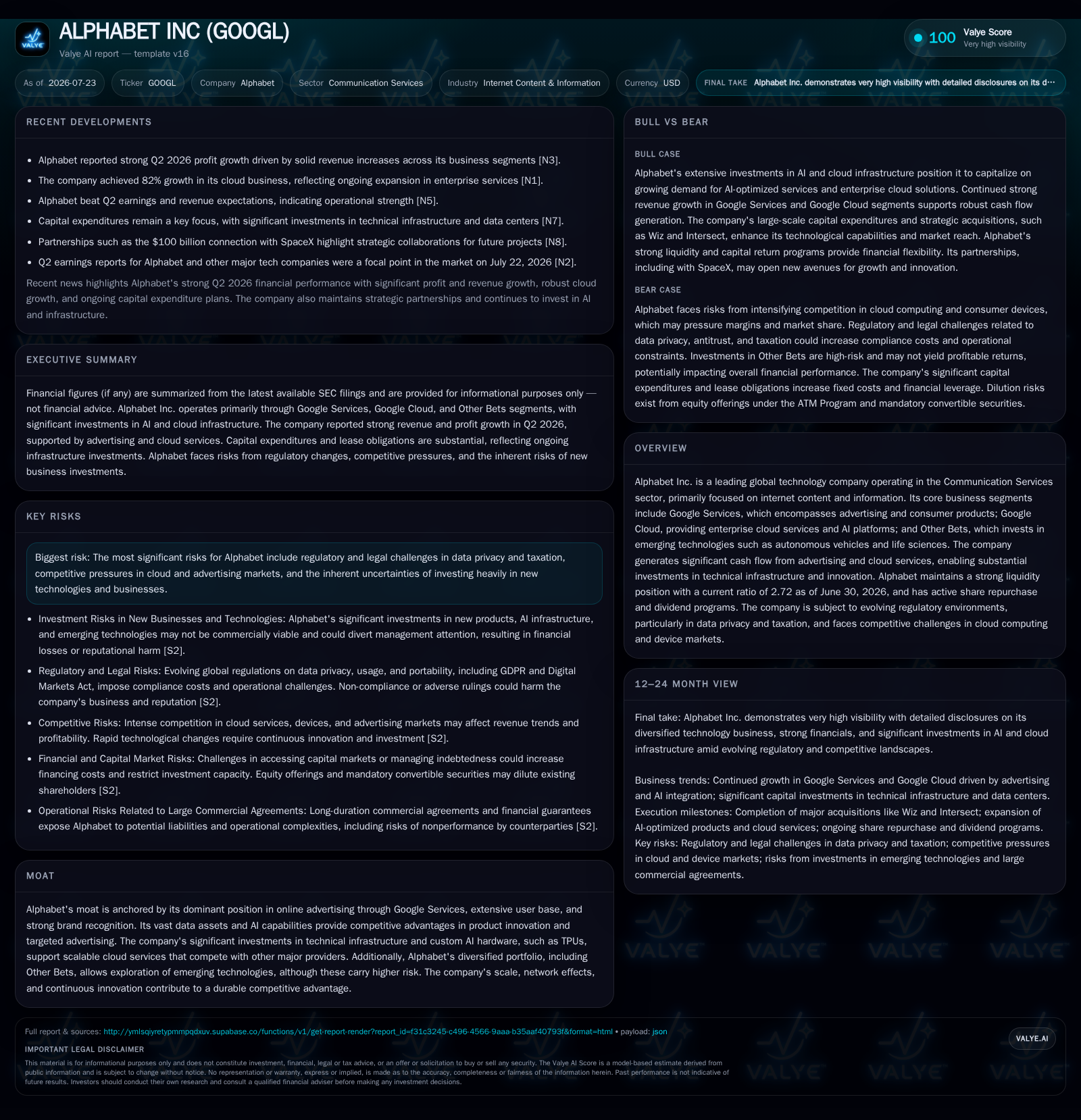
In Q2 2026, Alphabet Inc. demonstrated robust revenue growth driven by its Google Services advertising businesses and accelerating cloud segment, supported by ongoing investments in AI infrastructure and products. The company faces growing regulatory challenges focused on antitrust and data privacy across multiple jurisdictions, which pose potential risks to its monetization models. Alphabet’s diverse business model balances high-margin advertising with investment-heavy cloud computing and Other Bets, requiring significant capital expenditures that impact near-term margins but aim to sustain long-term competitive advantages. Monitoring paid click volumes, cost-per-click trends, and cloud profitability will be critical to assessing Alphabet’s trajectory in a shifting regulatory and competitive landscape.
Recent Operating Update: Strong Growth Powered by Advertising and Cloud
However, this growth is accompanied by substantial increases in capital expenditures related to data center expansions, AI hardware development (notably its custom TPUs), and workforce expenses to support scaling [S12]. These investments indicate Alphabet's strategy to solidify its competitive positioning against major cloud providers like AWS and Microsoft Azure.
Business Model: Monetizing User Engagement Through Diversified Platforms
Alphabet operates three primary segments: Google Services, Google Cloud, and Other Bets [S22]. Google Services encompasses digital advertising on Google Search & other properties (including YouTube), subscription services like YouTube Premium, devices such as smartphones and wearables, plus app ecosystems. Advertising revenue is primarily generated through paid clicks (search ads) where advertisers pay per user engagement measured via CPC, alongside impression-based revenues on display network properties charged on cost-per-impression (CPM) metrics. Revenue volume is driven by user engagement levels (paid clicks, impressions), advertiser competition intensity influencing CPC/CPM prices, and seasonal fluctuations tied to broader economic cycles [S1].
Google Cloud's business model consists of consumption-based fees for its cloud platform services plus subscriptions for collaboration tools within Google Workspace. This dual monetization via pay-as-you-go IaaS/PaaS/SaaS contracts fosters recurring revenue streams but demands continuous capex investment to maintain low latency, security certifications especially for regulated industries (financial services, healthcare), and sufficient compute capacity [S12]
Other Bets represents exploratory investments in emerging tech fields like autonomous vehicles (Waymo) and life sciences; these are high risk with less predictable returns but reflect diversification beyond core internet services.
Industry Structure & Competitive Position
Within digital advertising platforms, Alphabet holds a preeminent position supported by unparalleled search traffic scale combined with brand strength across Gmail, Maps, YouTube, etc. Its moat leverages large-scale data assets enabling precise targeting augmented by AI-driven content research view algorithms. Competitors in this space include Meta Platforms focusing on social ad monetization using behavioral data harvests, alongside Snap which targets younger demographics. Sustained innovation in ad formats and measurement capabilities determine pricing power affected by shifts in advertiser demand driven by macroeconomic conditions.
In cloud computing, Alphabet competes closely with Amazon Web Services (AWS) and Microsoft Azure—two materially larger providers with broader global infrastructure footprints. Alphabet differentiates through integrated AI products (custom TPUs enhancing training/inference speed) embedded across its stack supporting developer productivity gains. Yet the segment faces structural margin pressure given escalating capex needs for physical infrastructure deployments, cybersecurity investments, personnel costs for engineering expertise, alongside competitive pricing dynamics exacerbated by regulated contracts with public sector clients [S12]
The diversified portfolio approach offers resilience but also dilutes near-term profitability due to Other Bets’ continued research-intensive losses.
Growth Drivers
Key growth drivers include expanding global digital advertising spend fueled partly by rising online commerce penetration worldwide. Alphabet benefits structurally from increasing mobile device adoption amplifying user engagement footprints.
On the cloud front, enterprise migration toward hybrid/multi-cloud architectures coupled with heightened AI/ML workloads translates into greater demand for scalable IaaS/PaaS platforms. Alphabet's proprietary TPU hardware architecture underpins an advantage in offering optimized AI services tailored toward large-scale customers requiring low latency processing.
Additional tailwinds come from innovation in subscription services attached to premium digital content (YouTube Music/Premium) that generate recurring cash flows insulated somewhat from cyclical ad spend volatility.
Strategically targeted acquisitions announced in 2025 such as Wiz (cloud security) underscore commitment to enhancing the security posture of its cloud offerings—critical given rising cyber threats—to negotiate contracts with regulated industries more effectively [S18]
Geographical expansion into emerging markets continues at pace but requires adjustments due to local regulatory compliance requirements affecting data privacy implementation.
Risks & Watchpoints
Regulatory pressures represent the most pronounced risks. US Department of Justice lawsuits initiated years ago concerning advertising technology practices remain unresolved legally after mixed court rulings; proposed remedies could impose structural changes detrimental to existing business frameworks. European Commission fines levied for "self-preferencing" in ad tech further highlight risks related to market dominance enforcement [S13].
Privacy regulations globally are intensifying especially as they intersect with growing use of AI technologies that process vast personal datasets; compliance complexity poses operational disruption risks including potential product redesigns affecting user experience or advertiser targeting effectiveness [S10][S26].
Competition within cloud is fierce with formidable incumbents investing aggressively; failure to sustain innovation velocity or manage cost structures could impair market share gains or compress operating margins over time.
Investments in Other Bets sectors carry typical technological uncertainty compounded by high fixed costs resulting in widening operating losses unless clear commercialization pathways materialize promptly.
Macro factors such as currency fluctuations also have modest impacts on reported international revenues.
What To Watch Next
Monitoring the following milestones can provide insight into Alphabet’s execution:
- Paid click volumes growth rates relative to prior quarters indicate robustness of user engagement on search properties.
- Trends in cost-per-click metrics track advertiser willingness to pay amid saturation or competition effects.
- Quarterly Google Cloud revenue increases alongside improvements or stabilization in operating margins signal progress scaling profitable cloud operations.
- Updates on regulatory case timelines including final judgments related to US antitrust lawsuits or outcomes from European Digital Markets Act investigations will inform risk severity.
- Capital expenditure guidance clarifications reflect management confidence levels regarding infrastructure expansions supporting AI workloads.
- Developments regarding new product launches integrating AI capabilities or consumer device refresh cycles affecting ecosystem stickiness.
- Progression towards closing announced acquisitions such as Wiz influences strategic positioning particularly around enterprise security offerings.
Financial Profile Discussion
As of June 30, 2026, Alphabet reported cash & equivalents totaling $55.9 billion against total debt approximating $101.1 billion, yielding a net debt position near $45.2 billion [F1]. The company maintains a healthy liquidity profile evidenced by a current ratio of 2.72 reflecting ample short-term asset coverage over liabilities [F1]. This financial flexibility supports ongoing substantial capital expenditures critical for data center builds and AI hardware rollouts highlighted in recent filings [S12].
Free cash flow remains robust underpinning active share repurchase programs enhancing shareholder returns while preserving reinvestment capacity [S1]. Effective tax rates have crept up slightly due primarily to diminished deductions related to intangible income following new US tax legislation enacted mid-2025.
Balancing aggressive investment commitments against maintaining strong cash flow generation presents an ongoing capital allocation challenge but positioning appears aligned with sustaining innovation leadership amidst an evolving industry environment.
This analysis synthesizes Alphabet Inc.’s latest SEC filings alongside contemporary industry dynamics without providing investment advice or price opinions. It aims to deliver an informed perspective grounded strictly on cited facts relevant as of July 2026.
Disclaimer: This is research-only, informational analysis and not investment advice. It may include AI-generated interpretation and general industry context. Always verify important details using primary sources.

Comments