
Mueller Industries Expands Copper Tube Manufacturing with Bison Acquisition Amid Raw Material Volatility
The Q2 2026 update highlights Mueller Industries’ strategic acquisition and ongoing commodity cost management within its diversified industrial metals business.
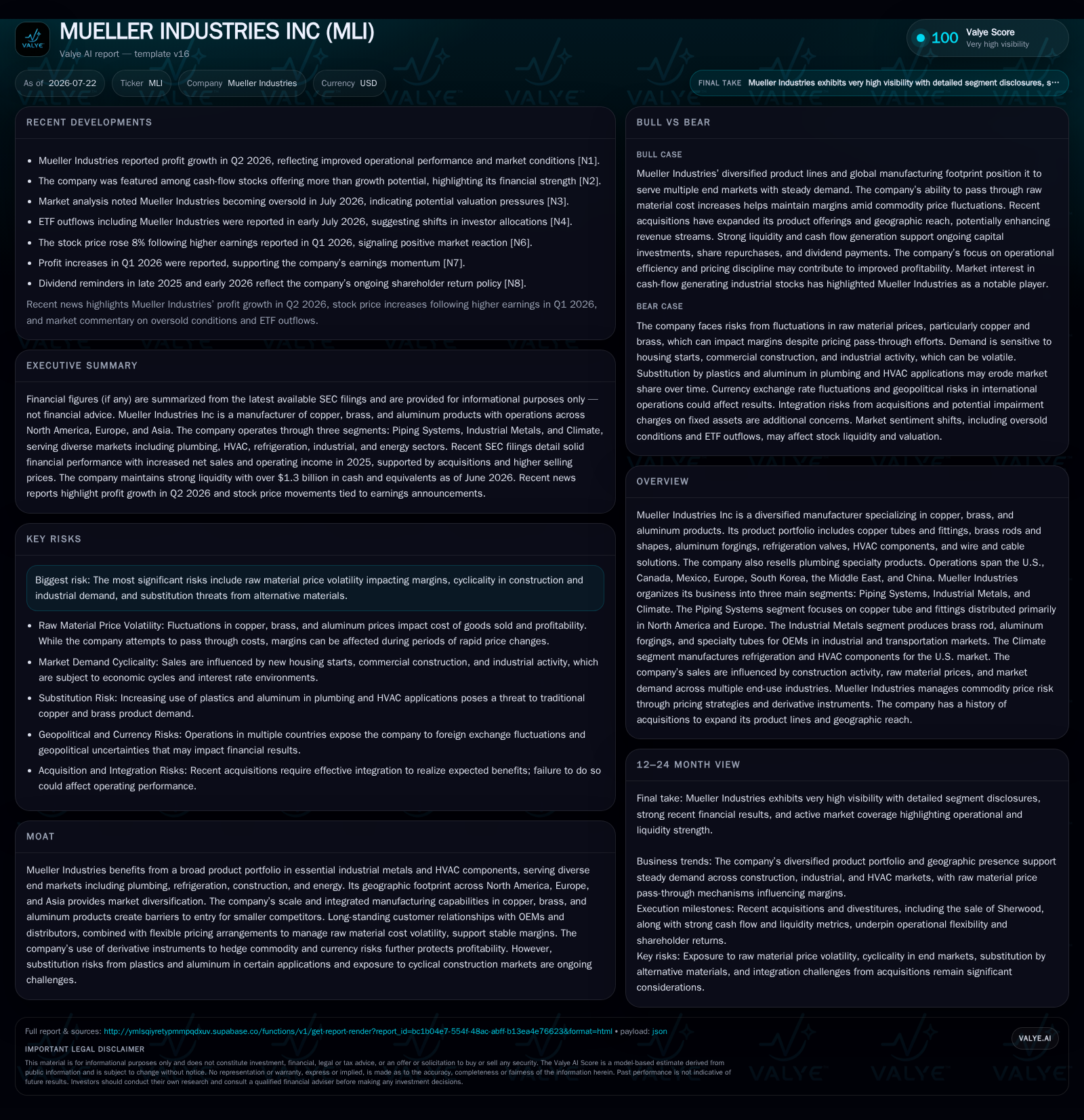
Mueller Industries reported in Q2 2026 the acquisition of Bison Metals Technologies LLC, strengthening its copper tube manufacturing footprint for HVAC, plumbing, and refrigeration markets. Operating segments remain diversified across piping systems, industrial metals, and climate products, supplying OEMs and distributors across North America, Europe, and Asia. The company continues to navigate raw material price volatility through commodity hedging and pricing strategies while leveraging geographic diversification for demand stability. Key risks include input cost swings, trade tariff uncertainties, and substitution pressures from plastics and aluminum alternatives.
Recent Operating Update
In the second quarter ended June 27, 2026, Mueller Industries announced its acquisition of Bison Metals Technologies LLC for approximately $138.3 million in cash on hand net of working capital adjustments [S2]. Bison is a U.S.-based manufacturer specializing in copper tubes serving industrial applications including HVAC, plumbing, refrigeration, and technical markets. This deal complements Mueller’s existing Piping Systems segment by adding capacity in Shawnee, Oklahoma—a key U.S. manufacturing location—bolstering production volumes during steady end-market demand.
Alongside this acquisition, inventory levels grew substantially to $607.7 million as of June 27 from $510.5 million at fiscal year-end December 27, 2025 [S2]. The inventory increase was primarily driven by raw materials and work-in-process buildup to support anticipated sales volumes across segments during ongoing input cost volatility
Mueller also maintains active commodity hedging programs to manage raw material pricing fluctuations which have historically pressed margins. As of the latest quarter, open copper futures contracts held amounted to $2.4 million targeting near-term copper inventory exposure [S2], illustrating proactive margin risk mitigation.
A notable corporate move earlier in the year involved the sale of Sherwood Valve LLC in January 2026 for approximately $57 million in cash consideration (net of working capital) [S21]. This divestiture trimmed exposure to brass and stainless-steel valves for compressed gas markets within the Industrial Metals segment but yielded a considerable pre-tax gain of roughly $41 million enhancing first quarter results
Business Model
Mueller Industries is a diversified manufacturer principally focused on fabricated metal products encompassing copper tubes and fittings; brass rods and shapes; aluminum forgings and impact extrusions; refrigeration valves; HVAC flexible duct systems; wire and cable solutions; plus reselling related plumbing specialty products such as valves and fittings [S1].
The company’s sales model targets multiple customer groups—wholesalers and distributors serving contractors in plumbing/refrigeration markets; OEM customers supplying manufactured housing and recreational vehicles; as well as industrial OEMs across transportation, energy infrastructure, telecommunication utilities sectors [S1]. Different product categories fit distinct downstream uses: Piping Systems segment products are mainly distributed through hardware wholesalers or specialized distributors operating across North America and Europe; Industrial Metals caters largely to OEMs requiring custom fabricated components compatible with complex engineering specifications; Climate segment focuses on refrigeration valves and assemblies sold primarily into U.S.-based HVAC original equipment manufacturers.
Revenue generation depends critically on production volume influenced by capacity utilization rates at multiple plants across geographies including the U.S., Canada, UK, South Korea (joint venture), Middle East (joint venture), Mexico, China, and Bahrain [S1],[S2]. Pricing flexibility plays a vital role given exposure to volatile inputs such as copper and aluminum prices. Mueller often seeks contractual arrangements or price pass-through mechanisms with customers alongside commodity derivative instruments designed to stabilize gross margins.
Value-added processing such as shaping brass rods into specialty components or extrusion of aluminum profiles offers differentiation over commodity metal suppliers but also entails capital-intensive manufacturing assets requiring continual modernization investments.
Industry Structure and Competitive Position
Operating within the industrial metals manufacturing sector specializing in fabricated copper, brass, and aluminum products anchors Mueller firmly midstream in the metals value chain—the stage transforming raw metals into semi-finished or finished components serving essential infrastructure industries like construction plumbing HVAC systems refrigeration transportation energy generation.
Peers include broad-based metal fabricators such as Reliance Steel & Aluminum Co., Worthington Industries among others who also compete on integrated manufacturing scale combined with geographic diversification enabling margin stability amid commodity price swings.
Mueller’s competitive moat derives from multi-segment product breadth coupled with global manufacturing footprints allowing supply-chain flexibility relative to regional demand fluctuations. Long-standing customer relationships particularly with OEMs provide recurring revenue streams with embedded switching costs tied to quality standards compliance critical for engineered metal components.
Commodity price management via hedging differentiates companies capable of protecting profitability during raw material spikes while geographic market diversity reduces dependency on any single macroeconomic cycle or tariff regime.
Nonetheless substitution risk from plastics or alternative material composites exists notably for non-structural pipe fittings or HVAC ducts where lower-cost polymers increasingly replace traditional metals.
Growth Drivers
Expansion opportunities rest significantly on infrastructure investments increasing demand for plumbing tubes/fittings; growth of HVAC & refrigeration system installations prompted by urbanization trends; replacement cycles within plumbing & refrigeration markets necessitating durable metallic components; industrial production upticks especially within electrical transmission & utility sectors requiring high-quality wire & cable solutions offered by acquisitions such as Nehring Electrical Works Company acquired in 2024 [S1]
Geographic expansion efforts leverage emerging market infrastructure spending while developed market modernization drives replacement volumes. Advances in manufacturing technologies facilitating enhanced value-added processing capabilities enable penetration into higher-margin specialty alloys or precision tube applications.
Strategic acquisitions like Bison Metals (Q1-Q2 2026) broaden operational scale specifically in copper tube fabrication addressing growing market segments across commercial HVAC/plumbing distribution channels consistently aligned with core competencies rather than diversified unrelated bets.
Risks / Watchpoints / Growth Constraints
Key risks encompass raw material input price volatility (copper/brass/aluminum) heavily impacting cost structures despite hedging. Inability to pass increased costs fully onto customers due to competitive intensity or contractual limits could compress margins materially.
Exposure to cyclical demand driven largely by construction activity subjects revenue streams to periodic downturns correlating with macroeconomic slowdowns in residential/commercial building sectors.
Ongoing substitution threats exist from plastic piping systems or aluminum replacing traditional brass/copper products particularly where cost advantages dominate performance requirements.
Trade policy uncertainties including tariffs or import/export restrictions complicate supply chain planning potentially inflating landed costs or disrupting just-in-time manufacturing models especially amid geopolitical tensions involving key suppliers or markets.
Operational risks relevant include capacity constraints if rapid demand growth outpaces plant expansions requiring timely capital allocation decisions plus inventory management effectiveness balancing customer service levels with working capital efficiency amidst fluctuating input prices.
What to Watch Next
Monitor quarterly segment revenue contribution shifts post-Bison integration focusing on Piping Systems volume growth indicators including order backlogs and plant utilization metrics. Scrutinize gross margin trends reflecting raw material price pass-through success relative to industry peers employing similar commodity hedges. Track management commentary around potential impacts from evolving trade tariffs especially related to Chinese or Mexican supply chains affecting cost bases or export competitiveness. Observe capital expenditure deployments aimed at capacity expansion or technology upgrades supporting value-added product lines key for sustaining long-term differentiation. Keep an eye on receivables/inventory turnover ratios as working capital efficiency gauges signaling operational resilience amid volatile input costs. Follow developments on substitute material adoption rates influencing product mix evolution over time across core customer segments driving future growth profiles. Watch financial policy updates including share authorization changes or stock split impacts communicated recently enhancing shareholder equity structure [S4],[N2],[N3].[N4]
Financial Profile Discussion
Mueller Industries holds a solid liquidity position evidenced by approximately $1.39 billion in cash and cash equivalents as of June 27, 2026 contrasted against current liabilities totaling about $596 million yielding a strong current ratio near 4.78 suggesting abundant short-term solvency coverage [F1],[S2].
the company’s balance sheet recorded minimal explicit long-term debt at about $5.24 million (excluding current portion) with no borrowings drawn against its unsecured revolving credit facility set at $100 million maturing March 2031 representing financial flexibility [S11]. This conservative leverage stance positions Mueller well to fund organic capex or strategic M&A such as Bison acquisition completed from cash reserves minimizing refinancing needs while preserving investment-grade balance sheet integrity.
Inventory increases noted between year-end 2025 ($510 mln) & Q2 2026 ($607 mln) reflect strategic stocking possibly due to commodity input lead times or market demand anticipation yet require continued monitoring since excess working capital can impair free cash flow conversion if not aligned with actual sales acceleration [S2].[F1]
Valuation reserves against inventories remained stable implying disciplined reserve policies intact amid elevated raw material market values supporting cautious asset impairment approaches [S2].
This analysis synthesizes Mueller Industries’ latest financial disclosures alongside industry context without expressing investment advice. All citations derive from official SEC filings dated through July 22nd, 2026 except where news sources are indicated.
Disclaimer: This is research-only, informational analysis and not investment advice. It may include AI-generated interpretation and general industry context. Always verify important details using primary sources.

Comments