
EQT Corp’s Appalachian Midstream Backbone Confronts Pricing Rigidity and Market Pressures
EQT Corporation's latest quarter reveals the interplay of fixed-rate midstream contracts and upstream production amid natural gas market dynamics.
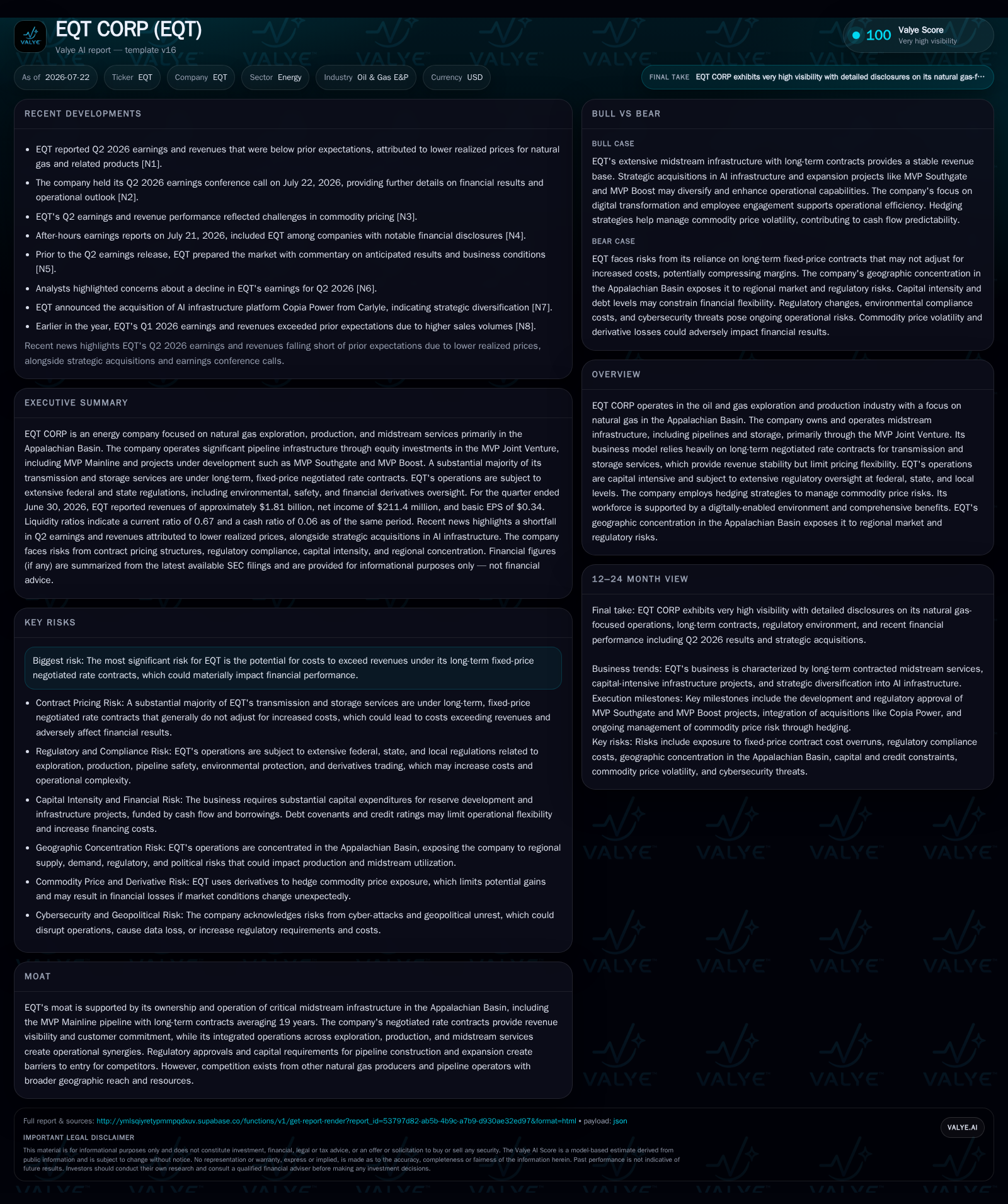
EQT Corporation’s Q2 2026 results reflect continuing pressure from lower realized natural gas prices impacting upstream earnings, while its midstream segment benefits from long-term negotiated rate contracts providing revenue stability but limiting price adjustment flexibility. The company’s strategic focus remains on Appalachian Basin production complemented by equity investments in the Mountain Valley Pipeline (MVP) Joint Venture, which is expanding capacity through projects pending regulatory approval. Capital intensity and regulatory complexities remain significant, with execution of MVP Southgate and MVP Boost projects crucial to future growth. Hedging gains partially offset commodity price volatility. EQT’s concentrated geographic exposure and regulatory environment pose medium-term operational and financial risks.
Recent Operating Update
EQT Corporation reported Q2 2026 results that underscore ongoing challenges in upstream earnings primarily due to lower realized natural gas prices despite stable production volumes. Revenues fell short of analyst expectations, reflecting margin pressures in upstream operations amid commodity price softness [S2][N2]. Conversely, the midstream segment demonstrated relative stability, supported by long-term negotiated rate contracts that underpin revenue visibility for transmission and storage services operated through the Mountain Valley Pipeline (MVP) Joint Venture. These contracts, particularly on the MVP Mainline, have a weighted average remaining term of approximately 19 years, providing predictable cash flow from firm transportation commitments but limiting pricing flexibility in response to cost changes [S1][S13].
Capital expenditures remain significant as EQT funds its proportional equity investments in two major MVP expansion projects: MVP Southgate, a planned 31-mile, 30-inch diameter interstate natural gas pipeline extension targeting new delivery points in Rockingham County, North Carolina; and MVP Boost, a compression enhancement project designed to increase MVP Mainline capacity by approximately 0.6 billion cubic feet (Bcf) per day through upgrades at existing compressor stations and construction of a new station in Virginia [S1]. Both projects are targeting mid-2028 commissioning, contingent on final Federal Energy Regulatory Commission (FERC) approvals. Estimated capital costs for these expansions range from $370 million to $540 million, reflecting the capital-intensive nature of midstream infrastructure development.
The quarter also featured favorable cash settlements on commodity derivatives totaling $73 million, primarily from NYMEX natural gas hedge positions [S15]. This active hedging strategy mitigates earnings volatility stemming from fluctuating market prices and provides a partial cushion for upstream cash flow amid commodity price uncertainty
Business Model Overview
EQT operates predominantly in the oil and gas exploration and production (E&P) sector with a concentrated geographic focus in the Appalachian Basin, emphasizing natural gas assets. The company’s integrated business model combines upstream activities—exploration, drilling, and production of natural gas—with midstream operations including gathering, transmission via pipelines such as MVP Mainline, and storage facilities. Upstream revenues are driven by production volumes (measured in million cubic feet per day, MMcf/d) multiplied by realized commodity prices, which are inherently volatile. In contrast, midstream revenues derive mainly from firm transportation contracts under long-term negotiated rates, generating fee-based income streams with limited exposure to commodity price fluctuations.
This bifurcated revenue structure balances upstream spot-market sensitivity against downstream fee-for-service stability. While the long-duration contracts provide predictable cash flows for transmission services, they also introduce potential margin risks if operating costs rise faster than contract escalators or if contracted volumes decline. Key operating metrics include production volumes, average realized prices (adjusted for hedging), midstream pipeline capacity utilization, contracted throughput volumes, and weighted average contract terms.
EQT’s customers encompass natural gas purchasers such as utilities and commercial end-users for upstream production, and shippers who contract pipeline capacity under firm service agreements typically spanning nearly two decades for MVP Mainline. These contracts impose switching costs and volume commitments, enhancing revenue visibility but capping pricing agility in the midstream segment.
Industry Structure and Competitive Position
The oil and gas E&P industry is capital intensive, requiring substantial upfront investments in drilling rigs, exploration rights, and midstream infrastructure such as pipelines and compression facilities. EQT’s dual role as an upstream producer focused on Appalachian Basin shale formations and as an equity investor/operator in critical regional midstream infrastructure assets offers operational synergies through integrated supply chain control.
Competitors include independent producers with more geographically diversified portfolios that may better mitigate regional market downturns, as well as larger integrated oil and gas majors with broader capital access and global market reach. However, EQT’s ownership stake in the MVP Joint Venture provides a competitive advantage in Appalachian midstream infrastructure, a niche with high barriers to entry due to regulatory complexities and capital requirements.
The midstream sector’s regulatory environment, particularly FERC permitting, creates significant entry hurdles, insulating incumbents like EQT but requiring ongoing compliance diligence. Long-term negotiated rate contracts provide revenue stability uncommon among operators reliant solely on spot market pricing but introduce inflexibility during periods of rising operating costs or adverse volume trends [S1][S20]. EQT explicitly acknowledges the risk that fixed-price contracts may limit the ability to recover cost increases, potentially compressing margins—a critical watchpoint distinguishing it within its competitive set.
Growth Drivers
EQT’s growth prospects are anchored in several key areas:
- Upstream reserve replacement through successful drilling programs in the Appalachian Basin, supporting sustained or increased production volumes.
- Expansion of midstream capacity via MVP Joint Venture projects such as the Southgate pipeline extension and Boost compression project, enabling incremental firm throughput commitments.
- Regulatory approvals that unlock new development areas or accelerate project timelines.
- Technological advancements improving drilling efficiency and reducing operating costs, thereby enhancing capital productivity.
- Active commodity price hedging programs that lock in favorable prices and stabilize cash flows amid market volatility.
- Strategic acquisitions that complement existing assets and expand geographic or operational scale [S1][N8][N1]
Performance against these growth drivers can be monitored through KPIs such as production volumes (MMcf/d), reserve replacement ratios indicating sustainable hydrocarbon replenishment, contracted throughput volumes reflecting midstream demand, weighted average contract terms evidencing customer commitment longevity, capital expenditure discipline measured by CapEx relative to cash flow, hedging effectiveness via derivative mark-to-market results, and operating cash flow stability.
Risks and Watchpoints
EQT faces several operational and financial risks:
- Fixed-price negotiated rate contracts limit upside pricing flexibility if operating expenses rise unexpectedly or regulatory compliance costs increase beyond projections [S20].
- Commodity price declines directly impact upstream revenues; although hedging partially offsets this, inherent price volatility remains a significant factor.
- Potential regulatory delays or denials related to MVP expansion projects could postpone capacity growth and increase capital costs [S1][S23].
- Geographic concentration in the Appalachian Basin exposes EQT to regional regulatory changes and demand fluctuations, contrasting with more diversified peers.
- Liquidity constraints are evident with a current ratio of approximately 0.67 as of June 30, 2026, indicating limited short-term asset coverage against liabilities despite low reported debt levels [F1].
- Execution risk exists around integrating capital projects and realizing anticipated operational efficiencies.
- Seasonal demand variability, particularly higher winter natural gas consumption, affects throughput volumes and operational planning [S1].
Monitoring cost control relative to contracted revenues is critical, as rising expenses without corresponding contract adjustments could materially erode margins.
What to Watch Next
Key developments to monitor include:
- Progress on FERC approvals for MVP Southgate and MVP Boost projects through late 2026 and early 2027, which will influence project feasibility and commissioning timelines.
- Capital expenditure pacing relative to budget to assess execution discipline on expansion initiatives.
- Quarterly production volume updates, adjusted for seasonal effects, providing insight into upstream operational health.
- Midstream contracted throughput and pipeline utilization rates post-expansion rollout, indicating demand capture effectiveness.
- Mark-to-market derivative valuations revealing hedging program performance amid commodity price changes.
- Regulatory developments affecting pipeline tariff structures or environmental compliance costs, potentially impacting future contract terms.
- Changes in liquidity metrics, including the current ratio, reflecting working capital management amid ongoing capital investments [S2][N3][N17]
Financial Profile Discussion
As of June 30, 2026, EQT reported cash and cash equivalents of approximately $113 million against current liabilities of about $1.75 billion, resulting in a current ratio near 0.67, signaling potential near-term liquidity constraints relative to obligations [F1]. Total debt was not reported as outstanding in recent filings, suggesting a low leverage position or accounting treatment nuances [F1]. This liquidity profile necessitates careful working capital management, especially given substantial ongoing capital expenditures to support MVP expansion and upstream drilling activities.
Hedging gains during Q2 2026 contributed positively to cash flow stability, partially offsetting the seasonality and volatility inherent in commodity markets [S15][S4]. Capital expenditures remain elevated to fund strategic growth infrastructure, illustrating the trade-off between investment for future capacity and near-term liquidity preservation
Overall, EQT’s financial metrics should be interpreted in the context of balancing upstream commodity price cyclicality with downstream contractually stabilized revenues, further buffered by disciplined hedging strategies amid sizable capital deployment requirements typical of regional Appalachian operators.
This analysis synthesizes publicly filed SEC disclosures supplemented with contemporaneous market news sources without expressing investment research views. It aims to provide an informed understanding of EQT’s operational positioning amidst prevailing sector dynamics, factoring key strategic initiatives alongside evolving macroeconomic and regulatory variables shaping financial outcomes.
Disclaimer: This is research-only, informational analysis and not investment advice. It may include AI-generated interpretation and general industry context. Always verify important details using primary sources.

Comments