
Catalyst Crew Technologies Repositions with AI Healthcare Ambitions Amid Liquidity Strains
The company’s recent quarterly filing outlines a strategic pivot toward AI-driven healthcare platforms while revealing critical liquidity challenges that threaten near-term execution.
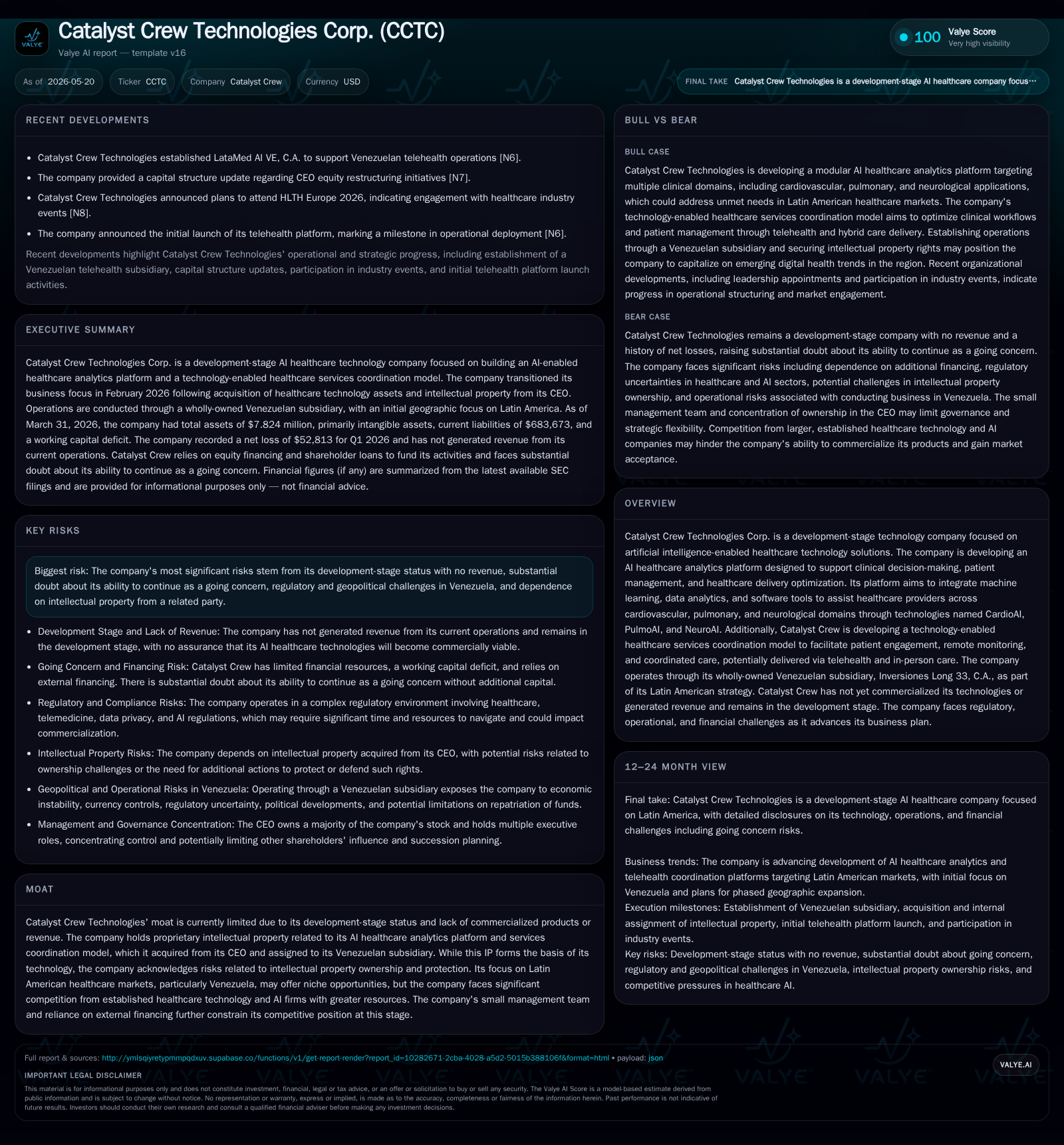
Catalyst Crew Technologies Corp. has transitioned from a dormant shell to a development-stage AI healthcare technology company focusing on Latin American markets, especially Venezuela. Its latest quarter reflects acquisition of core AI assets and organizational activity geared toward telehealth and analytics platforms, but it faces severe cash flow constraints and a substantial doubt about its ability to continue as a going concern. The business model centers on modular clinical decision-support platforms—CardioAI, PulmoAI, NeuroAI—and technology-enabled healthcare coordination services, though these remain uncommercialized. The company's growth prospects hinge on successful platform development, regulatory navigation in a challenging LATAM landscape, and capital raises to sustain operations.
Latest Quarterly Update Signals Strategic Pivot and Operational Status
Catalyst Crew Technologies Corp., according to its latest 10-Q filed May 20, 2026 [S2], has formally transitioned from inactive shell status into an active development-stage entity focused on artificial intelligence-enabled healthcare technology solutions. This pivot was crystallized by the February 17, 2026 asset acquisition agreement, through which Catalyst acquired proprietary AI healthcare assets comprising software code and analytical models intended to underpin modular clinical decision-support applications (CardioAI for cardiovascular health; PulmoAI for pulmonary conditions; NeuroAI for neurological assessments) alongside supporting telehealth infrastructure.
The quarter ending March 31, 2026 showed no revenue generation as the company remains pre-commercial [S2]. Operating expenses rose materially from roughly $16k to $43k year-over-year Q1 periods due primarily to increased professional fees accompanying the strategic transition and heightened developmental activities. Net loss widened to $52.8k compared with $24.5k in prior year Q1 snapshot [S2]. Operating cash flow was negative $28.4k despite modest financing inflows slightly up from prior year [$28k vs $19k] as Catalyst Crew continues relying heavily on equity or debt funding [S2].
This quarterly disclosure lays bare both a sharp strategic repositioning toward AI health tech in Latin America as well as precarious funding constraints that pose an existential operational risk in the near term.
Business Model: AI Healthcare Analytics Platform and Services Coordination
Catalyst Crew’s business model centers on developing an integrated artificial intelligence-powered healthcare analytics platform intended to provide modular clinical decision support across multiple disease domains relevant to Latin American health systems [S1]. The principal applications under development (CardioAI, PulmoAI, NeuroAI) are designed to leverage machine learning algorithms capable of cardiovascular risk stratification, pulmonary disease detection/prediction, and neurological condition analysis respectively. These tools aim to process heterogeneous healthcare data inputs (structured EHR data and unstructured clinical notes) to yield risk assessments and actionable clinical insights supporting provider decision-making.
Complementing these analytic modules is a technology-enabled healthcare services coordination framework envisioned to facilitate patient engagement workflows including remote monitoring via connected devices along with hybrid delivery models integrating telehealth consultations and potential in-person care touchpoints [S1]. This infrastructure is targeted to streamline longitudinal patient management by enhancing communication channels between patients and providers while enabling operational efficiencies for healthcare organizations.
Currently early-stage without commercialized offerings or recurring revenue streams [S1][S2], the revenue generation model will likely rely on subscription or licensing fees paid by healthcare providers or institutional buyers once products achieve regulatory clearance and demonstrate clinical utility. The ability to embed this platform within existing regional health networks will be critical given differential infrastructure readiness and regulatory environments especially within Venezuela.
Competitive Environment and Industry Structure in Latin America’s Healthcare Tech
Catalyst Crew operates within a competitive landscape featuring global incumbents specializing in AI-driven digital health platforms such as IBM Watson Health (prior iterations), Google Health initiatives, various specialized telehealth service providers partnering with Latin American payers or ministries of health. However, unlike larger multinational players predominantly targeting developed market clients or broad international partnerships, Catalyst's niche focus on Venezuela and adjacent Latin American countries creates both opportunities for tailored solutions responsive to local market idiosyncrasies as well as significant risk stemming from regional economic instability and regulatory unpredictability [S1].
While global competitors benefit from scale economies enabling deeper R&D investment and broader go-to-market reach potentially limiting Catalyst’s competitive positioning initially, localized expertise embedded via its Venezuelan subsidiary could facilitate early engagements within underserved segments where digital health penetration remains nascent yet growing.
Regulatory scrutiny over AI algorithms used in clinical decision support adds complexity given diverse approval pathways across Latin American jurisdictions requiring compliance with data privacy laws such as Brazil’s LGPD or Venezuela’s evolving frameworks. This environment heightens barriers related not just to product acceptance but also market entry timing.
Growth Drivers: Technology Development, Market Entry, and Telehealth Expansion
Catalyst Crew’s growth prospects rest fundamentally upon milestones including completion of algorithmic development validating predictive accuracy of CardioAI/PulmoAI/NeuroAI components through clinical studies or pilot deployments—a necessary precursor for provider uptake. Press releases detail initial telehealth platform launches with plans for geographic expansion via LataMed AI VE C.A., designed specifically to support Venezuelan operations reflecting execution progress beyond conceptual stage [N7][N8].
Broader digitization trends in Latin American healthcare systems driven by cost pressures amid constrained public budgets fuel demand for innovations reducing avoidable hospitalizations through early risk detection and remote management—tailwinds underpinning Catalyst’s solution relevance.[N10][N11]
Additional growth levers involve securing strategic partnerships with regional hospitals or payers willing to co-develop use cases demonstrating efficacy coupled with navigating complex reimbursement scenarios where sustainable pricing models might emerge over time depending on comparative effectiveness evidence.
Platform scalability enhanced through modular architecture enables incremental introduction of additional disease conditions or integration with third-party data sources increasing overall value proposition paralleling evolving customer needs.
Risks and Constraints: Financing Pressure, IP Ownership, and Geopolitical Challenges
A dominant risk factor outlined squarely by Catalyst’s management concerns chronic undercapitalization placing substantial doubt about continuing operations beyond twelve months without infusions of outside funding [S2][S1]. Negative operating cash flows compounded by escalating liabilities versus nonexistent current assets exacerbate financial fragility leaving limited runway.
Intellectual property ownership poses another material uncertainty since core technology was transferred from the company’s CEO via related-party asset purchase agreements subject potentially to dispute or legal defense complexities threatening continuity of proprietary exclusivity needed for competitive differentiation [S1]. The acquisition followed by internal IP assignment into the Venezuelan subsidiary may complicate enforcement especially across jurisdictions.
Geopolitical instability inherent in Venezuelan operations brings multifaceted challenges: currency controls restrict repatriation of funds; regulatory unpredictability heightens compliance burdens; political developments create operational interruptions or cost inflation risks; economic volatility can compress purchasing power among target customers adversely impacting monetization opportunities [S1].
Operationally the very small management team dependent on CEO continuity elevates key person risk jeopardizing advancement if turnover occurs before full-scale commercial deployment [S1]. Lastly, delays in regulatory approvals for medical software products or non-acceptance by clinicians could stall adoption causing adverse feedback loops impeding growth.
Catalyst Crew’s Near-Term Milestones and Key Execution Watchpoints
Near-term focus centers on advancing completion and validation stages of their three primary AI platforms aimed at producing robust predictive tools ready for pilot program trials expected imminently per recent communications [N10][N11]. Monitoring milestones such as obtaining institutional review board approvals for testing cohorts or securing first commercial contracts will serve as demand indicators.
Expansion of telehealth services into additional clinics or municipalities within Venezuela via LataMed AI VE C.A. constitutes practical execution events providing concrete user adoption metrics reflecting commercial traction [N7][N8].
Capital raising initiatives scheduled as private placement rounds will critically determine survival prospects; failure here would result in curtailment of R&D investment potentially mandating reorganization or liquidation steps per audit substantial doubt disclosures [S2].
Legal formalization processes clarifying intellectual property rights within corporate governance frameworks represent important watchpoints mitigating material litigation risk—a source of potential dilution or operating disruptions if unsettled [S1].
Finally leadership stability particularly retention of CEO Kevin Rodan Levy who controls major IP assets represents a pivotal governance factor affecting continuity during this pivotal scale-up phase [S1]
Concise Financial Summary: Liquidity, Debt, and Capital Raising Needs
As reported at March 31, 2026 end-period [F1],[S2], Catalyst Crew held total debt approximating $300,688 against zero reported current assets yielding a dangerously low current ratio effectively nil. The company recorded net losses of $52,813 for Q1 2026 contrasted against $24,455 net loss year-earlier period illustrating escalating cash consumption primarily attributable to increased professional fees linked to transition activities [S2]. Operating cash flows were negative roughly $28k driven largely by net loss plus working capital fluctuations while financing activities generated only modest positive inflows slightly exceeding prior year levels.
Auditor opinions reflected substantial doubt about ability to continue as a going concern highlighting critical dependency on immediate financing access which remains uncertain [S2][S1]. Planned equity offerings have been signaled but no binding commitments secured emphasizing precarious nature of financial runway.
Absent rapid capital injections enabling continued product development ramp up plus operating overhead coverage there exists high risk that material adverse impacts will impair prospects sharply.
This analysis is based solely on publicly filed information from SEC forms as of May 2026 combined with related news releases. It does not constitute investment advice but provides an independent operational assessment grounded strictly in disclosed facts.
Disclaimer: This is research-only, informational analysis and not investment advice. It may include AI-generated interpretation and general industry context. Always verify important details using primary sources.

Comments