
Celcuity Advances Gedatolisib Development Amid Clinical Milestones and Capital Structure Challenges
Latest quarterly results highlight progress in Phase 3 trials of gedatolisib, with strategic initiatives refining equity compensation while navigating financial leverage.
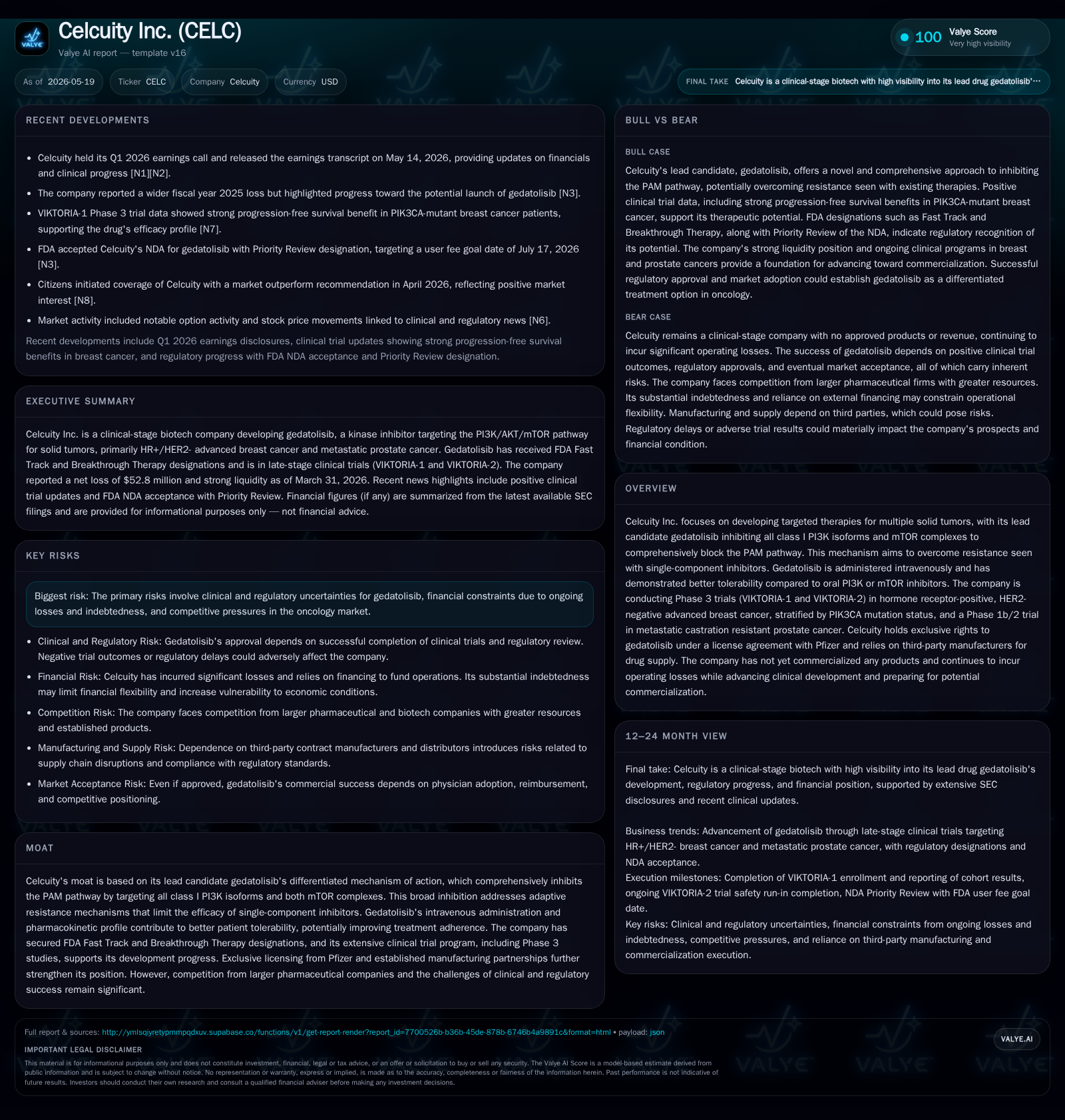
Celcuity Inc. continues to advance its lead asset, gedatolisib, a comprehensive inhibitor of the PAM pathway targeting HR+/HER2- breast cancer and mCRPC in pivotal clinical studies. Recent filings confirm no material change to risk factors but underscore ongoing operational losses and indebtedness that pose financial constraints. The company’s business model hinges on regulatory approvals and successful commercialization of gedatolisib, supported by exclusive licensing from Pfizer and diligent trial execution. Growth drivers include Phase 3 enrollment completion and potential first-line therapy indications, though risks around clinical outcomes, reimbursement, and capital access persist.
Recent Operating Update
Celcuity's latest disclosure via its May 14, 2026 10-Q filing reaffirms foundational progress coupled with continued financial headwinds typical of clinical-stage biotech firms. No material changes were noted in risk factors compared to prior annual reports, indicating persistent operating challenges but stable strategic execution [S2][S21]. The company reported cash and equivalents of approximately $145 million as of March 31, 2026, counterbalanced by total debt near $138 million—yielding a modest net cash position of about $-7 million net debt at quarter-end [F1].
In parallel, Celcuity’s May 18, 2026 Form 8-K detailed the adoption of a new stock incentive plan authorized at the Annual Meeting held May 14. This plan allows issuance of up to three million shares to employees and replaces the prior stock option scheme—a move aimed at refining compensation structures for talent retention during late-stage development pressures [S3]. The company also expanded its employee stock purchase plan shares by nearly 290,000 shares for an additional ten years.
Business Model
Celcuity operates as a clinical-stage biotechnology entity focused exclusively on developing gedatolisib, a kinase inhibitor designed to target multiple solid tumor types through comprehensive inhibition of the phosphatidylinositol-3-kinase (PI3K)/AKT/mTOR (PAM) signaling pathway. Gedatolisib binds all class I PI3K isoforms alongside both mTOR complexes (mTORC1 and mTORC2), offering a broader mechanistic blockade than existing agents which typically inhibit only one or two nodes within this pathway [S1]. This breadth aims to circumvent adaptive resistance mechanisms common with single-component inhibitors.
Revenue generation is currently nonexistent given that Celcuity has not yet commercialized any products [S1][S11]. Future income streams will derive from product sales pending regulatory approval of gedatolisib. To prepare for eventual commercialization, management must build out sales forces, marketing capabilities, manufacturing scale (currently reliant on third-party suppliers), and pricing/reimbursement frameworks responsive to evolving healthcare regulations such as the Inflation Reduction Act (IRA), which imposes Medicare price negotiation starting in 2026—a critical consideration affecting net revenues from second-line breast cancer therapies
Customers will primarily be oncology treatment centers and hospitals administering intravenous therapies. Insurance payors—including Medicare, Medicaid, commercial insurers—will dictate access via coverage policies heavily influenced by pharmacoeconomic evaluations demonstrating gedatolisib's safety and efficacy advantages relative to competitive therapies.
Industry Structure and Competitive Position
Celcuity competes within the broader oncology therapeutics sector that features significant R&D intensity, regulatory complexity, and competition from large pharmaceutical incumbents with extensive pipelines targeting PI3K/AKT/mTOR pathways. Most marketed or investigational drugs do not fully inhibit all relevant enzymes simultaneously; thus, Celcuity's differentiation hinges on gedatolisib's pan-class I PI3K plus dual mTOR complex inhibition alongside intravenous administration offering better tolerability profiles compared to oral agents known for challenging side effects that limit adherence [S1].
This mechanistic edge combined with regulatory Fast Track and Breakthrough Therapy designations reflect FDA recognition of unmet medical need in hormone receptor-positive (HR+), HER2-negative (HER2-) advanced breast cancer progressing after CDK4/6 inhibitors—where approximately 37,000 patients are estimated eligible annually in the U.S.—placing celcuity within a relevant niche albeit under intense competitive scrutiny [S1]. Other pipeline candidates targeting different molecular axes or combination regimens represent key competitive risks.
Growth Drivers
Growth is contingent primarily upon multiple overlapping clinical development milestones: completion of pivotal Phase 3 trials VIKTORIA-1 (completed enrollment in cohorts for PIK3CA wild-type and mutant tumors) and ongoing VIKTORIA-2 trials evaluating gedatolisib in combination therapies resistant to endocrine treatments. Early positive efficacy signals have been reported publicly underscoring improved progression-free survival especially in PIK3CA mutant patients—critical for later FDA label discussions [N8][S1]. Additionally, a Phase 1b/2 study targeting metastatic castration-resistant prostate cancer enhances pipeline breadth.
Regulatory catalysts include FDA Priority Review program acceptance following NDA filing in November 2025 with a PDUFA action date set for July 17, 2026. Successful approval would trigger commercial launch preparations aiming at second-line breast cancer indications initially; further expansion into first-line uses or other tumor types could follow pending additional data analysis.
From a market standpoint, achieving favorable reimbursement agreements especially under Medicare price negotiation frameworks will be essential for pricing power. The ability to leverage intraveous dosing tolerability benefits may facilitate physician adoption compared to oral competitors amidst evolving safety profiles.
Risks / Watchpoints / Growth Constraints
Clinical-development uncertainties loom large as do regulatory hurdles inherent to novel oncology drugs: response variability between PIK3CA wild-type vs mutant populations could narrow label scope or impact prescribing volumes. Trial delays or adverse safety signals carry material risk case.
Financially, sizeable indebtedness imposes constraints on operational flexibility [S4]. Capital needs will spike approaching commercialization as marketing infrastructure scales; failure to secure financing under reasonable terms may necessitate partnerships diluting upside or slowing development pace.
Pricing pressures under IRA mandate heightened focus on demonstrating cost-effectiveness versus incumbent therapies or biosimilars; coverage denials or inadequate reimbursement rates could undermine market penetration.
Intellectual property protections remain a key vulnerability due to patent prosecution complexities inherent in biotechnology sectors; litigation risks around infringement claims also persist given competitive overcrowding around the PAM pathway therapeutics [S16]. Furthermore, compliance burdens related to healthcare privacy laws (HIPAA/HITECH), anti-kickback statutes and state-level pharmaceutical regulations impose operating costs that may increase as commercialization proceeds.
What To Watch Next
Key near-term milestones include:
- FDA NDA review outcome expected by July 17, 2026 — approval would validate product viability but delays or requests for additional data could stall launch timelines [S22]
- Additional readouts from VIKTORIA-2 trial assessing first-line endocrine-resistance cohort efficacy/safety — impacts label expansion potential [N2]
- Progress updates from mCRPC Phase 1b/2 combination study — broadens pipeline scope beyond breast cancer
- Commercial infrastructure hiring and manufacturing scale-up announcements post-approval should substantiate go-to-market readiness
- Financing activity insights including any equity offerings or partnership deals affecting capital structure dynamics given elevated leverage levels [S3]
Financial Profile Summary
At quarter-end March 31, 2026, Celcuity held cash reserves around $145 million against total debt near $138 million resulting in a modest net cash position of approximately $-7 million net debt [F1][S2]. The company continues generating quarterly operating losses consistent with pre-commercial developmental stage status. Current assets significantly exceed liabilities, with a current ratio of approximately 12.31x as of March 31, 2026, indicating strong short-term liquidity [F1]. However, heavy reliance on external funding remains given absence of revenues thus far requiring ongoing capital raising or collaboration agreements supportive of late-stage regulatory undertakings.
This analysis is based solely on publicly available disclosures up to May 19, 2026. It does not constitute investment advice but aims to provide an informed industry perspective grounded in reported operations and sector context.
Disclaimer: This is research-only, informational analysis and not investment advice. It may include AI-generated interpretation and general industry context. Always verify important details using primary sources.

Comments