
Cantor Equity Partners VI's Launch and Search Strategy Details
Cantor Equity Partners VI progresses its SPAC mandate with stable governance, a focused sector strategy, and active board strengthening.
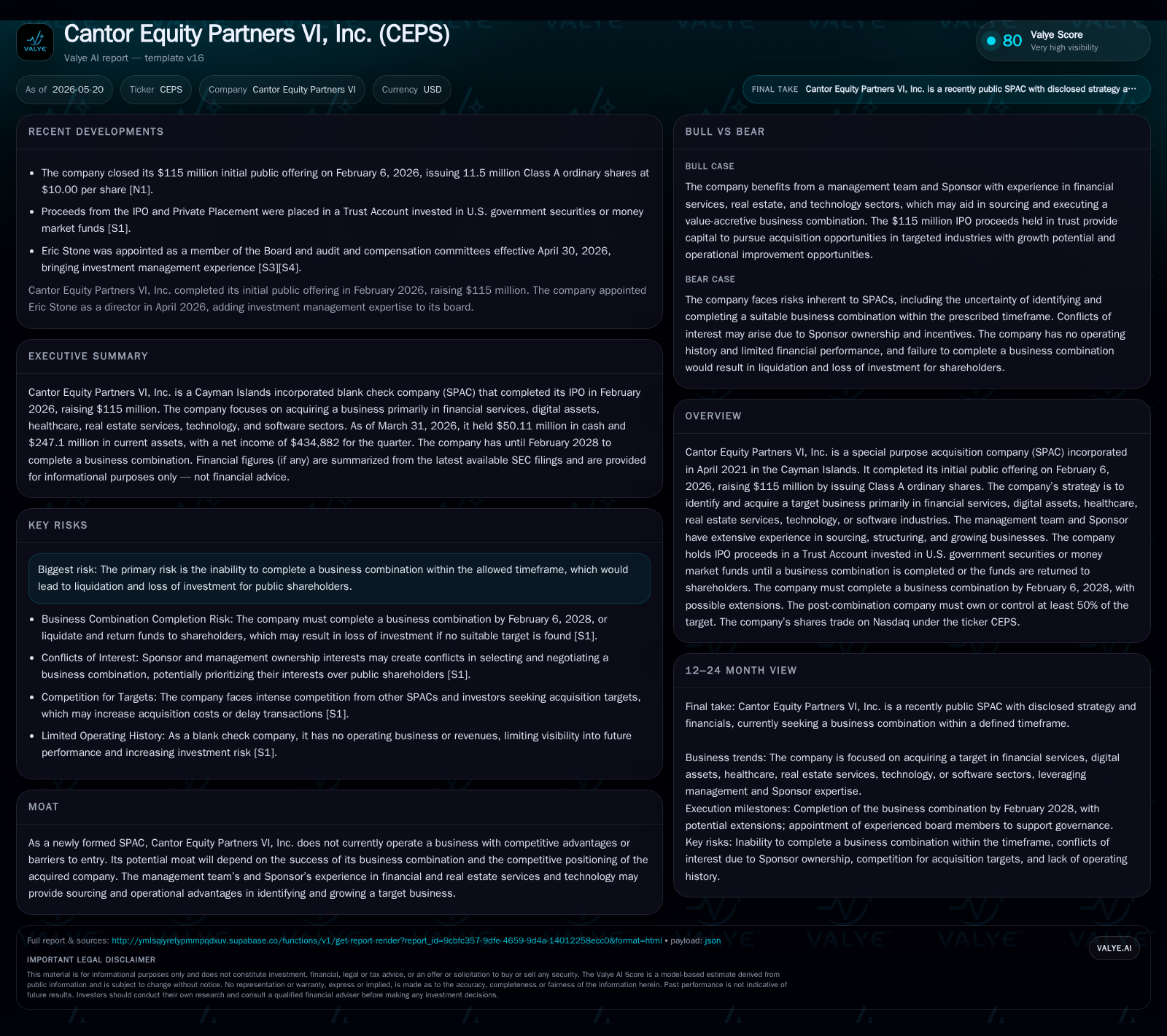
Cantor Equity Partners VI, Inc., a Cayman Islands SPAC that completed its IPO in February 2026, reported no changes in risk factors in its latest quarterly filing and appointed investment veteran Eric Stone to its board in early May 2026. The company holds $115 million raised from the IPO in trust as it pursues a business combination targeting sectors including financial services, digital assets, healthcare, real estate services, technology, or software. Its Sponsor’s deep industry experience frames a competitive edge in sourcing and operational value creation. Key risks center on completing a deal before the February 2028 deadline, with investor watchpoints set on deal progress and board effectiveness under new leadership.
Latest Quarterly Update and Board Developments
Cantor Equity Partners VI filed its most recent quarterly report on May 14, 2026 [S2], reiterating the absence of any material changes to risk factors disclosed initially in its February prospectus and March annual filing [S1]. This stability indicates no emerging threats to the company’s strategic plan or governance since IPO completion in early February 2026. Furthermore, an important governance update occurred on April 30, when Eric Stone joined the Board as a Class I director and assumed roles on both the audit and compensation committees [S3][S6]. Mr. Stone’s extensive background managing mid-cap equity portfolios at Iridian Asset Management enhances Cantor's capacity to oversee rigorous due diligence processes and safeguard shareholder interests during the complex acquisition phase.
Business Model of Cantor Equity Partners VI
Cantor Equity Partners VI operates as a special purpose acquisition company (SPAC), raising capital through an initial public offering aimed explicitly at sourcing a suitable private company acquisition target within approximately two years post-IPO [S1]. It raised $115 million by issuing Class A shares at $10 each in February 2026. These capital proceeds are securely held in a Trust Account invested primarily in U.S. government securities or money market funds until deployment toward a proposed business combination or eventual liquidation if no deal is consummated [S1]. The business model leverages sponsor incentives aligned through private placement shares and management roles designed to motivate efficient target identification and value-enhancing acquisition execution. Despite lacking standalone operations currently—a common characteristic among newly formed SPACs—the company benefits strategically from Cantor’s core expertise spanning financial services and real estate sectors.
Industry Focus and Competitive Positioning
While unrestricted by mandate limitations on target industry verticals per se, Cantor Equity Partners VI has identified strategic preferences for sectors including financial services, digital assets, healthcare, real estate services, technology, and software [S1]. This focus corresponds with Cantor affiliates’ capabilities such as CF&Co.’s investment banking strength and BGC Group’s brokerage and trading technologies coupled with Newmark’s extensive real estate services network. This multifaceted Sponsor platform presents a differentiated pipeline advantage relative to more narrowly focused SPACs by fostering proprietary deal flow access through cross-sector relationships. Additionally, the involvement of experienced financial executives like Eric Stone is likely to support robust valuation discipline amidst an environment where pricing power depends heavily on sponsor reputation and network leverage rather than product differentiation.
SPAC Market Context and Strategic Implications
In accordance with standard SPAC structures post-PIPE capital raises and public listing milestones [S1], Cantor Equity Partners VI must complete its qualifying business combination by February 6, 2028. This statutory deadline imposes timing pressure that compels focused deal origination efforts. The current SPAC market exhibits both opportunities and challenges—on one side prevailing interest in tech-enabled sectors aligns well with Cantor’s target areas; conversely rising quality thresholds mean fewer undervalued targets exist without premium valuations which may pressure returns post-combination (analysis). Consequently, effective governance plus Sponsor credibility become even more critical to secure optimal transaction terms within bounded timelines.
Growth Drivers: Potential Targets and Market Reach
The path to growth for Cantor Equity Partners VI lies fundamentally in identifying an acquisition target that offers scalable revenue streams within their preferred sectors supported by unmet demand or disruptive innovation [S1]. With adequate capital backing ($115 million raised), management has resource flexibility to pursue mid-market entities or carve-outs where operational improvements can expand margin profiles post-close. The Sponsor’s embedded expertise across diverse financial services and real estate commodities facilitates informed diligence assessing growth levers—such as cross-selling technology upgrades into legacy commercial service firms or backing fintech innovations targeting underpenetrated niches (analysis). KPIs relevant here encompass deal pipeline robustness measured via exclusive discussions progressing through LOIs toward final agreements alongside regulatory clearances necessary for closing.
Key Risks and Operational Constraints
The dominant risk confronting Cantor Equity Partners VI stems from failing to consummate any business combination prior to the February 2028 cutoff specified by its corporate charter [S2]. Such an outcome triggers liquidation of trust assets less transaction expenses resulting in loss scenarios for public shareholders typical across blank check companies. Other risks inherent include valuation missteps given competitive bid environments for quality targets plus reliance on limited Sponsor bandwidth if simultaneously engaged with other affiliated SPACs reviewed under conflict mitigation safeguards described in filings [S1]. External conditions such as macroeconomic volatility could also depress plausible targets’ financial performance complicating attractively priced deals (analysis). From an operational standpoint, efficient integration post-acquisition remains critical but contingent on selecting targets amenable to scalable synergy realization.
What Investors Should Monitor Next
Key focus areas for stakeholders include tracking disclosures related to potential business combinations announced via press releases or SEC filings indicating letters of intent or definitive agreements entered [S3]. Progress updates around due diligence workflows particularly regulatory interactions would also help clarify execution viability. The newly appointed board member Eric Stone’s influence over audit rigor and compensation structures warrants observation given implications for governance quality ahead of significant capital deployment decisions [S6]. Additional signs such as amendments extending transaction deadlines or changes to risk factor disclosures will provide further insight into deal cadence or emerging challenges.
Summary Financial Position
As of March 31, 2026 (end of Q1), Cantor Equity Partners VI reported cash and cash equivalents totaling approximately $50.1 million alongside aggregated current assets near $247.1 million reflecting IPO trust balances predominantly invested conservatively consistent with regulatory guidelines governing SPAC proceeds [F1]. Operating income ran negative at around $133 thousand attributable primarily to administrative costs prior to any acquisition-related revenues—standard for early-stage blank check entities without operating subsidiaries. No new debt obligations are noted restricting future capital flexibility consistent with ongoing liquidity preservation for business combination preparation [S2]. This healthy liquidity profile supports continued strategic pursuit without immediate refinancing pressures.
This analysis reviews publicly available information without providing investment advice. Prospective investors should conduct further due diligence considering individual risk tolerance aligned with the unique nature of SPAC vehicles such as Cantor Equity Partners VI.
Disclaimer: This is research-only, informational analysis and not investment advice. It may include AI-generated interpretation and general industry context. Always verify important details using primary sources.

Comments