
Cyber Enviro-Tech Unwinds Oil Assets to Refocus on Water and Soil Remediation Technologies
Following divestiture of oil operations and subsidiary shutdown, CETI targets water and soil remediation with advanced filtration tech and partnerships.
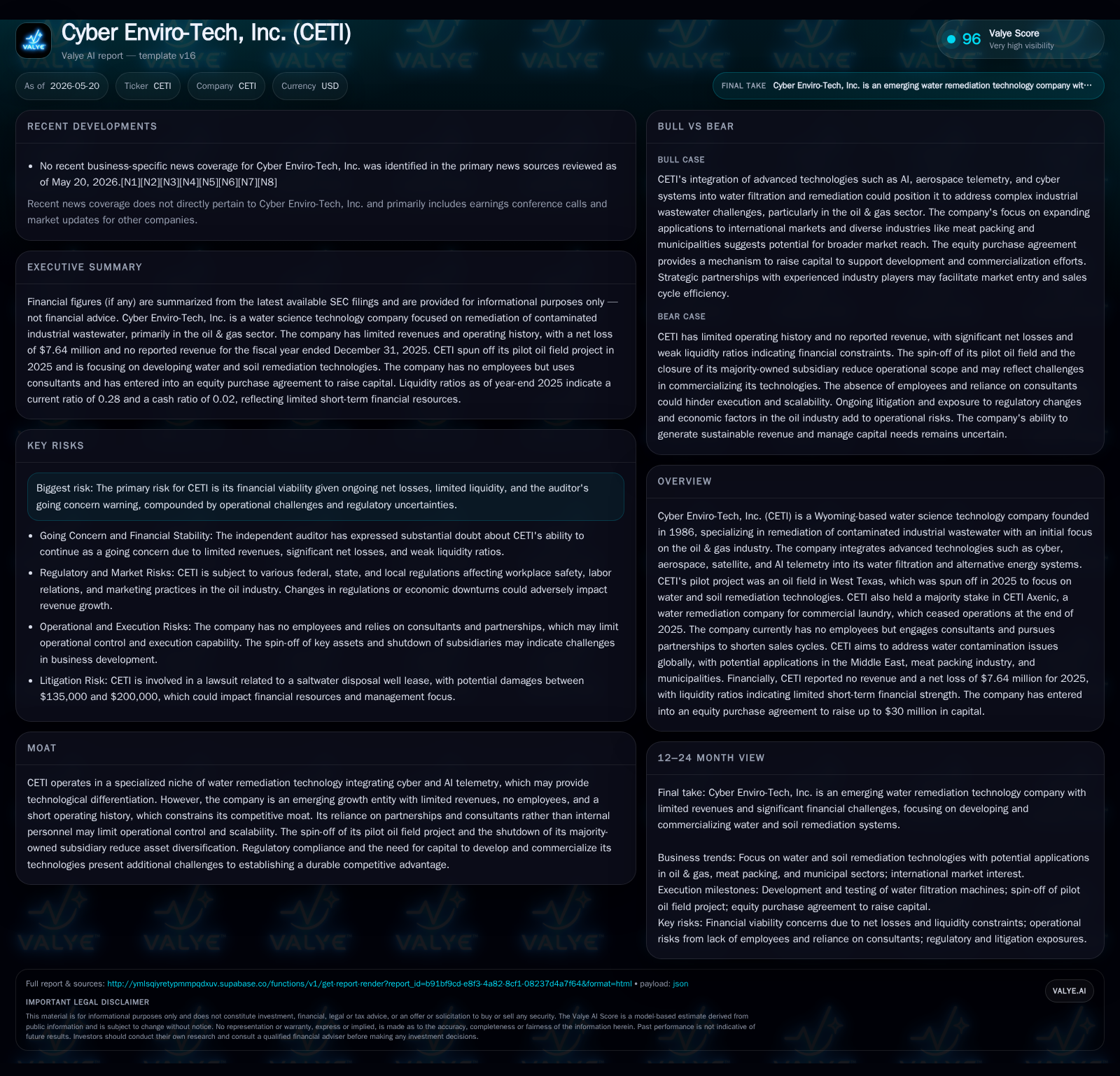
Cyber Enviro-Tech, Inc. (CETI) recently completed strategic divestitures including the spin-off of its Alvey oil field pilot project and closure of majority-owned CETI Axenic, consolidating its focus on developing water and soil remediation technologies. The company integrates cyber, aerospace, satellite, and AI telemetry into its filtration systems, targeting contamination issues initially linked to oil & gas wastewater but adaptable across other industrial verticals. Operating exclusively via consultants and partnerships without employees, CETI faces scalability and financial viability challenges amid ongoing losses, low liquidity, and substantial debt. Near-term growth hinges on successful technology commercialization in niche industrial sectors and expansion through strategic partnerships.
Recent Strategic Developments: Spin-Offs and Operational Focus
Cyber Enviro-Tech’s latest pivotal change is the October 2025 spin-off of its Alvey oil field pilot project located in Callahan County, Texas. This divestiture marks a clear operational pivot away from direct oil production assets toward technology-driven remediation services for contaminated water and soil [S1], [S5]. Concurrently, CETI shuttered CETI Axenic—which it owned a majority stake in—a water remediation venture focused on the commercial laundry sector that ceased operations at the end of 2025 [S1]. These moves drastically reshape CETI’s asset base and risk profile by withdrawing from upstream oil operations and narrowing the firm strictly to remediation technology development.
Further illustrating this strategic tightening is CETI’s decision to cut internal headcount to zero employees as of December 31, 2025; instead it employs seven consultants to maintain operations [S1]. Management turnover also punctuates recent months: CFO Deborah Casper-Stone resigned effective April 30, 2026, with Dan Leboffe reappointed immediately after having served prior terms [S26], [S24]. This churn during a critical transition phase raises questions about management continuity amid challenging execution.
Combined, these events underscore Cyber Enviro-Tech’s repositioning as a lean technology entity prioritizing innovation in water/soil remediation over legacy upstream asset ownership.
Business Model and Technological Differentiation
CETI generates value by leveraging integration of cyber technologies—including aerospace-grade sensors, satellite communications, AI-based telemetry—and industrial engineering applied to water filtration systems designed initially for contaminated wastewater from the oil & gas sector [S1], [S5]. Its core offerings include neural sensor-enabled filtration machines equipped with controls networked through cellular connectivity to provide real-time monitoring and adaptive environmental remediation.
This technology-centric value proposition aims to distinguish CETI from commodity filtration providers by enabling modularity across multiple contamination environments—from industrial wastewater streams to soil decontamination projects slated for Middle Eastern deployment. However, given the firm operates without direct staff—relying fully on external consultants—it faces operational constraints around intellectual property control, rapid prototyping capacity, and longitudinal customer support effectiveness [S1]
Revenue generation depends primarily on B2B sales made through partners with pre-existing industry relationships who can shorten notoriously prolonged sales cycles characteristic of regulated environmental sectors. Consulting sales intermediaries are vital since CETI lacks traditional internal sales infrastructure; their experience expedites client acquisition within tightly networked vertical markets including municipalities and meat processing plants [S1]. This partner-driven sales approach may provide access advantages but also risks margin pressure owing to third-party commissions alongside reduced agility.
Industry Context and Competitive Positioning
Within industrial water remediation—a market dominated by established chemical treatment firms, membrane technology specialists, and emerging AI-driven solution providers—CETI occupies a niche integrating advanced telemetry into filtration systems [S1]. While this technological amalgamation could offer differentiation particularly if neural sensing enables superior contamination detection or process optimization, CETI’s lack of scale or operating history substantially limits competitive moat.
Regulatory dynamics present both barriers to entry and opportunity: strict compliance requirements favor incumbents embedded in client networks yet heighten switching costs for customers seeking reliable certifications. By deploying consultants with deep vertical expertise rather than building proprietary channels CETI leverages existing ecosystem knowledge at the expense of ceding some buyer relationship centrality.
Peers in this space typically possess broader product portfolios spanning chemical additives, bio-remediation agents, large-scale filtration membrane manufacturing plus integrated monitoring software suites. In contrast, CETI remains focused on hardware-software fusion targeting selected subsegments. This concentrated product stance could be advantageous if it leads to specialization gains but risks slower market penetration without comprehensive service offerings.
Growth Drivers: Technology Expansion and Partnership Engagements
Looking ahead, CETI positions R&D investment (~$396k spent in 2025) as key to maturing its filtration technology pipeline with ambitions beyond initial oil & gas uses to environmental solutions applicable internationally—namely Middle East soil/oil remediation—and domestically serving municipalities plus meat packing industry clients faced with stringent effluent regulations [S1], [S5].
The company’s asset-light model predicates growth largely on establishing high-value partnerships that accelerate client onboarding while mitigating fixed cost burdens. These partners provide not only sales channels but also market intelligence aiding iterative refinements necessary for early-stage tech products subject to rigorous field testing under diverse contaminant profiles.
Achieving commercial traction requires measurable milestones such as system deployments validated via trial results or contract awards that convert pilot projects into recurring revenue streams. Persistent small revenue (~$24k last reported) reflects nascent commercialization stage yet highlights foundational progress towards practical technology scaling.
Risks and Constraints: Financial Stability and Market Challenges
Cyber Enviro-Tech faces acute financial stress evidenced by heavy net losses totaling approximately $7.6 million in 2025 paired with scant cash reserves near $50 thousand as of year-end [F1]. Total debt hovered near $3 million creating significant leverage that suppresses liquidity—the current ratio was only roughly 0.28 indicating potential short-term solvency issues [F1]. These factors underpin an independent auditor's going concern warning underscoring capital runway uncertainty [S1].
Operational risk compounds this fragile position: zero full-time employees means reliance on consultant arrangements that may undermine institutional knowledge retention or impose variable cost structures less favorable than salaried headcount. Additionally, regulatory complexity governing hazardous waste handling can delay sales cycles or increase compliance costs posing hurdles particularly for an emerging growth entity without entrenched legal or policy expertise.
Market concentration within regulated industrial domains further exposes CETI's boutique status; failure to deliver demonstrably superior outcomes compared to incumbent technologies may stymie customer adoption. The cessation of Axenic removes a potentially complementary revenue source further narrowing diversification.
Milestones and What to Watch Next
Critical near-term indicators include progress reports on securing new commercial contracts that leverage CETI’s filtration systems in targeted verticals such as municipal wastewater treatment or meat packing facilities known for stringent environmental standards [S1], [S5]. Regulatory approvals or certifications achievable would materially enhance credibility needed for customer buy-in.
Management composition stability following CFO transitions will also warrant scrutiny given finance leadership changes could impact reporting cadence or investor confidence [S26]. Updates on R&D pipeline maturity—such as demonstration projects deploying neural sensor telemetry integration—would signal momentum beyond basic conceptual development.
Furthermore, tracking utilization of equity purchase agreements providing up to $30 million financing capacity will illuminate capital adequacy essential for sustaining innovation activities amidst losses [S22]. Execution against these milestones forms the basis for assessing future viability.
Financial Overview: Supporting Evidence of Capital Constraints
This financial profile substantiates persistent funding needs reinforcing execution risk inherent in scaling novel water remediation technologies in highly regulated sectors. The auditor’s going concern disclosure complements these metrics highlighting runway uncertainty absent new capital influxes or material business developments [S1].
This analysis is based solely on company-reported filings filed through May 20, 2026. It aims to evaluate Cyber Enviro-Tech's evolving operational focus without extending investment advice.
Disclaimer: This is research-only, informational analysis and not investment advice. It may include AI-generated interpretation and general industry context. Always verify important details using primary sources.

Comments