
Spectrum’s Strategy and Growth Challenges in 2026: Charter Communications Review
Charter’s Q1 2026 results underscore a strategic emphasis on bundled connectivity amid revenue pressures and margin shifts.
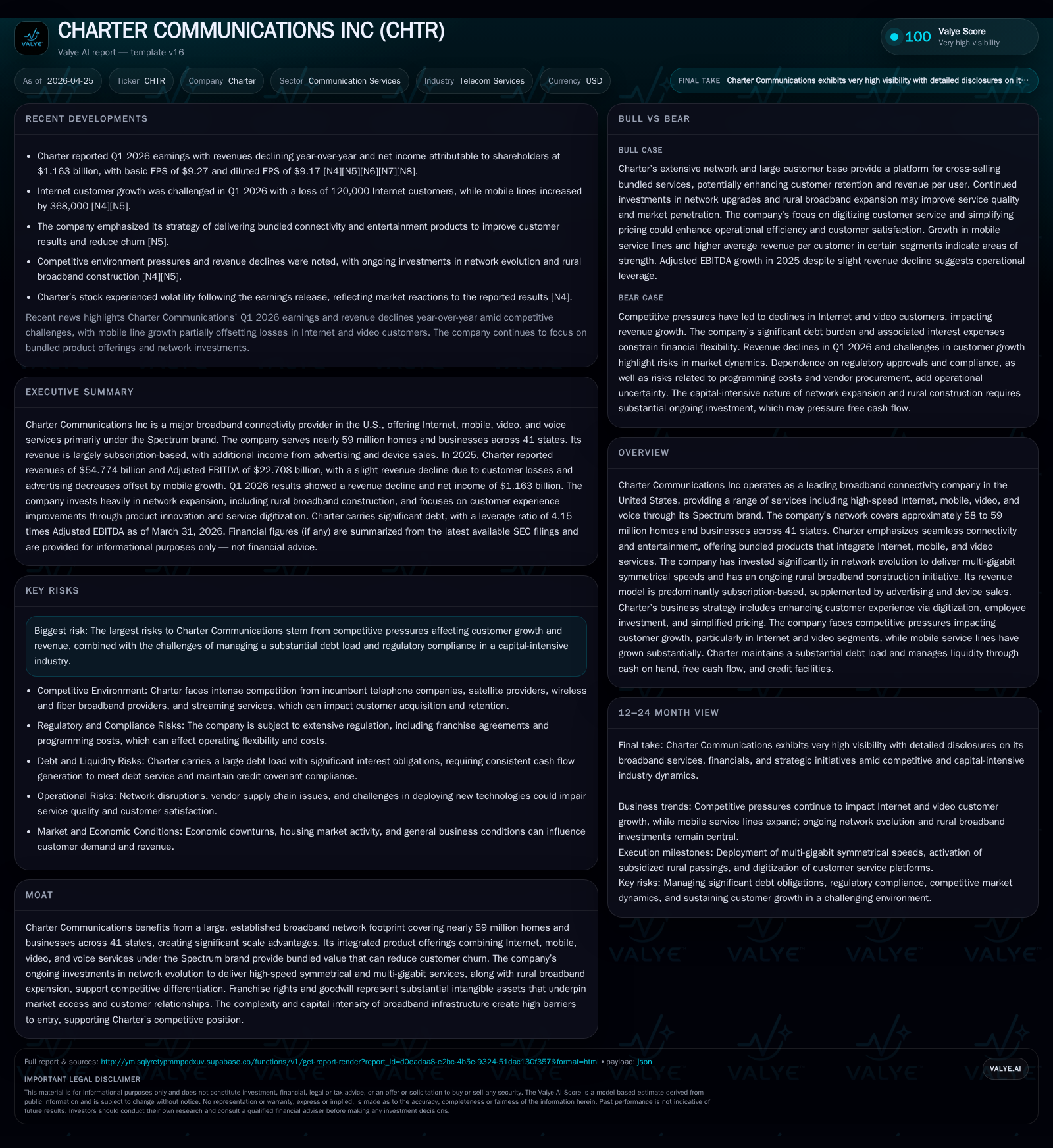
In Q1 2026, Charter Communications reported a year-over-year revenue decline tempered by mobile growth but faced ongoing margin pressures from programming cost reductions offset by rising other expenses. The company continues to prioritize bundled offerings under the Spectrum brand, leveraging network upgrades and rural broadband expansions to drive customer retention and growth. However, intensifying competition and pricing challenges coupled with increased operational costs present notable headwinds in the near term. Financially, Charter maintains a sizeable debt load balanced against robust cash flow generation and substantial capital investments focused on network evolution.
Latest Quarterly Operating Results: Revenue and Margin Dynamics
Charter Communications’ first-quarter 2026 filing [S2] reveals a nuanced operating picture characterized by a slight year-over-year revenue decline amid ongoing competitive headwinds. Total operating expenses remained largely stable ($8.16 billion vs. $8.19 billion in Q1 2025), but the composition shifted notably. Programming costs decreased to $2.088 billion from $2.302 billion a year prior — a positive sign amidst industry-wide content cost pressures — while other costs of revenue rose to $1.765 billion from $1.584 billion. Field and technology operations expenses modestly decreased to $1.258 billion, indicating some operational efficiencies or timing effects.
Other expense lines such as marketing and residential sales ($919 million) and customer operations ($766 million) remained relatively flat compared to the prior year quarter. Stock compensation expenses showed a slight decline reflecting rationalized equity awards or lower employee churn.
Despite these shifts balancing out overall cost burdens, Adjusted EBITDA edged down to about $5.64 billion compared to $5.76 billion in Q1 2025 [S2], corroborating margin compression partly stemming from competitive revenue pressure notwithstanding mobile subscriber additions.
Net income attributable to shareholders held reasonably firm at $1.16 billion versus $1.22 billion previously, highlighting disciplined cost control even as revenue softened slightly as reported alongside missed analysts’ revenue expectations [N3].
Business Model and Product Offering: Spectrum’s Bundled Services Evolution
Charter’s core value proposition is embedded in its subscription-based model that bundles broadband Internet, voice, video, and mobile under the Spectrum brand [S1]. This approach enables deeper wallet share per household via integrated services designed around connectivity convenience and entertainment.
The company has steadily transitioned from traditional cable TV toward streaming applications embedded within its bundles at no extra charge—leveraging deals with leading content programmers to enhance perceived value while managing content cost inflation [S1]. July 2025 saw the launch of à la carte streaming app sales through the newly introduced Spectrum App Store digital storefront, streamlining customer access to third-party OTT platforms [S1]. The deployment of Xumo stream boxes further complements this ecosystem by offering flexible set-top streaming hardware aligned to evolving consumer preferences.
Pricing simplification under the "Life Unlimited" brand platform emphasizes lower promotional rates combined with persistent bundled discounts designed to lower churn risk and bolster retention [S1]. Meanwhile, incremental investments targeting employee wages and benefits along with digitization of customer service platforms are intended to improve service quality and reduce operational friction points [S1].
Competitive Landscape and Industry Structure: Scale, Barriers, and Market Pressures
Charter holds a significant competitive advantage arising from its extensive fiber-rich network footprint spanning nearly 59 million homes across 41 states [S1]. This scale affords it breadth economies particularly critical given the capital-intensive nature of broadband infrastructure investment posing substantial entry barriers.
Nonetheless, competitive intensity remains high as cable operators vie against telco fiber providers and wireless players alike for consumer connectivity dollars — especially in price-sensitive markets. Programming costs remain a volatile input despite recent declines seen this quarter; advertising sales reductions also reflect shifting industry monetization dynamics [S1].
Pricing power is limited by multichannel competitors aggressively targeting video subscribers with promotional offers while pure-play broadband rivals compete vigorously on speed-to-price ratios [N3]. Given Charter's relatively broad bundle offerings, it faces constant pressure balancing value creation against margin preservation.
Growth Drivers: Network Upgrades, Rural Expansion, and Mobile Line Additions
Investment initiatives remain core growth drivers as Charter continues expanding rural broadband availability with an outlay of approximately $2.2 billion spent during fiscal 2025 resulting in about 483,000 newly activated subsidized rural passings [S1], underscoring efficient capital deployment given typical build cost intensities.
Simultaneously, the network evolution program aims for symmetrical multi-gigabit speeds across the footprint integrating mobile connectivity with home broadband for seamless convergence everywhere Charter operates [S1]. This initiative not only supports incremental ARPU expansion opportunities but also enhances stickiness through differentiated product quality.
Mobile line additions contributed materially last year—with roughly 1.9 million net new lines added—offsetting some broadband losses seen elsewhere in video subscriptions [S1]. Spectrum’s bundled mobile offerings are thus increasingly central to cross-selling strategy designed to deepen user engagement within its ecosystem.
Growth Constraints: Competition, Pricing Pressure, and Cost Management
Despite gains in mobile subscribers boosting overall connectivity penetration, Q1 results indicate persistent revenue contraction signaling intensified price competition especially across core Internet and video products [S2],[N3]. Customer churn remains a challenge as price-sensitive consumers shift among providers while streaming substitutes erode conventional video revenues.
Operational expense pressures have been partially offset by programming cost declines but rebounded elsewhere—in particular field/technology operations which remain labor-intensive amid ongoing network upgrades—and marketing expenditures needed to drive acquisition volume in crowded markets [S2]. Increasing investment in employee wages aimed at enhancing service quality further elevates fixed cost bases though they are expected to pay off via improved retention metrics over time [S1].
The interplay between shrinking revenues from legacy segments versus rising investment requirements constrains near-term margin expansion prospects requiring careful stewardship of costs alongside continued scale leverage.
Key Near-Term Indicators to Monitor: Customer Metrics and Service Innovation
Market participants should closely monitor monthly subscriber churn data alongside average revenue per user (ARPU) trends to gauge how effectively bundled offers retain customers amid aggressive competitor pricing [S1],[N4]. Adoption metrics for the Spectrum App Store digital storefront will be critical in understanding consumer willingness to engage with curated streaming app ecosystems within provider-controlled platforms.
Expansion progress in rural broadband passings funded by subsidies provides another forward-looking signal of footprint growth potential supporting long-term subscription additions [S1]. Uptake rates for Xumo streaming devices will offer insights into Charter’s evolving video product strategy effectiveness as consumer preferences continue shifting toward flexible streaming hardware solutions.
Execution on digitization initiatives impacting customer service efficiency could translate into lower transaction volumes reducing operational drag while raising satisfaction scores—metrics worth tracking via quarterly disclosures [N4].
Financial Position Snapshot: Debt, Cash Flow, and Capital Investments
Historical performance (annual)
|
| FY | Rev ($bn) | Net ($bn) | CFO ($bn) | OpInc ($bn) | Rev YoY | Net YoY |
|---|---|---|---|---|---|---|
| 2025 | 54.8 | 5.0 | 16.1 | 12.9 | -0.6% | -1.9% |
| 2024 | 55.1 | 5.1 | 14.4 | 13.1 | +0.9% | +11.5% |
| 2023 | 54.6 | 4.6 | 14.4 | 12.6 | +1.1% | -9.9% |
| 2022 | 54.0 | 5.1 | 14.9 | 12.0 |
Source: SEC companyfacts cache [F1].
Capital returns and efficiency (annual)
|
| FY | Buybacks ($bn) | FCF ($bn) | ROE% |
|---|---|---|---|
| 2025 | 5.1 | 4.4 | 31.1 |
| 2024 | 1.2 | 3.2 | 32.6 |
| 2023 | 3.2 | 3.3 | 41.1 |
| 2022 | 10.3 | 5.5 | 55.4 |
Source: SEC companyfacts cache [F1].
Charter enters mid-2026 with a sizeable leverage profile consistent with its capital-intensive business model. As of December 31, 2025, total debt stood near $94.76 billion offset marginally by $477 million cash reserves yielding an approximate net debt of $94.28 billion [F1]. Adjusted EBITDA for Q1 2026 remained solid at approximately $5.64 billion compared with $5.76 billion prior year quarter sustaining strong cash flow generation capacity essential for servicing interest obligations which amounted to about $1.26 billion during this period [S2]. Annual capex runs north of $11 billion primarily allocated towards rural broadband expansion plus infrastructure modernization projects designed for symmetrical gigabit speed capabilities across Charter’s footprint [F1],[S1].
Free cash flow availability after capex investment supports continued deleveraging initiatives including share repurchases—which totaled over $5 billion in fiscal 2025—and maintaining investor distributions despite earnings headwinds [F1],[S2].
This analysis synthesizes Charter Communications’ recent quarterly performance within the context of its longer-term strategic imperatives emphasizing bundled connectivity innovation amid evolving industry challenges. While competitive pressures constrain near-term topline growth prospects alongside margin headwinds from operating expense dynamics, Charter’s scale advantages coupled with focused capital allocation towards network evolution and rural expansion underpin durable positioning within the U.S. telecom services sector.
Disclaimer: This document is an industry analysis intended solely for informational purposes without any investment advice or endorsement of securities discussed herein.
Disclaimer: This is research-only, informational analysis and not investment advice. It may include AI-generated interpretation and general industry context. Always verify important details using primary sources.

Comments