
Charlie's Holdings Advances Product Portfolio Amid Market and Regulatory Challenges
Charlie's Holdings recently strengthened its liquidity through a strategic equity offering while confronting complex regulatory hurdles in the nicotine alternatives sector.
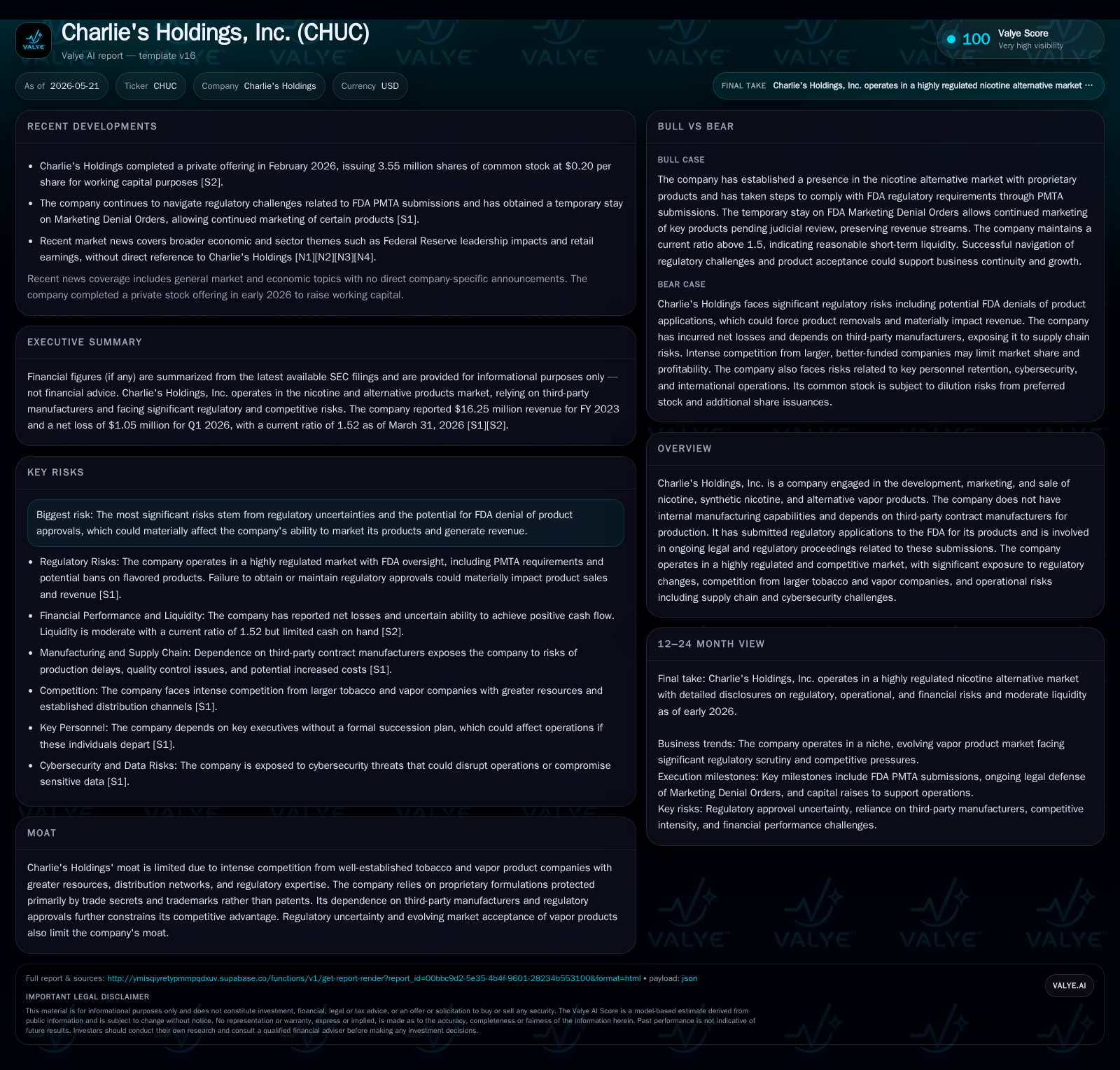
In May 2026, Charlie's Holdings executed an unregistered share sale raising $270,000 in cash and extinguishing $1 million in debt, bolstering immediate working capital. The company operates as a product developer relying on third-party manufacturing for nicotine, synthetic nicotine, and alternative vapor products within a highly regulated and competitive environment with ongoing FDA premarket tobacco application reviews. Growth prospects hinge on successful regulatory approvals and continued product innovation, whereas risks center around regulatory uncertainties, manufacturing dependencies, and competitive pressures from larger incumbents. Near-term milestones include FDA decisions on PMTAs and execution of capital strategies to sustain operational runway.
Recent Quarterly Operating Update: Liquidity Boost and Operational Outlook
Charlie's Holdings disclosed a significant capital transaction in its May 20, 2026 Form 8-K supplementing the quarterly 10-Q that underscores efforts to stabilize liquidity during ongoing operational challenges. The company sold 6.35 million shares of common stock at $0.20 per share through an unregistered offering that generated $270,000 in immediate cash proceeds alongside $1 million paid through debt forgiveness by some investors [S3]. These proceeds were earmarked for working capital enhancement as Charlie's continues navigating cash flow constraints linked to net negative operating cash flows documented in recent years [S1]. This infusion provides critical near-term runway extension against a backdrop where regulatory uncertainties and margin pressures persist [S2]. The dual nature of the transaction—cash plus debt forgiveness—reflects the investor base's recognition of underlying balance sheet leverage issues needing mitigation to avoid liquidity distress.
Business Model: Outsourced Manufacturing in a Niche Nicotine Products Market
Charlie's Holdings operates primarily as a product developer and marketer within the nicotine alternatives niche rather than as a manufacturer. It lacks internal commercial-scale manufacturing capacity and instead depends exclusively on third-party contract manufacturers to produce its array of offerings including nicotine, synthetic nicotine formulations, and alternative vapor devices [S1]. Reliance on external manufacturers introduces operational risks such as potential delays, quality control lapses, or cost overruns given that contract manufacturers manage production yields and quality assurance independently. While Charlie's protects its intellectual property chiefly via trade secrets and trademarks rather than patents—limiting formal legal protection—the proprietary formulations constitute its core value driver [S1][S29]. Regulatory approvals are critical given federal oversight; the company has invested approximately $6.5 million in premarket tobacco applications (PMTAs), which require compliance with evolving FDA standards before products can be marketed broadly.
Competitive Environment: Navigating Intense Industry Pressures and Regulatory Constraints
The competitive landscape for Charlie's Holdings is dominated by large tobacco conglomerates and well-capitalized vapor product companies possessing extensive distribution networks, manufacturing scale advantages, robust regulatory affairs teams, and established brand equity. In contrast, Charlie's limited production scale and lack of patent-protected innovations constrains its moat; competitive differentiation rests largely on brand positioning within a niche segment plus proprietary formulations safeguarded as trade secrets. The patchwork of federal, state, and local regulations adds complexity; various agencies including the FDA impose stringent advertising restrictions, marketing controls especially over flavors associated with youth appeal, labeling requirements, and manufacturing compliance obligations [S6][S9]. Additionally, regulations like the amended PACT Act constrain interstate online sales channels necessitating costly compliance infrastructure.
The evolving regulatory environment heightens uncertainty about market access longevity for certain products; denial of PMTAs would require removal from shelves impacting revenue generation materially [S16]. Competitors frequently leverage superior scale to absorb compliance costs more efficiently. Moreover, public health advocacy campaigns influence adult consumer preferences dynamically impacting demand trends across combustible tobacco replacements versus emerging synthetic nicotine variants.
Growth Drivers: Product Pipeline Evolution and Regulatory Strategy
Charlie’s path to growth lies primarily in successful navigation through FDA market authorization processes coupled with pipeline innovation aligned with regulatory mandates. The recent introduction of disposable SBX-branded vape products aims to replace legacy portfolio items driving future revenues; these products’ classification outside traditional tobacco product definitions may afford regulatory benefits though this remains subject to governmental interpretation [S14]. Strategic investments have also targeted age-gating technology development designed to prevent underage access while ensuring adult user availability; notably collaboration with IKE integrates advanced age-verification systems affiliated with select ENDS offerings enhancing compliance posture amid rising scrutiny on youth vaping access [S8].
Ongoing amendments of PMTA submissions reflect adaptive regulatory engagement underpinning sustained efforts to maintain pending status of applications despite received Marketing Denial Orders currently stayed pending judicial review by the Fifth Circuit Court since late 2025—a critical litigation milestone preserving short-term market eligibility in compliant states such as Louisiana [S16]. Continued investment in proprietary formulations targeting differentiated user experience combined with emerging scientific data additions represent incremental value creation vectors conditional on future approval outcomes.
Risks and Constraints: Regulatory Uncertainty, Manufacturing Dependence, and Market Acceptance
The overarching risk theme confronting Charlie’s is regulatory unpredictability influencing almost every business facet—from product marketing authorization risks that could lead to forced withdrawals if PMTAs are denied or fail approval processes [S16]—to intensifying oversight of flavor bans or ingredient-level restrictions adversely affecting product usability. Dependence on third-party contract manufacturers raises supply chain vulnerabilities including potential quality control failures triggering recalls or shipment delays that could impair revenue timing or damage brand perception [S1][S13]. Clinical evidence gaps for certain innovative synthetic nicotine formulations detract from safety assurances potentially reducing consumer adoption momentum amid heightened public health awareness.
Additional factors tempering growth include competitive threats from entrenched tobacco giants with far stronger R&D budgets plus brand recognition limiting Charlie’s ability to command sustained pricing power or distribution shelf space margins. Manufacturer compliance failures or discontinuities could necessitate costly supplier transitions disrupting timelines. Also material is the company’s need to continually attract skilled talent necessary for regulatory affairs, marketing expertise, legal strategy formulation without an established succession plan currently documented raising operational continuity concerns [S20]. Product liability exposure remains inherent given addictive substance usage albeit covered by insurance that may be insufficient under extreme claim scenarios.
What to Watch Next: FDA Decisions, Product Approvals, and Capital Management
Key upcoming milestones central to Charlie’s operating trajectory include anticipated resolutions on outstanding PMTAs currently under suspension via litigation action through mid-2026 whose ultimate disposition will determine whether affected synthetic-nicotine product sales endure uninterrupted or must cease leading to top-line declines [S16]. Additional potential capital market transactions following Q2 earnings could follow given persistent historical operating losses underscoring ongoing funding requirements notwithstanding recent equity injections [S2][S3]. Development or formalization of enhanced manufacturing partnerships improving capacity reliability or cost structures will also be material given full outsourcing dependence.
Monitoring developments regarding age-gating technology effectiveness vis-à-vis evolving youth access regulations alongside variable state-level legislation updates will provide insight into how effectively Charlie’s adaptation efforts mitigate adverse regulatory impacts while maintaining consumer accessibility.
Financial Snapshot: Liquidity Position and Debt Forgiveness Through Share Offering
At quarter-end March 31, 2026, Charlie's Holdings displayed current assets approximating $14.1 million against current liabilities roughly $9.27 million reflecting a current ratio about 1.52 indicative of reasonably sufficient short-term liquidity coverage despite ongoing cash burn dynamics [F1]. Total debt stood near $2.15 million mostly unsecured alongside negligible cash reserves (~$400) underscoring tight balance-sheet leverage conditions typical for early-stage players reliant on funding cycles without substantial positive operating cash flow generation [F1][S2].
The May 2026 equity offering bridged crucial near-term gaps by raising $270K in fresh cash coupled with extinguishing $1 million related debt—relieving leverage burden materially while reinforcing working capital availability supportive of continued operations absent immediate refinancing pressures or covenant breaches [S3]. This latest financing complements previous February 2026 equity issuance further illustrating reliance on episodic capital raises aligned with developmental progress milestones rather than stable internally generated funds.
This analysis synthesizes publicly filed disclosures through May 21, 2026 and accompanying sector understanding without investment research views or price guidance. All operating narratives derive from primary SEC filings supported explicitly by citations where numeric metrics are referenced.
Disclaimer: This is research-only, informational analysis and not investment advice. It may include AI-generated interpretation and general industry context. Always verify important details using primary sources.

Comments