
CyberloQ Technologies Sharpens Financial Security Offering with Latest Platform Innovation
CyberloQ’s latest quarterly filing highlights progress in platform scalability, strategic partnerships, and ongoing integration within the financial ecosystem.
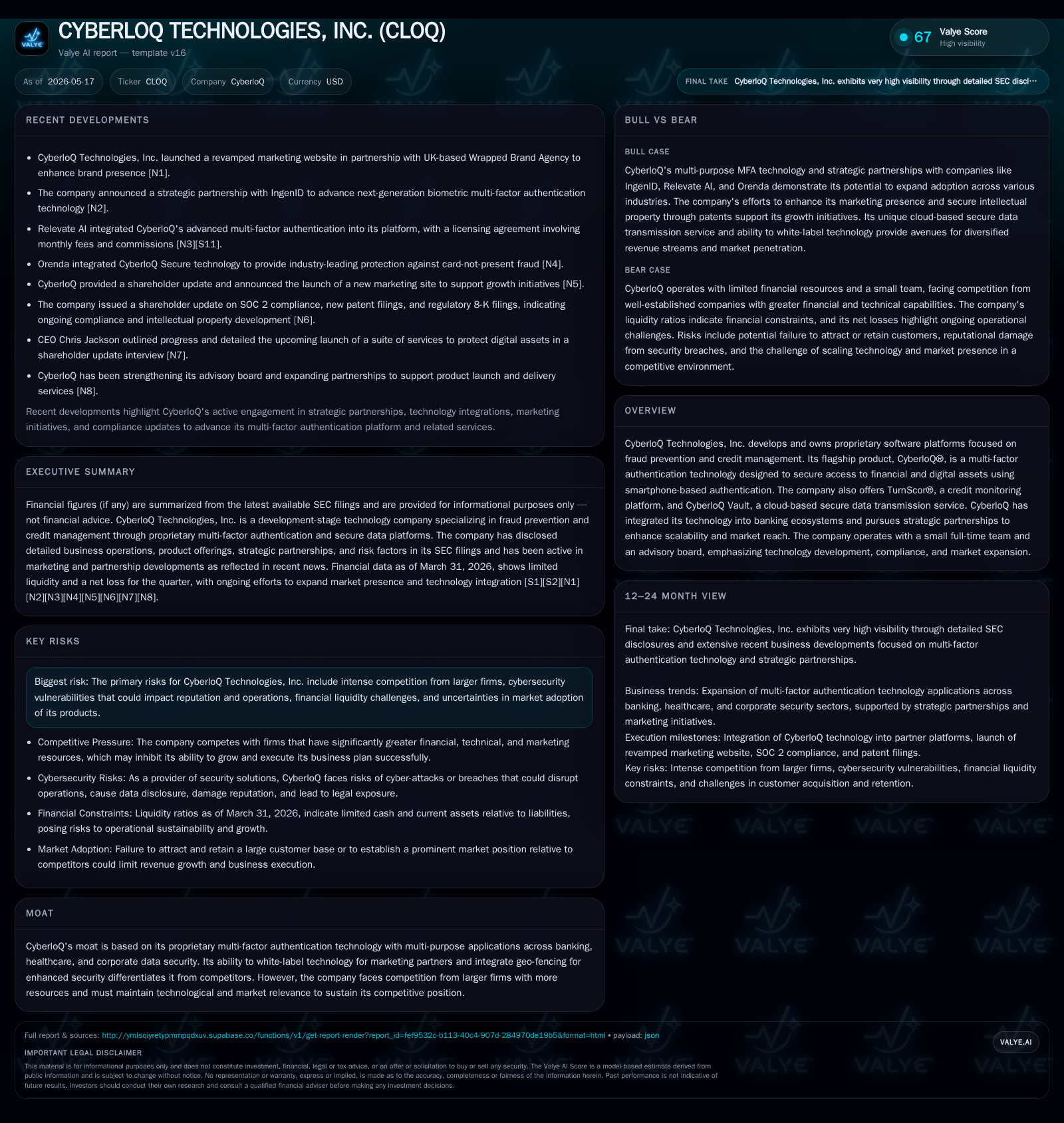
In its May 2026 10-Q, CyberloQ Technologies disclosed continued efforts to enhance the CyberloQ® multi-factor authentication (MFA) platform’s scalability and integration, including a notable partnership with Orenda scheduled for rollout starting May 2026. The company’s core business model revolves around licensing proprietary MFA technology and complementary secure data and credit monitoring services. While CyberloQ faces significant competition from larger incumbents in financial cybersecurity, it differentiates through multi-purpose applications spanning banking, healthcare, and corporate data security, coupled with white-labeling and geo-fencing capabilities. Key growth drivers include expanded market adoption through strategic partnerships and platform upgrades, though execution risks remain elevated due to limited resources and liquidity constraints.
Latest Operating Update: Quarterly Developments and Strategic Partnerships
CyberloQ Technologies’ latest quarterly filing dated May 15, 2026 [S2] underscores active development toward enhancing the scalability of its flagship multi-factor authentication platform. The company has undertaken infrastructure upgrades including UI/UX streamlining to better support deliverables across multiple strategic channels. A key operational milestone is the forthcoming integration of CyberloQ Secure MFA technology into Orenda’s platform starting in May 2026 [N1], reflecting CyberloQ's approach of embedding its solutions within partner ecosystems to expand market reach. This agreement exemplifies CyberloQ’s strategy to leverage institutional partnerships that provide licensing revenue streams via monthly fees plus commission on user activity.
The filing indicates ongoing refinement of the original platform's architecture aimed at improving scalability—an essential factor for supporting volume growth among institutional clients. Such efforts suggest management prioritizes not just securing new customers but also ensuring their experience supports sustainable adoption.
Business Model and Product Ecosystem Overview
CyberloQ operates a B2B software licensing model emphasizing fraud prevention via its proprietary CyberloQ® MFA platform [S1]. Revenue principally derives from institutional clients who license access to this smartphone-based authentication protocol designed to combat unauthorized transactions across banking cards, digital accounts, or any secured digital asset. Customers pay for access to secured authentication layers that control permission by device usage within predefined transactional limits.
Complementary products further diversify the offering: TurnScor® provides a cloud-based credit monitoring service accessible via web applications aimed at both individuals and institutionally bundled clients; meanwhile, CyberloQ Vault offers a cloud-secured data transmission portal featuring encryption reinforced by geo-fencing to restrict access by physical location [S8]. These ancillary services augment the main product suite while creating cross-selling opportunities within client relationships.
The company differentiates itself via several technological advantages. Notably, CyberloQ’s white-label capability allows marketing partners to customize branding—enhancing channel adaptability. Geo-fencing incorporation provides contextual security controls rarely seen in competing mobile authentication solutions. Coupled with smartphone-centric MFA protocols attuned to current cybersecurity flexibility demands, these features bolster its competitive positioning.
Operationally, CyberloQ runs with a skeletal full-time staff consisting only of a President and Vice-President supported by an advisory board from banking, technical, and business backgrounds [S1]. This lean structure focuses on technology development efficiency but may limit scalability without external partnership synergies.
Competitive Landscape and Industry Positioning
CyberloQ faces a competitive environment dominated by well-capitalized fintech and incumbent financial institutions with built-in mobile security features—examples cited include Wells Fargo’s “on/off” card functionality, Discover Card’s “Freeze It,” and established players such as Ondot Systems [S12]. These competitors wield scale advantages in marketing reach, capital resources, and existing customer bases.
However, CyberloQ claims differentiation through its multipurpose product design applicable beyond banking into healthcare—securing digitized personal health records—and broad corporate data protection using integrated geo-fencing [S1]. The ability to white-label products permits flexible deployment across various industries without extensive brand-building costs.
Switching costs bolster stickiness since deep integration into banking ecosystems involves backend linkage with transaction processing systems that are complex to replace once deployed. Regulatory dynamics implicitly favor robust MFA deployments as financial services tighten authentication standards nationally; hence compliance alignment could support demand. Yet sustaining competitiveness requires continual innovation amidst growing resource gaps.
Growth Drivers: Market Adoption and Technology Scalability
Expansion prospects hinge on broadening industry penetration—banking remains core given established integrations—but targeted growth in healthcare data security leverages rising digitization trends of patient records [S1]. Corporate adoption for database security via geo-fencing adds another vertical avenue.
Strategic partnerships function as key catalysts; for instance, alliance arrangements like the recent integration deal with Orenda slated for May deployment enable leveraging third-party distribution channels for more efficient market access [N1]. Similarly structured agreements such as that with Relevate AI pending licenses generate recurring fee income alongside user-activity commissions [S18].
Technological enhancements reported in the annual filing involve infrastructure modernization supporting higher volume throughput and improved user interfaces [S1], necessary steps for accommodating expected customer scaling without degradation in performance or security reliability.
Cross-selling TurnScor credit monitoring alongside MFA packages could increase average revenue per client if institutional customers opt for bundled offerings providing multidimensional fraud prevention and credit insights.
Risks and Challenges: Competition, Cybersecurity, and Financial Constraints
Despite technological moat elements, CyberloQ confronts sizeable risks primarily from entrenched competitors wielding vastly superior capital reserves capable of aggressive marketing or rapid feature rollouts [S12]. Failure to achieve critical mass customer retention would hinder viability.
Cybersecurity risk paradoxically exists as the company itself provides security systems; any breach caused by technical vulnerabilities, operational errors or malicious activity threatens reputational damage with downstream effects including legal exposure or operational interruptions [S12]. Given the nature of client data handled—financial records or PII—the impact of compromise can be severe.
Additionally, small employee headcount may constrain product development velocity or marketing outreach capabilities required for winning new contracts in competitive environments [S1]. Execution failures amplify growth uncertainties.
Key Milestones Ahead: Catalysts for Demand and Operational Execution
Monitoring initial phase implementations of CyberloQ’s technology within Orenda’s platform will be a crucial near-term indicator of functional uptake beginning May 2026 [N1]. Tracking subsequent customer onboarding rates across partnered channels will offer concrete evidence regarding commercialization effectiveness.
Similarly noteworthy will be updates stemming from Relevate AI integration arrangements providing incremental user-based licensing revenue streams plus referral commissions—these contracts couple operational execution with recurring income potential [S18]
Further improvements in user experience via UI/UX upgrades as noted in filings may aid retention benchmarks if measurable feedback mechanisms emerge during rollout phases [S2]. Observing renewal rates or expansion bookings will help validate scale economies promised by recent infrastructure investments.
Transparent disclosure of usage metrics once publicly available would enhance visibility into demand trajectory amidst industry noise.
Financial Profile Summary
As per the latest available balance sheet data at quarter-end March 31, 2026 [F1], CyberloQ maintained cash and equivalents near $46K alongside total debt approximating $32.5K resulting in net cash positioning around $13K. Operating losses persist though exact quarterly income figures are limited; annual results showed continued negative operating margins consistent with technology development stage and limited commercial scale [F1]. Capital resources remain tight restraining investment flexibility in sales or R&D activities vital for maintaining competitive relevance.
This fragile financial footing underscores the imperative of efficiently converting partnership agreements into cash-generating contracts while tightly managing expenses to sustain runway until positive operating leverage can be achieved.
This analysis synthesizes information explicitly supported by regulatory filings and public disclosures without extrapolating beyond documented facts. It emphasizes recent operating developments as foundational context before broader business model evaluation within the cybersecurity software domain specializing in fraud prevention technologies focused primarily on institutional multi-factor authentication solutions.
Disclaimer: This is research-only, informational analysis and not investment advice. It may include AI-generated interpretation and general industry context. Always verify important details using primary sources.

Comments