
Clover Health’s Growth Rebound Contrasts Persistent Profitability and Regulatory Challenges
Clover Health is expanding Medicare Advantage membership rapidly via its data-driven platform but continues to face losses and regulatory uncertainties.
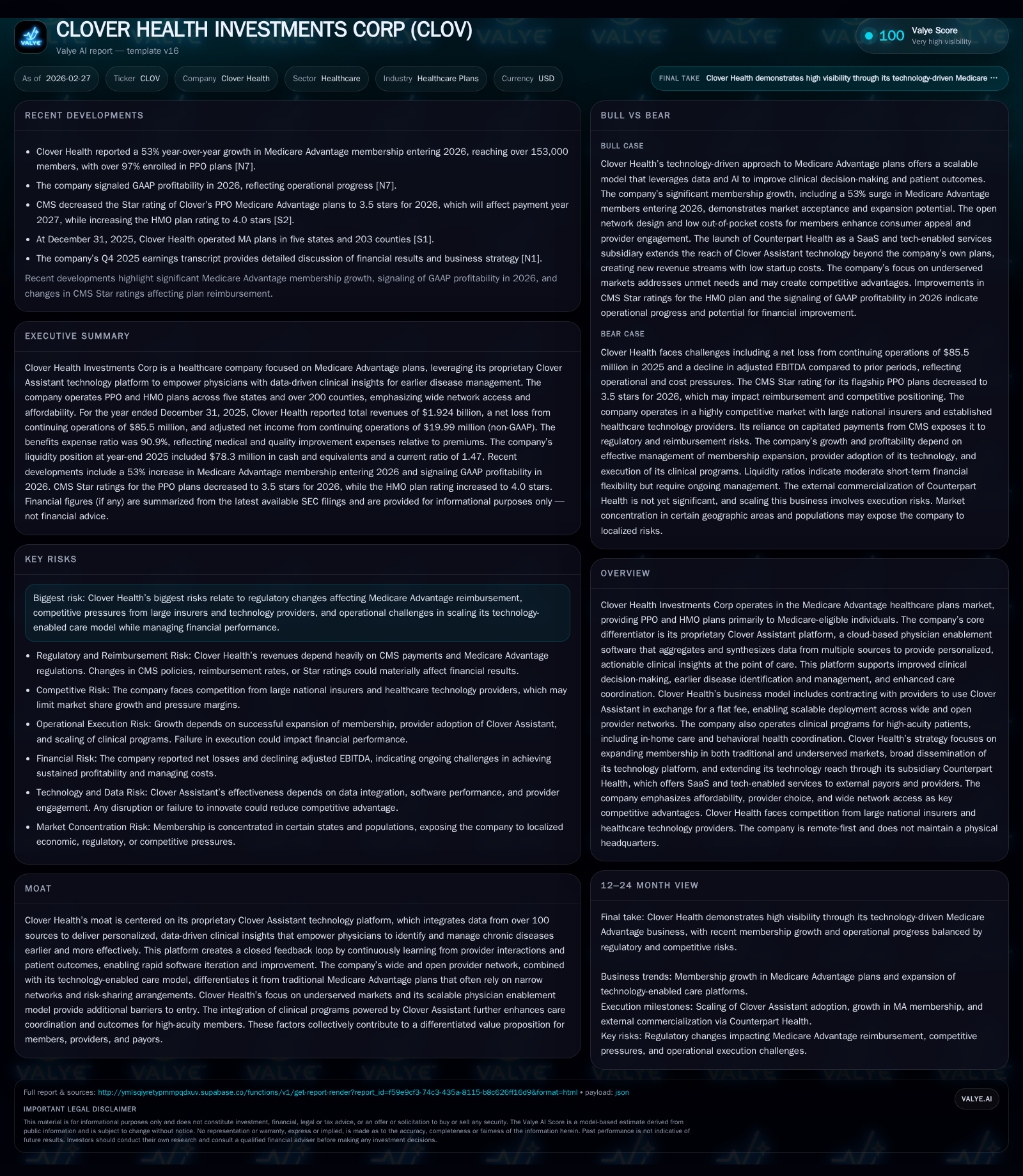
Clover Health Investments Corp reported strong growth in Medicare Advantage membership of over 50% in 2025, driven by the proprietary Clover Assistant platform’s physician enablement and open network model. Despite this revenue increase to nearly $1.9 billion from insurance premiums in 2025, the company remains unprofitable with an operating loss of approximately $85 million and negative operating cash flow. Regulatory scrutiny, including CMS Star rating reductions for PPO plans affecting future reimbursements, poses ongoing risks. Capital allocation has included moderate share repurchases, but cash flow deficits persist. The company’s proprietary technology and open network differentiate it amid intense competition from large insurers, though profitability hurdles and regulatory compliance remain key challenges.
Company Overview and Business Model
Clover Health Investments Corp operates in the Medicare Advantage (MA) healthcare sector focusing primarily on PPO (Preferred Provider Organization) and HMO (Health Maintenance Organization) plans for Medicare-eligible individuals. The core strategic differentiator is its proprietary clinical decision-support software, Clover Assistant, which aggregates data from over 100 sources to provide personalized recommendations to physicians at the point of care [S1][S5].
Clover Assistant creates a robust closed feedback loop that improves clinical insights through continuous learning from provider interactions and patient outcomes. This platform supports not only earlier chronic disease identification and management but also care coordination efforts via specialized clinical programs such as in-home care, behavioral health coordination, and post-hospital discharge support [S1][S17].
The company’s insurance products emphasize wide provider networks with less restrictive access than traditional MA plans, allowing members to see providers both inside and outside the network without cost penalties—the hallmark feature of its flagship PPO plans that represent over 97% of membership [S1][S5].
Historical Performance and Revenue Drivers
Clover Health has experienced volatile financial results since at least 2022 but showed notable top-line growth acceleration in recent periods. Annual revenues declined sharply from $3.48 billion in FY2022 to $2.03 billion in FY2023 but rebounded strongly to $1.37 billion in FY2024 followed by a substantial jump of over 40% YoY to $1.92 billion in FY2025 [F1]. This revenue trajectory closely aligns with MA membership growth—membership swelled by approximately 53% year-over-year entering 2026, reaching over 113,800 members across five states and around 200 counties [S1][N9][N7].
Despite revenue gains, profitability remains elusive. Operating losses narrowed significantly from -$371 million in FY2022 to -$209 million in FY2023, then improved further to -$45 million by FY2024 but deteriorated again to -$85 million in FY2025 [F1]. This reflects heavy investments into expanding the Clover Assistant platform capabilities, scaling clinical programs for high-acuity patients, broad marketing efforts, operational expansion into new geographic areas, and evolving go-to-market strategies including the external licensing SaaS product Counterpart Assistant launched in mid-2024 [S1][S5][S18].
Key Financial Metrics Summary
Historical performance (annual)
| FY | Rev ($bn) | Net ($mm) | CFO ($mm) | OpInc ($mm) | Rev YoY | Net YoY |
|---|---|---|---|---|---|---|
| 2025 | 1.9 | -86 | -67 | -86 | +40.3% | -98.9% |
| 2024 | 1.4 | -43 | 35 | -46 | -32.6% | +79.8% |
| 2023 | 2.0 | -213 | -116 | -209 | -41.5% | +37.0% |
| 2022 | 3.5 | -339 | -204 | -371 |
Source: SEC companyfacts cache [F1].
Capital returns and efficiency (annual)
| FY | Buybacks ($mm) | FCF ($mm) |
|---|---|---|
| 2025 | 18 | -69 |
| 2024 | 2 | 33 |
| 2023 | 6 | -116 |
| 2022 | 6 | -208 |
Source: SEC companyfacts cache [F1].
Figures rounded; revenue YoY reflects changes relative to prior year; net income YoY unavailable when prior net income is negative.
Future Growth Prospects
The primary driver for Clover’s future growth is continued expansion of Medicare Advantage membership through leveraging Clover Assistant's differentiated technology-enabled approach to provider enablement coupled with wide open network accessibility—a patient-centric value proposition uncommon among larger incumbent MA players who often have narrower networks [S14]. Expanding geographically beyond current five-state footprint is indicated as a medium-term objective [S1].
Secondary growth avenues include broader commercialization of Counterpart Assistant as a SaaS offering to payors and providers outside Clover’s own MA plans—potentially creating new low-capex revenue streams aligned with broader industry trends towards tech-enabled value-based care delivery platforms [S5][S7].
However, growth may be capped or slowed by regulatory headwinds such as CMS Star Ratings impacting reimbursement rates—the PPO plan star rating was downgraded to 3.5 stars for calendar year 2026 affecting payments starting in 2027 [S1]. Competitive pressure from established national insurers with deeper capital resources and proprietary data assets remains intense [S15]. Furthermore, operational challenges scaling a technology-heavy model while managing medical cost trends under complex Medicare reimbursement frameworks represent ongoing constraints.
Forecasts and Milestones to Monitor
While formal guidance is not provided explicitly in available disclosures, key milestones include:
- Monitoring quarterly membership growth rates during upcoming Annual Election Periods as MA enrollment expands seasonally.
- Tracking CMS Star Rating trends for Clover plans which directly influence future reimbursement profiles.
- Observing profitability inflection points where adjusted EBITDA turns sustainably positive amid scaling efforts.
- Progress on commercial adoption of Counterpart Assistant SaaS with external clients beyond internal MA operations.
- Operational metrics related to Benefit Expense Ratios (BER), currently reported normalized around ~91% for insurance benefits expense—a figure elevated compared to traditional peers implying upside if efficiencies improve [S1][F1].
Capital Allocation and Financial Positioning
Clover Health’s capital allocation demonstrates focused share repurchase activity—in FY2025 it repurchased approximately $18.3 million worth of Class A common stock following exhaustion of a prior $20 million repurchase program initiated mid-2024 [S22][F1]. These buybacks are relatively modest against total market cap given ongoing strategic investment needs.
Liquidity stands supported by cash and equivalents totaling roughly $78 million at end-2025 despite noteworthy negative operating cash flows amounting to -$67 million for the same period [F1][S6]. Capital expenditures remain low at around $2 million annually reflecting the software-centric asset base.
Return on equity remains negative approximately -24%, consistent with continuing net losses accumulation against shareholder capital injected since IPO [F1]. This reflects ongoing scale-up phase expenses exceeding current insurance underwriting margins.
Industry Context and Competitive Positioning Analysis
Medicare Advantage is an intensely competitive segment dominated by large insurers such as UnitedHealth Group, Humana, Aetna/CVS Health, Centene, among others who command vast provider networks and possess more diversified healthcare ecosystems [S15]. These incumbents increasingly embed their own digital tools or partner externally to support value-based care initiatives.
Clover differentiates itself through its open network philosophy combined with AI-driven physician enablement—its Clover Assistant enhances provider capabilities not merely within its own insurance ecosystem but also aims to influence broader market participants via SaaS offerings like Counterpart Assistant [S14][S17]. Yet technological differentiation alone does not insulate Clover entirely from regulatory complexities associated with Medicare billing accuracy, fraud risk (including scrutiny under False Claims Act), or pricing pressures inherent within CMS Medicare Advantage contracts—areas highlighted repeatedly under risk factors [S4][S9][S10][S16][S18].
Regulatory Environment Considerations
As a Medicare Advantage sponsor operating under CMS oversight with federal risk adjustment payment models, Clover faces heightened scrutiny regarding claims submission accuracy and coding integrity under evolving enforcement norms [S9][S10]. Recent reductions in Star ratings for its dominant PPO plans imply potential lower future reimbursements impacting margins substantially.
Moreover, healthcare fraud investigations including DOJ inquiries currently affect Clover requiring sustained compliance investments ensuring transparency around coding practices and payment arrangements with providers [S4][S9]. Non-compliance risks include treble damages under FCA suits alongside reputational impacts that can materially affect financial results.
Industry-wide developments on prescription drug pricing regulation, data privacy mandates such as HIPAA conformity expansions, state-level insurance solvency requirements further complicate operational checks on scale expansion horizons [S12][S18][S19]. Clover discloses ongoing monitoring efforts but acknowledges these risks could materially adversely impact future results.
Summary
Clover Health Investments Corp embodies a distinctive approach within the highly competitive Medicare Advantage landscape through its cloud-based physician enablement technology paired with open network insurance plans that prioritize consumer choice and affordability. The company achieved substantial MA membership growth in recent years fueling significant revenue rebounds exceeding $1.9 billion in total revenues during FY2025.
Nevertheless, persistent operating losses reflecting continued investments into product development, geographic expansion, clinical programs addressing high-acuity populations alongside regulatory risks weigh heavily on financial performance metrics including negative operating cash flows and suboptimal returns on equity as of the latest annual report date.
Investor focus should remain attentive toward CMS policy developments impacting reimbursement frameworks—especially Star Ratings shifts—and progress on commercial SaaS adoption beyond internal plan populations that could diversify revenue streams without proportionate cost increments.
While industry dynamics favor scale advantages held by entrenched players, Clover’s innovative integration of AI-powered clinical decision support embedded into an expansive beneficiary choice framework marks it as a notable innovator pursuing sustainable differentiation in the evolving value-based Medicare ecosystem.
This analysis is intended for informational purposes only; it does not constitute investment advice or recommendations regarding any securities discussed herein.
Disclaimer: This is research-only, informational analysis and not investment advice. It may include AI-generated interpretation and general industry context. Always verify important details using primary sources.

Comments