
ClimateRock’s SPAC Lifeline: Execution Stretch, Liquidity Crunch, and the Countdown to a Business Combination
Facing a severe liquidity deficit and no operating revenues, ClimateRock’s future now hinges on securing a viable target and closing its Business Combination before its extended deadline. Sponsor loans and amended terms buy time, but execution and funding risks remain acute.
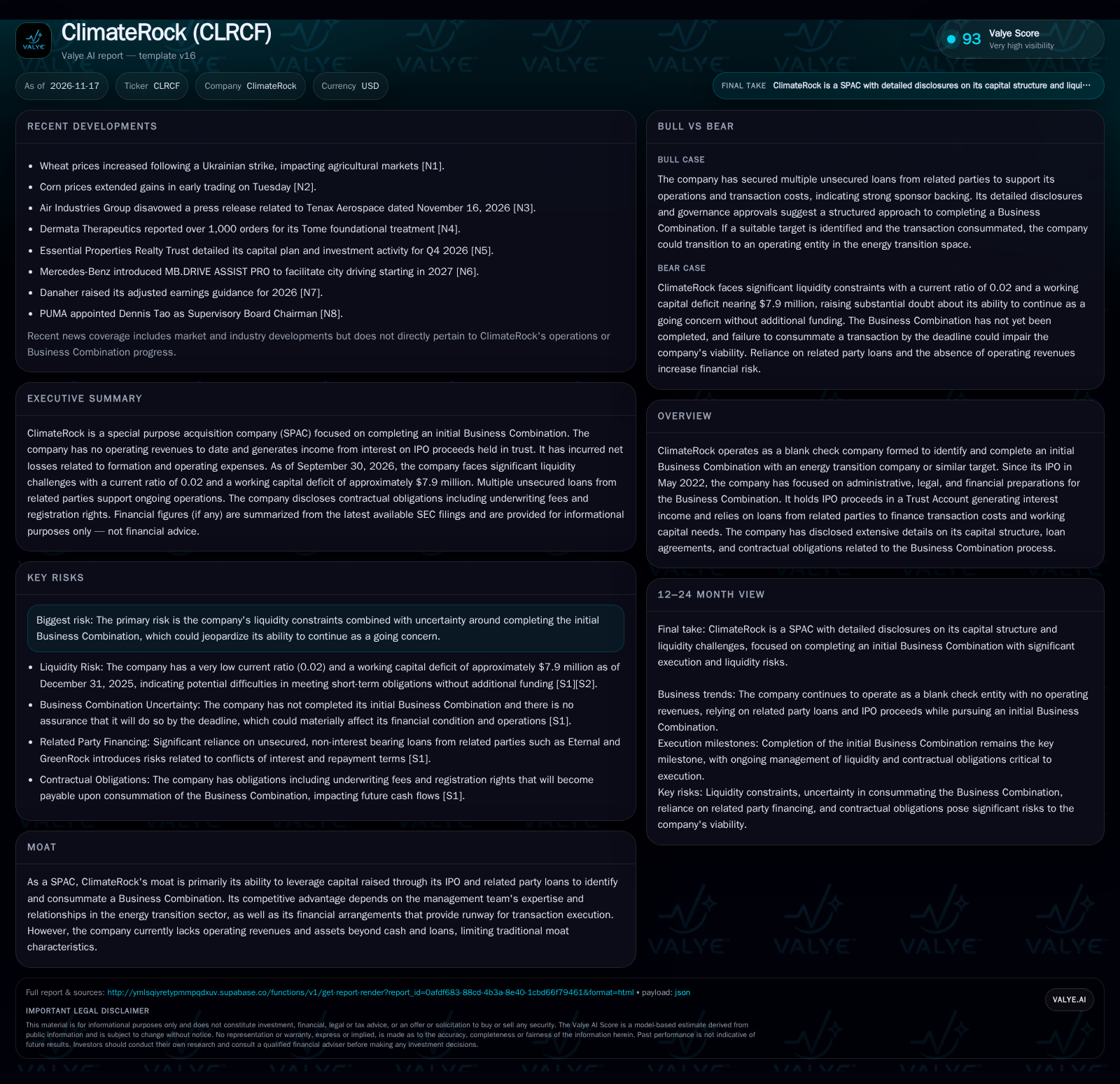
ClimateRock, a SPAC targeting the energy transition sector, continues to operate without revenues, relying on sponsor and related-party loans to cover expenses. As of September 30, 2026, it reports a working capital deficit of about $7.9 million and a current ratio of 0.02, raising substantial doubts about its ability to continue as a going concern. Recent amendments extend its merger deadline to May 2027, but the company’s survival depends on closing a Business Combination and securing additional funding in a tightening SPAC environment. [S1] [S2]
ClimateRock exemplifies the late-stage SPAC dilemma: flush with ambition but starved for cash, and with the promise of a transformative merger perpetually just out of reach. As of September 2026, the company faces a stark working capital deficit and an acute liquidity crisis, with no operating revenues to offset ongoing expenses. Sponsor and related-party loans have kept the lights on, but with mounting obligations and only an extended deadline between the company and potential dissolution, ClimateRock’s future now depends entirely on its ability to secure and close a Business Combination in the coming months. The outcome will test both the resilience of its sponsor network and the realities of today’s post-boom SPAC market.
Liquidity Deficit and Extended Timeline Define ClimateRock’s Present
ClimateRock’s most material current facts are its severe liquidity constraints, continued lack of operating revenues, and the recent extension of its Business Combination deadline. As of September 30, 2026, the company’s current assets of $159,034 are dwarfed by current liabilities of $8,693,306, resulting in a current ratio of 0.02 and a working capital deficit of approximately $7.9 million [S2]. The company has not generated operating revenues since inception, relying instead on interest from IPO trust funds and a series of unsecured, mostly related-party loans to cover expenses [S1] [S2].
In October 2026, ClimateRock amended its Business Combination agreement with GreenRock, extending the outside date for a deal to March 31, 2027, and subsequently gained shareholder approval to extend its own merger deadline to May 2, 2027 [S1]. This buys additional time but does not address the urgent need for additional funding to meet ongoing obligations. The company’s going concern status is in question, with its survival now dependent on closing a Business Combination or raising new capital [S1] [S2].
SPAC Economics: Fee Drag, Sponsor Leverage, and the Cost of Delay
ClimateRock’s business model is that of a typical SPAC pre-merger: it has no operating revenues, instead earning modest interest income on IPO proceeds held in trust. This income is insufficient to cover recurring public company expenses, due diligence, and deal negotiation costs. Operating leverage is negative at this stage: incremental expenses (legal, audit, compliance, and deal sourcing) accrue regardless of deal progress, while the company has no top-line growth until a merger closes.
The funding structure is highly reliant on related-party loans—some interest-free, others with high interest rates and original issue discounts (such as a 10% annual rate and 20% OID on the July 2026 GreenRock loan) [S1]. These loans bridge liquidity gaps but add future repayment obligations, sometimes convertible to equity or warrants, which can dilute future shareholders. If a Business Combination is closed, the merged entity may face a capital structure loaded with sponsor and related-party claims, potentially limiting post-merger flexibility.
The SPAC also faces significant contractual obligations, such as deferred underwriting fees and registration rights, that become payable only if a Business Combination is consummated. These off-balance-sheet liabilities create a binary outcome: if no deal closes, the company is liquidated with remaining trust proceeds distributed to public shareholders (sponsors and affiliates typically get nothing); if a deal closes, the new entity inherits the fee and loan burden, impacting future cash flows.
SPAC Market Saturation and Sponsor Relationships Shape Competitive Dynamics
ClimateRock’s competitive position is shaped less by traditional business moats and more by its sponsor network, deal sourcing capabilities, and capital structure flexibility. In the current late-cycle SPAC environment, competition is fierce for high-quality targets, particularly in the energy transition sector, which has attracted significant investor and sponsor attention.
The primary counterforces are the glut of SPACs chasing a shrinking pool of attractive, deal-ready targets and the growing skepticism among public market investors regarding SPAC economics. Many targets now have the leverage to negotiate favorable terms or to reject SPAC offers outright, especially if they have access to private capital or direct listings. ClimateRock’s reliance on related-party loans may be a symptom of these competitive pressures, as sponsors are forced to bridge funding gaps themselves.
Possible substitutes for targets include private equity, venture capital, or traditional IPO routes—which may offer cleaner capital structures or less dilution. ClimateRock’s potential advantage lies in its sponsor relationships within the energy transition space, but this edge is meaningful only if it can secure a willing and credible target before its extended deadline.
Breakthrough Transaction Unlocks Value—But Only with Timely Execution and Fresh Capital
In a favorable scenario, ClimateRock successfully closes a Business Combination with a compelling energy transition target before the May 2027 deadline. The deal structure attracts PIPE (private investment in public equity) or other external capital, replenishing liquidity and enabling the merged entity to fund its growth plan. Sponsor and related-party loans are converted into equity or warrants on mutually agreeable terms, minimizing cash outflows and aligning incentives.
This outcome would be confirmed by announcements of a definitive merger agreement with a credible, scalable operating company, followed by regulatory filings detailing PIPE commitments or other external funding. Additional evidence would include a post-merger pro forma balance sheet showing adequate working capital and manageable debt. If a high-quality target with revenue traction and a clear growth narrative is acquired, market sentiment could shift positively, unlocking value for both legacy SPAC and new shareholders.
Falsification would occur if deal terms are repeatedly renegotiated, target quality is low, or external capital is unavailable—leaving the company unable to close or fund the merger.
Deadline Extension Buys Time, but Execution and Dilution Risks Persist
The most plausible scenario is that ClimateRock continues to operate in a state of limbo, using sponsor and affiliate loans to meet basic obligations while aggressively seeking a merger candidate. The extended deadline to May 2027 provides a temporary reprieve, but each month of delay increases the company’s funding needs and the likelihood of further dilution or unfavorable loan terms.
The base case is confirmed by continued reliance on related-party loans, further amendments to deal terms or deadlines, and incremental but non-definitive merger progress (such as non-binding LOIs, exclusivity agreements, or target shortlists). If a deal is eventually announced, it may be with a less attractive target or on terms that heavily favor sponsors and creditors over public shareholders.
Falsification would occur if the company fails to secure further funding, if regulatory or shareholder approvals are withheld, or if the SPAC is forced into liquidation before closing a merger.
Funding Exhaustion or Failed Merger Triggers Liquidation and Sponsor Losses
The adverse scenario is that ClimateRock is unable to close a Business Combination before its May 2027 deadline, either due to an inability to secure a suitable target, lack of external funding, or regulatory/market obstacles. In this case, the company would be forced to liquidate, distributing remaining trust assets to public shareholders while sponsors and related parties lose their investment in founder shares and warrants.
This scenario would be confirmed by public disclosures of failed merger negotiations, notices of insufficient funding to continue operations, or announcements of SPAC liquidation. If sponsor loans come due without a merger to convert them into equity or warrants, creditors may seek repayment, but recovery prospects are limited by the company’s depleted cash position.
Falsification would occur if a credible deal is announced and funded before the deadline, or if a significant new capital infusion is disclosed.
Milestones That Will Determine Whether ClimateRock Transitions or Terminates
Announcement of a definitive Business Combination agreement with a credible, revenue-generating target—particularly one with energy transition assets or growth prospects.
Disclosure of PIPE or other external financing commitments concurrent with or following the merger announcement, to provide post-deal liquidity.
Updates on the conversion, extension, or repayment terms of sponsor and related-party loans, especially those with high interest or original issue discounts.
Shareholder vote outcomes on merger proposals or further deadline extensions, as these may signal market appetite and sponsor resolve.
Material amendments to the merger agreement or outside date—either signaling progress (e.g., removal of closing conditions) or warning of continued execution risk.
Any regulatory or legal developments affecting the ability of SPACs to close mergers or access capital markets, which could alter the feasibility of the Business Combination.
Disclaimer: This is research-only, informational analysis and not investment advice. It may include AI-generated interpretation and general industry context. Always verify important details using primary sources.

Comments