
Cambium Networks Faces Financial Crossroads with Delisting and Supply Risks
Cambium Networks’s latest quarterly disclosure reveals significant liquidity challenges compounded by a Nasdaq delisting and supply chain vulnerabilities.
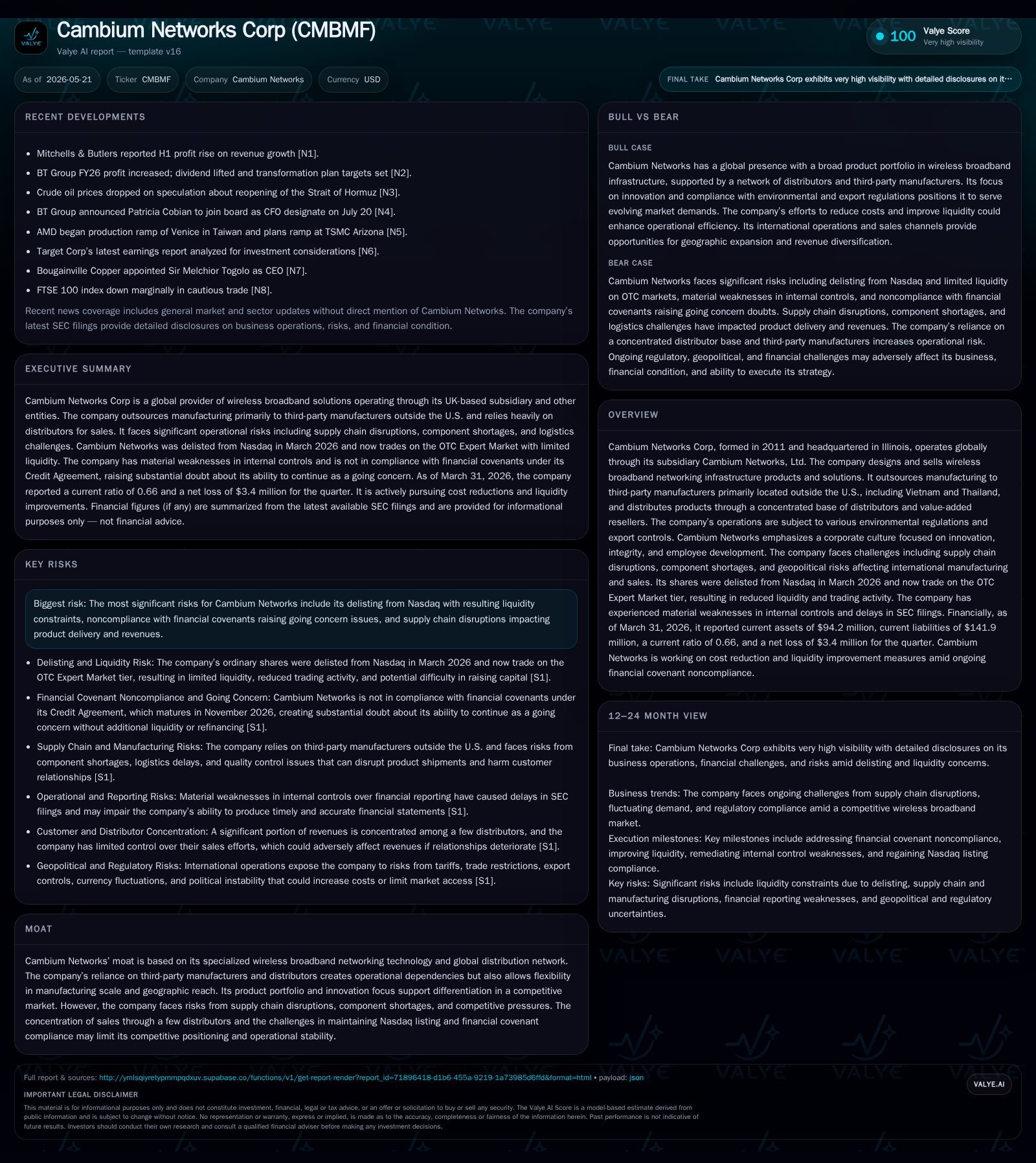
The May 2026 10-Q filing outlines Cambium Networks’ breach of financial covenants under its credit agreement alongside an official delisting from Nasdaq earlier in March. Driven mainly by continued operating losses, the company confronts severe liquidity constraints with current assets covering only two-thirds of current liabilities. Cambium’s business model, centered on outsourced manufacturing and a concentrated distributor base for wireless broadband infrastructure, faces heightened risk from ongoing supply pressures and geopolitical uncertainties. While innovation and international expansion remain strategic growth pillars, these are tempered by operational dependencies and looming refinancing needs ahead of November 2026 maturity. The immediate outlook is marked by constrained financial flexibility and execution risk amid the capital markets exclusion.
The company disclosed persistent noncompliance with several critical financial covenants tied to its credit agreement, which matures in November 2026 [S2][S4]. This fragility compounds an already challenging liquidity position where current liabilities substantially outweigh current assets—$141.9 million against $94.2 million respectively—yielding a constricted current ratio of 0.66 [F1].
Earlier in March 2026, Cambium’s shares were officially delisted from the Nasdaq Global Market due to failure to meet listing requirements including delayed periodic filings and minimum bid price rules [S3]. The loss of access to a prominent exchange notably impairs the company’s ability to raise equity capital or obtain favorable financing, increasing reliance on existing lenders or alternative sources that may prove scarce or costly.
Even as management endeavors to engage lenders for covenant waivers or restructuring negotiations, the company explicitly acknowledges significant doubt about continuing as a going concern absent additional liquidity improvements or capital raising [S2][S4]. This operational stress test on top of governance lapses (material weaknesses delaying SEC filings) signals a pivotal crossroads demanding swift remedial action.
Cambium’s Business Model: Wireless Broadband Solutions and Manufacturing Dependencies
Cambium Networks operates primarily through designing specialized wireless broadband networking infrastructure hardware sold globally via a concentrated distributor network [S1]. The company itself outsources almost all manufacturing operations to third-party facilities predominantly based in Southeast Asia (Vietnam and Thailand), enabling scalable production without heavy fixed asset investment but exposing Cambium to supply chain volatility risks inherent in offshore production models [S1].
Strategically, Cambium leverages innovation in proprietary wireless technology suites targeting network operators demanding robust point-to-point and point-to-multipoint connectivity solutions. Revenue materializes when distributors purchase from Cambium at negotiated prices often influenced by volume contracts, product mix (e.g., standard versus high-performance units), and market demand trends.
This model generates gross margins sensitive to component costs and logistics expenses. Given recent global inflationary pressures coupled with semiconductor shortages affecting critical chipset availability, Cambium experiences margin pressure risks which are exacerbated by its limited vertical integration [S1][S25]. Moreover, the concentrated nature of channel partners (~32-34% of revenue from top three distributors annually) introduces demand visibility challenges and customer concentration risk; distributor contract termination or major customer losses can materially impact sales volumes abruptly [S17].
Notably, the business also faces environmental compliance demands including EU RoHS/WEEE directives related to hazardous substances in electronics which impose incremental research & development costs as well as potential redesigns if exemption statuses change—a factor that could weigh on product costs or launch timing [S1][S14][S28]
Competitive Dynamics in the Wireless Networking Sector
Within its market segment for unlicensed wireless broadband hardware spanning sub-7 GHz bands and emerging mmWave technologies, Cambium competes against players ranging from Ubiquiti Networks to established telecom giants like Ericsson and Nokia active especially in licensed spectrum segments [S1][S23]. This landscape intensifies pressure on technological differentiation; while Cambium has carved out a moat through specialized products and global channel distribution networks providing geographic reach, it lacks extensive patent portfolios enjoyed by larger competitors that can effectively defend IP or leverage cross-licensing arrangements.
The third-party manufacturing reliance provides operational flexibility but limits control relative to vertically integrated peers who may better manage component shortages internally or enforce tighter supply chain agility. Additionally, competition aggressively pursues pricing incentives within distributions channels where Cambium's retailers also carry competing brands—exposing it to margin erosion risks if unable to maintain distributor favor through rebates or promotional support [S17]
Intellectual property litigation risk is non-trivial given historical claims especially around Wi-Fi technologies deployed broadly within its product line. Patent assertion entities or larger players with substantial patent arsenals could increase enforcement actions against Cambium as it attempts growth in competitive arenas featuring complex technological standards expansions such as CBRS (Citizens Broadband Radio Service) markets in the U.S. [S9][S23].
Growth Levers: Innovation Focus and Distribution Reach
Responding to market demands for higher bandwidth connectivity options with flexible deployment architectures remains central to Cambium's strategy [S1]. The company emphasizes continuous R&D investment matched with cultivating an inclusive corporate culture aimed at attracting diverse engineering talent globally—critical for staying ahead amidst accelerating wireless technology advances.
Expansion into new geographic territories through deepening relationships with value-added resellers offers pathways for incremental revenue streams despite macroeconomic headwinds constraining overall enterprise IT spend [S19]. Approximately half of revenues stem from international sales underscoring global footprint importance while exposing operations to currency fluctuation risks and local regulatory complexities that require tailored compliance approaches
While the outsourcing model curtails capital intensity allowing focus on innovation cycles over physical infrastructure buildup, scaling will depend heavily on stabilizing upstream supply chains prone to disruption from logistical bottlenecks or geopolitical instability affecting Southeast Asian manufacturing hubs [S25].
Incremental margin improvement opportunities reside in optimizing product mix toward premium offerings like mmWave hardware which commands higher ASPs (average selling prices) albeit likely limiting volume potential initially due to deployment specificity.
Risks and Constraints: Liquidity, Supply Chain, and Regulatory Compliance
Cambium navigates material liquidity strain exacerbated by operating losses—most recently reported operating income stood at a negative $27.96 million as of December 31, 2025—and substantial net debt approximating $68.4 million restricting financial maneuverability ahead of debt maturity late in calendar year 2026 [F1].[S2]
Supply disruptions remain a potent threat given reliance on external component suppliers facing semiconductor industry cyclicality heightened by tariff regimes impacting imported goods. Margin contraction arises if cost increases cannot be transferred downstream due to distributor pricing competition or contract structures limiting flexibility [S25]
Regulatory exposure spans environmental requirements (RoHS/WEEE compliance costs potentially rising if exemptions narrow) alongside intensified scrutiny over conflict minerals disclosures masked within complex semiconductor sourcing chains—each introducing potential incremental costs or reputational risks should lapses occur [S14][S28].
Legal contingency provisions underline persistent intellectual property vulnerability common within high tech markets; future litigation could divert management attention or impose financial penalties sizeable enough to impair earnings further given limited cash reserves currently held.
The recent Nasdaq delisting imposes a further layer of liquidity constraint by reducing institutional investor access thus narrowing funding avenues primarily now circle back to bank facilities subject often to restrictive covenants contributing directly to strategic inflexibility in R&D investments or go-to-market initiatives [S3][S4]
Near-Term Red Flags and Catalysts to Watch
Investors should monitor developments around refinancing efforts before the November 2026 credit facility maturity deadline—a milestone likely pivotal in determining survivability absent partial debt forgiveness or equity infusion mediated via alternative markets given OTC trading status post-delisting [S2][S3]
Progress on negotiating covenant waivers will provide insight into lender relationship health as defaults accumulate raising default-triggered acceleration risks prompting possible forced asset liquidations.
Close attention should also track restoration of timely SEC filings since compliance hurdles explain part of listing failures signaling broader organizational control issues needing remedial governance improvements for sustainable operations reliability.
Supply chain normalization signs such as improved component availability or easing freight cost inflation would mitigate one immediate margin pressure vector; similarly increased order backlogs absent cancellations would imply firm end-user demand resilient despite macro uncertainty.
No direct guidance was issued beyond these operational disclosures leaving room for material upside/downside surprises dependent heavily on execution amidst multifaceted external constraints.
Financial Overview: Liquidity Crunch Amid Operating Pressures
As of Q1 2026 ending March 31st, Cambium holds approximately $94 million in current assets against nearly $142 million in current liabilities reflecting tight working capital management challenges underscored by a current ratio significantly below unity at roughly 0.66 indicative of near-term liquidity distress [F1]
With total estimated net debt near $68 million largely unchanged per last available balance sheet figure dated June 2024, heightened leverage combined with consistent operating losses (-$27.96M operating income reported FY25) compounds going concern uncertainties noted explicitly within recent SEC risk disclosures requiring urgent capitalization remedies or structural adjustments [F1][S2]
This financial snapshot frames Cambium’s delicate balancing act between sustaining innovation-driven growth investments while trimming costs amid restricted cash flow visibility compounded by external supply shocks alongside compliance breaches eroding capital market confidence.
This analysis is based solely on information derived from disclosed SEC filings up to May 2026 without conjecture outside those data points. It reflects observed operational dynamics amplified by detailed strategic context endemic to companies entrenched in wireless networking infrastructure sectors reliant on outsourced manufacturing paired with concentrated channel distributions.
Disclaimer: This is research-only, informational analysis and not investment advice. It may include AI-generated interpretation and general industry context. Always verify important details using primary sources.

Comments